Strategic Review and Operational Evolution of India Nuclear Doctrine
Source:The Hindu ↗
Why It Matters
It addresses core elements of India's national security architecture and nuclear posture, offering critical insights for GS3 (Security) and GS2 (International Relations) regarding deterrence, strategic stability, and regional security dynamics.
Summary
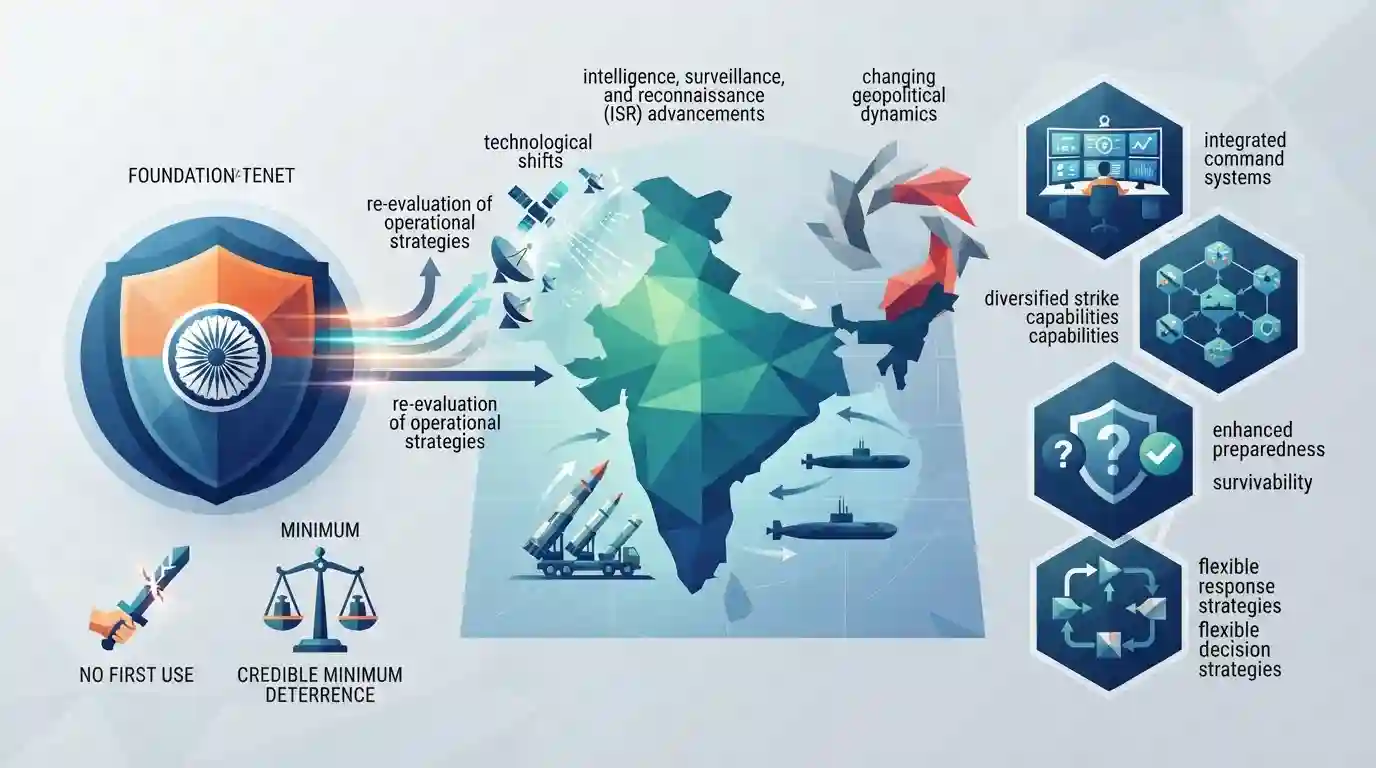
The article examines India's nuclear doctrine, discussing how changing geopolitical dynamics and technological shifts necessitate a re-evaluation of its operational strategies without formally overturning foundational tenets like No First Use (NFU) and Credible Minimum Deterrence.
Key Points
- India's nuclear doctrine, centered around 'No First Use' (NFU) and 'Credible Minimum Deterrence', remains a cornerstone of its strategic stability.
- The debate on whether India should revisit or nuance its nuclear posture arises from evolving regional threats, including China's nuclear modernization and tactical nuclear weapons development by Pakistan.
- Revisiting the doctrine without formal revision emphasizes strategic flexibility, operational readiness, and technological upgrades (such as canisterization and multiple independently targetable reentry vehicles - MIRVs) while preserving core political commitments.
- Maintains a balance between strategic credibility and international responsibility, avoiding an arms race while ensuring robust deterrence.
Important Terms
Draft Nuclear Doctrine 1999

A blueprint released by the National Security Advisory Board in 1999 outlining India's foundational nuclear posture, emphasizing credible minimum deterrence and no-first-use principles.
UPSC context
GS Paper III (Security and Defence Preparedness); tests understanding of India's strategic evolution and foundational nuclear posture.
2003 Nuclear Doctrine
The official operationalized nuclear doctrine adopted by the Indian government in 2003, formalizing the No First Use (NFU) policy and massive retaliatory capability.
UPSC context
GS Paper III (Internal Security & Strategic Policy); tests core tenets of India's national security and deterrence architecture.
Nuclear Command Authority
India's highest decision-making body for nuclear weapons, comprising a Political Council (headed by the Prime Minister) and an Executive Council, ensuring strict civilian control.
UPSC context
GS Paper III (Security and Defence Preparedness); tests structural mechanisms of India's strategic command and control systems.
Prelims Trap
India's pursuit of MIRV technology and canisterized missiles officially terminates its 'No First Use' nuclear doctrine.
Aspirants often confuse operational shifts (like MIRVs and canisterization) with a formal abandonment of India's No First Use policy. India's core political doctrine remains unchanged while operational readiness evolves.
Static Concepts Connected
What are the institutional and operational pillars of India's official nuclear doctrine?
- 2003 Doctrine: India officially adopted its nuclear doctrine through a Cabinet Committee on Security (CCS) resolution in 2003, built on foundational principles.
- No First Use (NFU): India solemnly declares that it will not be the first to use nuclear weapons against any state, restricting use to retaliation only.
- Minimum Deterrence: Deterrence is maintained at a minimum level sufficient to inflict unacceptable damage, backed by a survivable second-strike capability.
- Civilian Command: Civilian control is absolute, exercised through the Nuclear Command Authority (NCA) chaired by the Prime Minister.
Cross-Topic Patterns
Nuclear Posture & Maritime Strategic Deterrence
Shifts towards canisterization and MIRVs require a resilient nuclear triad (Arihant-class SSBNs), testing India's naval preparedness and strategic sea-lane security doctrines in the Indian Ocean.
Regional Deterrence & Two-Front Strategic Challenges
China's rapid nuclear expansion and Pakistan's tactical weapons force India to balance strategic stability with advanced conventional-nuclear deterrence frameworks in regional diplomacy.

Expect a statement-based question contrasting NFU policy mechanics with operational adaptations like MIRVs and second-strike survivability.
