India Nuclear Doctrine Operational Posture and Strategic Stability
Source:The Hindu ↗
આ શા માટે મહત્વનું છે
India's nuclear doctrine shapes its regional deterrence architecture and strategic stability vis-a-vis nuclear-armed neighbors like China and Pakistan. Understanding whether and how to adapt nuclear postures without revising core tenets is crucial for aspirants studying national security, international relations, and defense policy.
સારાંશ
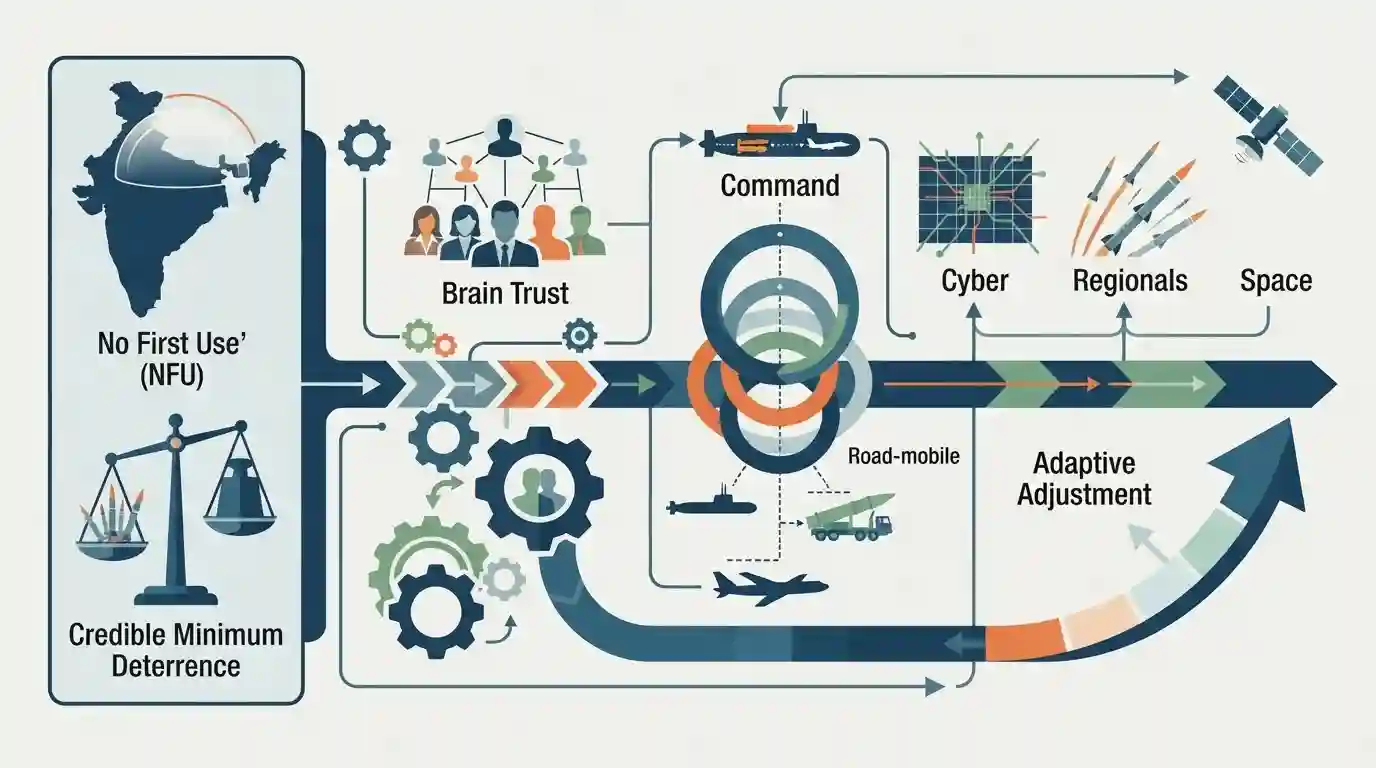
The article examines the enduring relevance and internal nuances of India's nuclear doctrine. It discusses how India can continuously review, update, and adapt its operational readiness, command structure, and deterrence posture regarding its 'No First Use' (NFU) commitment and credible minimum deterrence without officially overhauling or abandoning its core doctrine.
મુખ્ય મુદ્દા
- India's nuclear doctrine, anchored on 'No First Use' (NFU) and massive credible retaliation, remains a foundational pillar of its strategic stability.
- Emerging regional security dynamics, multi-layered deterrence requirements (China-Pakistan nexus), and technological advancements necessitate continuous internal evaluation of nuclear posture without formal structural changes.
- The debate over flexibility versus rigidity in NFU underscores the balance between assuring adversaries of non-aggression and retaining operational credibility.
- India's nuclear strategy maintains strategic autonomy while adapting command, control, and readiness postures to contemporary geopolitical shifts.
મહત્વપૂર્ણ શબ્દો
Draft Nuclear Doctrine (1999)

Released in 1999 by the National Security Advisory Board, this framework proposed core principles like No First Use, a credible minimum deterrent, and non-deployment, laying the foundation for India's official nuclear policy.
UPSC context
UPSC GS Paper III (Internal Security/Defense): Tests understanding of India's nuclear trajectory, strategic posture evolution, and core foundational security principles.
Official Nuclear Doctrine (2003)
Formally adopted in 2003, this doctrine commits India to a No First Use (NFU) policy, credible minimum deterrence, and civilian political control via the Nuclear Command Authority.
UPSC context
UPSC GS Paper II/III (International Relations/Security): Evaluates India's nuclear deterrence, regional stability, and non-proliferation stance.
National Security Council
India's apex executive agency advising the Prime Minister on political, economic, and strategic security affairs, operating via a three-tiered structure including the Strategic Policy Group and NSAB.
UPSC context
UPSC GS Paper II (Polity/Governance - Executive Bodies) and Paper III (Security Architecture): Tests knowledge of top-level defense decision-making frameworks.
સંલગ્ન સ્થિર ખ્યાલો
What are the core institutional and operational pillars of India's official nuclear doctrine adopted in 2003?
- No First Use: India pledges never to initiate a nuclear strike, reserving nuclear use strictly for retaliation against a nuclear attack on its territory or forces.
- Credible Minimum: Deterrence is maintained as a dynamic, survivable capability tailored to regional threats rather than a fixed numerical arsenal size.
- Civilian Control: Operational control is reposed in the Nuclear Command Authority, with the Prime Minister holding sole authorization for retaliatory strikes.
- WMD Caveat: Retaliation against major attacks using chemical or biological weapons is explicitly retained within the defensive posture.
આંતર-વિષય પેટર્ન
Nuclear Doctrine + Executive Governance Architecture
India's NFU policy and civilian-led Nuclear Command Authority intersect with parliamentary oversight and cabinet committee structures under GS Paper II.
Credible Minimum Deterrence + Strategic Autonomy
The shift from rigid numerical minimum deterrence to a dynamic capability mirrors strategic autonomy debates in India's non-alignment and multi-alignment posture.

NFU caveats (chemical/biological attacks) and NCA civilian control mechanics are prime candidates for a tricky GS-3 multi-statement Q.
સંલગ્ન PYQ · 1
સંલગ્ન PYQ · 1
- 2017MainsGS3
Give an account of the growth and development of nuclear science and technology in India. What is the advantage of fast breeder reactor programme in India?
