Critical Historical Evaluation of Chola Empire Legacy
Source:Indian Express ↗
Why It Matters
The Chola Empire is a cornerstone of the UPSC GS1 syllabus, specifically regarding their contributions to Dravidian architecture, bronze sculpture, and local administration. This critical perspective helps aspirants formulate balanced answers in Mains, moving beyond mere glorification to a multidimensional understanding of ancient and medieval socio-political structures.
Summary
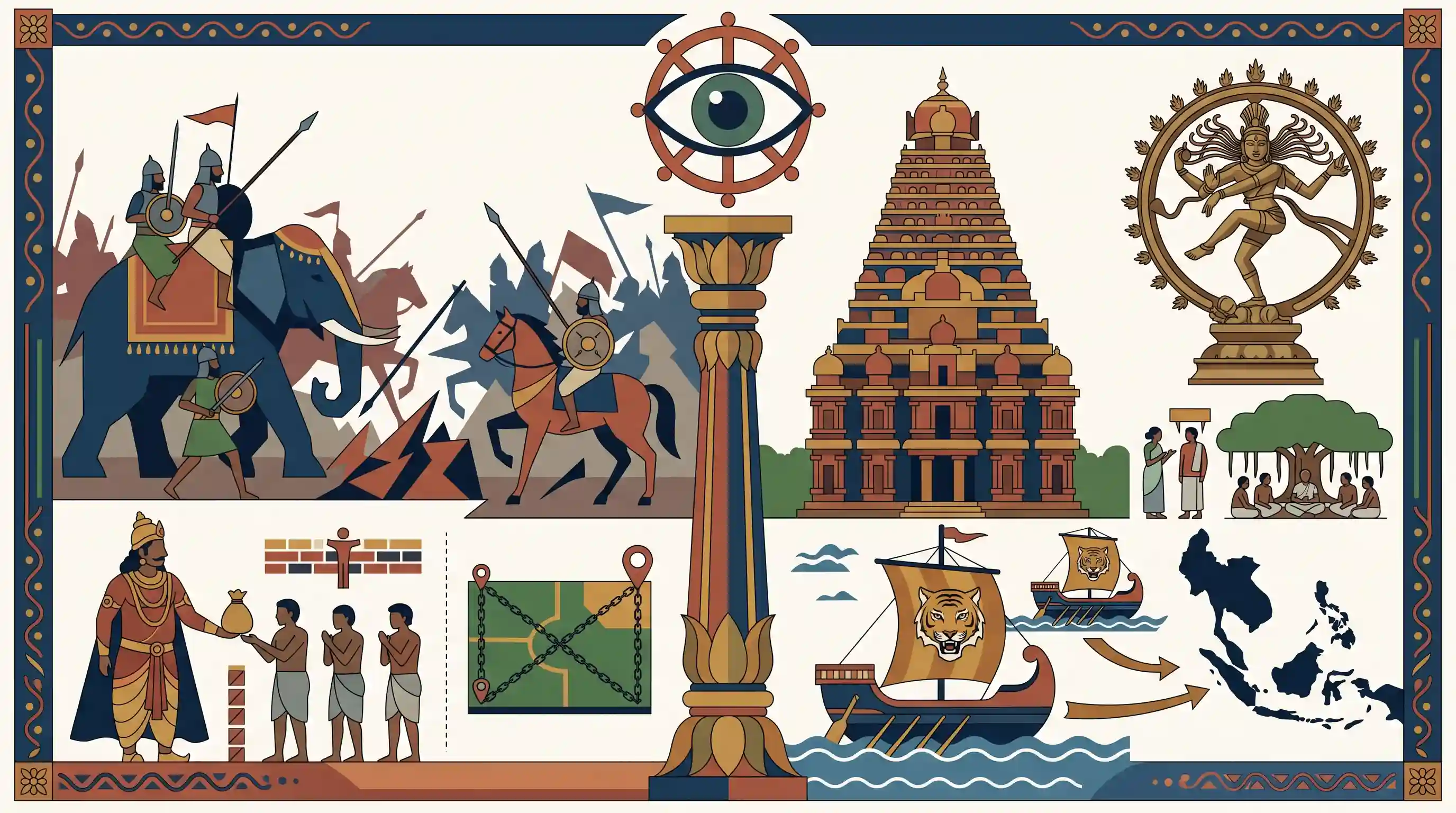
The article reflects critically on the legacy of the Chola Empire, advocating for an objective approach to its historical grandeur. While the Cholas achieved unprecedented milestones in temple architecture, bronze artistry, local self-governance, and maritime expansion into Southeast Asia, their era was also marked by medieval realities such as imperial warfare, land alienation, and strict caste hierarchies. Viewing the Chola period 'with eyes wide open' encourages a nuanced understanding of history, celebrating their monumental contributions to Indian heritage while remaining conscious of the socio-economic inequalities that characterized the time.
Key Points
- The Chola Empire (9th–13th centuries) achieved extraordinary heights in Dravidian temple architecture (e.g., Brihadeeswara Temple) and metallurgy, particularly through intricate bronze sculptures like the Nataraja.
- The Cholas were a formidable maritime power, using their navy to dominate the Indian Ocean trade routes and exerting significant cultural and political influence over Southeast Asia (e.g., the Sri Vijaya empire).
- They established an advanced administrative system, notable for highly organized local self-governance at the village level, as recorded in the Uthiramerur inscription.
- Revisiting this era 'with eyes wide open' involves avoiding pure romanticization by acknowledging the medieval realities of their rule, including aggressive imperial expansion, warfare, and a rigid caste-based social hierarchy.
Important Terms
Chola Dynasty

A powerful South Indian Tamil dynasty (9th-13th century CE) renowned for its imperial expansion, maritime dominance across Southeast Asia, and sophisticated administrative and revenue systems.
UPSC context
GS Paper I: Medieval History. Essential for understanding regional state formation, naval history, and cultural influence in Southeast Asia.
Dravidian Architecture
The South Indian temple style perfected by the Cholas, featuring massive pyramidal towers (Vimanas), elaborate entrance gateways (Gopurams), and granite-based structural engineering.
UPSC context
GS Paper I: Art and Culture. A frequent topic regarding the evolution of temple styles and UNESCO World Heritage sites.
Uthiramerur Inscription
A 10th-century epigraphic record from King Parantaka I's reign detailing the democratic functioning, eligibility criteria, and committee structures of Chola village assemblies (Sabhas).
UPSC context
GS Paper I: Medieval History/Administration. Often cited as evidence of ancient Indian local self-governance and democratic roots.
Kudavolai system
The unique Chola 'ballot-pot' election method where names of eligible candidates were written on palm leaves and drawn from a pot by a child to select committee members.
UPSC context
GS Paper I: History. Specifically tests knowledge of Chola administrative decentralization and early electoral processes.
Lost-wax bronze casting technique
A precision metal-casting method (Cire perdue) used to create iconic Chola bronzes, like the Nataraja, where a wax model is replaced by molten metal in a clay mold.
UPSC context
GS Paper I: Art and Culture. Critical for analyzing the technical sophistication and aesthetic refinement of medieval Indian sculpture.
Prelims Trap
The Uthiramerur inscription proves that universal democratic adult franchise existed in Chola village elections.
The Kudavolai system was highly restrictive, requiring property ownership, Vedic knowledge, and specific age criteria. It primarily governed Brahmin assemblies (Sabhas) in Brahmadeya villages, not universal democracy.
Static Concepts Connected
What are the key features of Dravidian temple architecture under the Cholas?
- Vimana: The main tower over the garbhagriha takes a distinct stepped pyramidal shape, unlike the curved Nagara shikhara.
- Gopuram: Massive, ornately decorated entrance gateways that became increasingly prominent in later Dravidian architecture.
- Mandapa: Pillared halls attached to the sanctum for public rituals, dances, and gatherings.
- Temple tank (Kalyani): The presence of a prominent water reservoir within the temple premises for ritualistic use.
How was local rural administration structured under the Chola Empire?
- Ur: The 'Ur' was the general assembly of a standard village, open to all tax-paying residents.
- Sabha or Mahasabha: The assembly specifically for Brahmin-dominated villages (Brahmadeyas), managing extensive land grants and local affairs.
- Kudavolai System: A lottery-based system used by the Sabha to elect members to executive committees (Variyams) using palm leaves drawn from a pot.
- Nadu: A grouping of villages forming a larger district, overseen by an assembly called the Nattar.
Cross-Topic Patterns
Chola maritime power + Modern Act East
Rajendra I's naval expedition to Srivijaya highlights India's historical maritime influence in the Indo-Pacific, offering a cultural and strategic precedent for India's current SAGAR and Act East policies.
Socio-cultural impact of Land Grants
Brahmadeya and Devadana land grants drove agrarian expansion and temple building but deepened rigid caste hierarchies—a recurring socio-economic theme across the Gupta, Pallava, and Chola eras.

Expect a multi-statement question contrasting Chola local governance (Uthiramerur) with modern decentralization or Gupta administration.
Linked PYQs · 3
Linked PYQs · 3
- 2013MainsGS1
Chola architecture represents a high watermark in the evolution of temple architecture. Discuss.
- 2022MainsGS1
Discuss the main contributions of Gupta period and Chola period to Indian heritage and culture.
- 2020PrelimsGS1
Consider the following events in the history of India: 1. Rise of Pratiharas under King Bhoja 2. Establishment of Pallava power under Mahendravarman - I 3. Establishment of Chola power by Parantaka - I 4. Pala dynasty founded by Gopala What is the correct chronological order of the above events, starting from the earliest time?
