ECI Electoral Roll Revision Ahead of Bihar Elections
Source:Indian Express ↗
Why It Matters
The preparation and revision of electoral rolls are foundational to the democratic process. Understanding the role of the ECI and the provisions of the Representation of the People Act is critical for UPSC aspirants studying polity, governance, and electoral reforms.
Summary
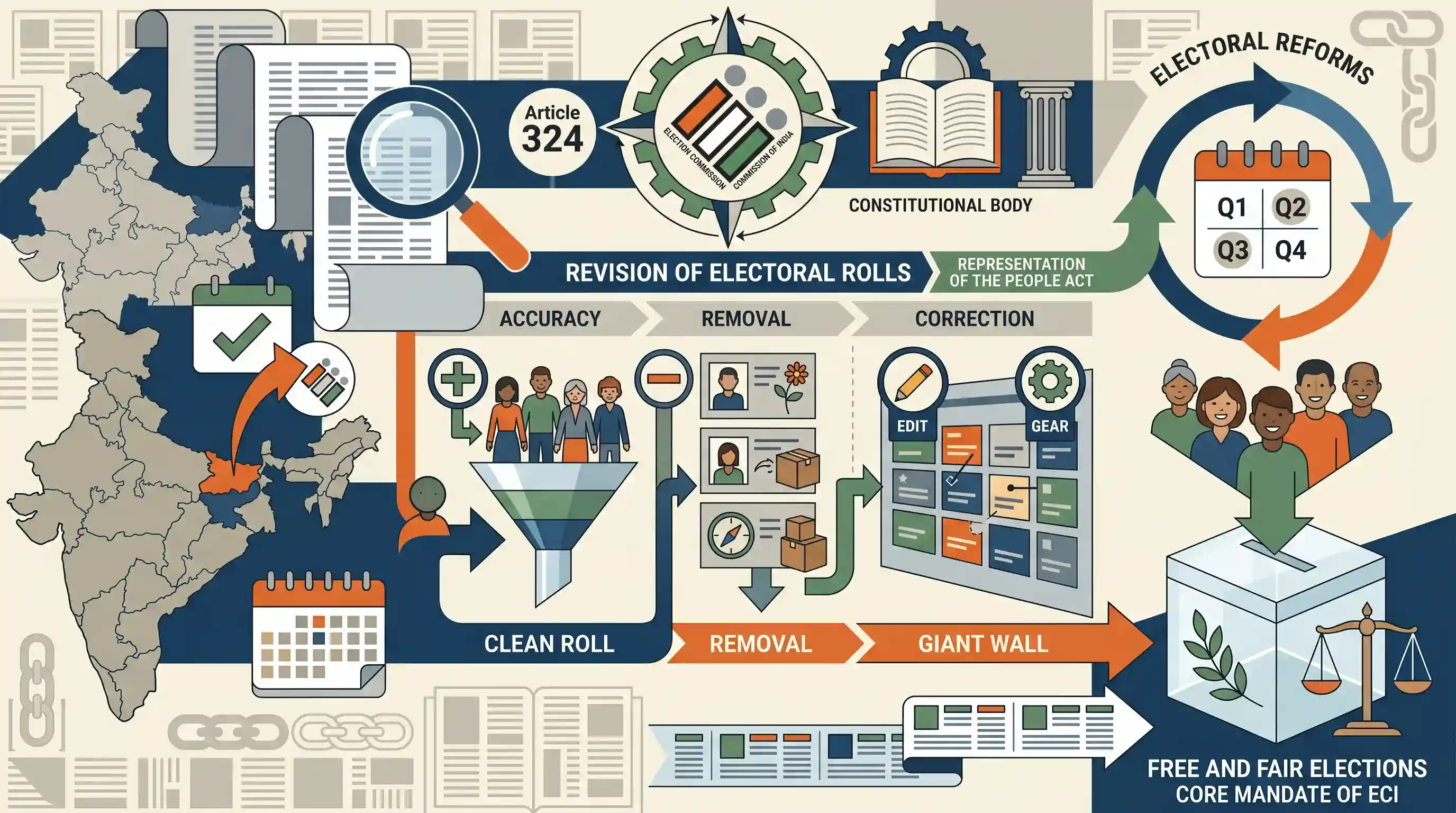
With the Bihar Assembly elections approaching, the Election Commission of India has initiated a revision of the state's electoral rolls. This standard procedural exercise ensures the accuracy of the voter list by adding newly eligible citizens, removing deceased or relocated voters, and correcting errors. The recent introduction of four annual qualifying dates under the Representation of the People Act makes voter registration a more continuous and inclusive process. Maintaining a clean electoral roll is a fundamental prerequisite for conducting free and fair elections, reflecting the core mandate of the ECI under Article 324 of the Constitution.
Key Points
- The Election Commission of India (ECI) has ordered a revision of electoral rolls in Bihar ahead of the upcoming state assembly elections to ensure an accurate and updated voter list.
- Electoral roll revision is a statutory requirement to register newly eligible voters, remove deceased or relocated individuals, and eliminate duplicate entries.
- Following recent electoral reforms and amendments to the Representation of the People Act, 1950, there are now four qualifying dates annually (January 1, April 1, July 1, and October 1) for youth to register as voters, increasing inclusivity.
- The revision process involves Booth Level Officers (BLOs) conducting field verifications and allows citizens to file claims and objections to maintain the integrity of the democratic process.
Important Terms
Election Commission of India (ECI)

An autonomous constitutional body established under Article 324 to oversee the "superintendence, direction, and control" of elections to Parliament, State Legislatures, and the offices of President and Vice-President.
UPSC context
GS Paper II: Constitutional Bodies. Vital for questions on electoral integrity and institutional autonomy.
Article 324
The foundational constitutional provision that vests plenary powers in the ECI to conduct free and fair elections, serving as a "reservoir of power" when specific laws are silent.
UPSC context
GS Paper II: Basic Structure/Polity. Tests knowledge of the ECI's source of authority.
Representation of the People Act, 1950
An act providing the legal framework for the allocation of seats, delimitation of constituencies, and the preparation of electoral rolls (voter lists) before actual polling.
UPSC context
GS Paper II: Salient features of RPA. Essential for understanding pre-election administrative procedures.
Representation of the People Act, 1951
An act governing the actual conduct of elections, including candidate qualifications/disqualifications, registration of political parties, corrupt practices, and resolution of electoral disputes.
UPSC context
GS Paper II: RPA. Frequently tested regarding candidate disqualification (Section 8) and electoral reforms.
Special Intensive Revision (SIR)
A comprehensive, time-bound house-to-house verification drive by Booth Level Officers to update voter lists by removing deceased/relocated entries and adding newly eligible citizens.
UPSC context
GS Paper II: Electoral Reforms. Contextualizes procedural accuracy and inclusion in democracy.
Qualifying Dates
Specific dates (January 1, April 1, July 1, and October 1) on which an individual must be 18 to register, modernized from a single annual date to improve inclusivity.
UPSC context
GS Paper II: Electoral Reforms. Tests knowledge of recent legislative amendments to the RPA.
Prelims Trap
"Preparation and revision of electoral rolls is governed by the Representation of the People Act, 1951."
RPA 1951 regulates the conduct of elections and corrupt practices. Preparation of electoral rolls, delimitation, and voter qualifications fall strictly under RPA 1950.
Static Concepts Connected
What is the primary difference between RPA 1950 and RPA 1951?
- RPA 1950: Governs the allocation of seats, delimitation of constituencies, qualifications of voters, and the preparation/revision of electoral rolls.
- RPA 1951: Regulates the actual conduct of elections, qualifications/disqualifications of candidates, resolution of election disputes, and corrupt practices.
How did the Election Laws (Amendment) Act 2021 change voter registration?
- Four Qualifying Dates: Replaced the single January 1 cut-off with four annual dates (Jan 1, Apr 1, Jul 1, Oct 1) to prevent youth from waiting a full year.
- Aadhaar Linkage: Permitted electoral registration officers to seek Aadhaar numbers to establish the identity of individuals and remove duplicate entries on a voluntary basis.
Cross-Topic Patterns
Electoral Rolls & Aadhaar Linkage
The 2021 amendment altering voter qualifying dates also introduced provisions to link Aadhaar with electoral rolls to curb duplicate entries, sparking debates on privacy and data protection.
Article 326 & Constitutional Rights
Voter registration links directly to the 'Right to Vote', which the Supreme Court has clarified is a constitutional and statutory right stemming from Article 326, not a Fundamental Right.

Expect a 2026 prelims question mixing the specific domains of RPA 1950 (electoral rolls, 4 qualifying dates) and RPA 1951 (conduct).
Linked PYQs · 5
Linked PYQs · 5
- 2017PrelimsGS1
For election to the Lok Sabha, a nomination paper can be filed by
- 2017PrelimsGS1
Right to vote and to be elected in India is a
- 2017MainsGS2
To enhance the quality of democracy in India the Election Commission of India has proposed electoral reforms in 2016. What are the suggested reforms and how far are they significant to make democracy successful?
- 2022MainsGS2
Discuss the role of the Election Commission of India in the light of the evolution of the Model Code of Conduct.
- 2024MainsGS2
Examine the need for electoral reforms as suggested by various committees with particular reference to "one nation one election" principle.
