Indus Waters Treaty Revision and India Riparian Rights Assertion
Source:The Hindu ↗
આ શા માટે મહત્વનું છે
The Indus Waters Treaty is historically celebrated as one of the world's most successful water-sharing pacts, having survived multiple India-Pakistan wars. India's recent push to renegotiate the treaty marks a watershed moment in bilateral relations, signaling a more assertive stance on its riparian rights and the weaponization of water diplomacy in response to ongoing security and diplomatic friction.
સારાંશ
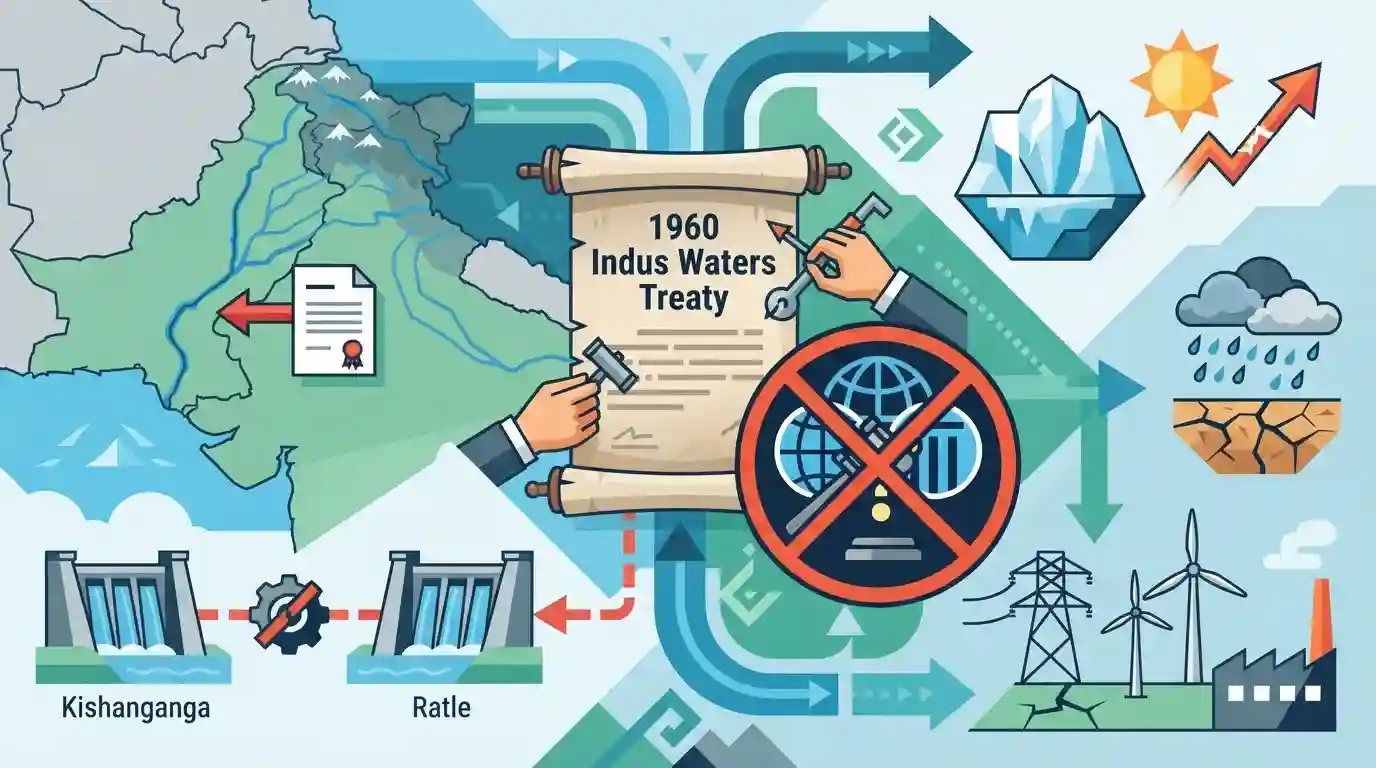
The article analyzes India's strategic decision to formally notify Pakistan of its intent to modify the 1960 Indus Waters Treaty (IWT). Triggered by chronic deadlocks over run-of-the-river hydroelectric projects such as Kishanganga and Ratle, India's move reflects deep frustration with Pakistan's alleged misuse of the World Bank’s dispute resolution framework. India contends that the IWT, drafted over six decades ago, is outdated and inadequate to address modern challenges, including climate change, shifting hydrological realities, and India's growing energy requirements. This potential revision signals a major shift in India's hydraulic diplomacy and carries profound legal, geopolitical, and environmental implications for transboundary water management in South Asia.
મુખ્ય મુદ્દા
- India has issued a formal notice to Pakistan seeking a review and modification of the 1960 Indus Waters Treaty (IWT), citing fundamental changes in circumstances.
- The core dispute revolves around India's construction of run-of-the-river hydroelectric projects on the western rivers, specifically the Kishanganga (Jhelum basin) and Ratle (Chenab basin) projects.
- India is frustrated with Pakistan's persistent objections and its simultaneous invocation of two parallel dispute resolution mechanisms at the World Bank (a Neutral Expert and a Court of Arbitration), leading to procedural gridlock.
- India argues that the 64-year-old treaty does not account for contemporary challenges such as climate change, environmental degradation, and the region's evolving energy and agricultural demands.
- Under the IWT, the Eastern Rivers (Ravi, Beas, Sutlej) were allocated for India's unrestricted use, while the Western Rivers (Indus, Jhelum, Chenab) were allocated largely to Pakistan, with India permitted limited non-consumptive uses like run-of-the-river hydropower.
મહત્વપૂર્ણ શબ્દો
Indus Waters Treaty (1960)

A bilateral water-sharing agreement between India and Pakistan, brokered by the World Bank, allocating the Eastern Rivers (Ravi, Beas, Sutlej) to India and the Western Rivers (Indus, Jhelum, Chenab) to Pakistan.
UPSC context
GS Paper II (Bilateral Relations/Agreements) and GS Paper III (Water Resources); tests transboundary water diplomacy and security.
Vienna Convention on the Law of Treaties
An international agreement of 1969 codifying customary international law on how treaties between sovereign states are drafted, interpreted, amended, suspended, or terminated.
UPSC context
GS Paper II (International Law/Relations); tests rules of treaty compliance, modification, and unilateral termination in transboundary disputes.
World Bank
A global financial institution that mediated the Indus Waters Treaty negotiations, acts as a signatory, and facilitates procedural appointments for the treaty’s dispute resolution mechanisms.
UPSC context
GS Paper II (International Institutions); tests the role of multilateral bodies in mediating and facilitating transboundary resource disputes.
Permanent Indus Commission
A bilateral body of Indian and Pakistani commissioners established under the IWT to exchange hydrological data, inspect river works, and resolve initial treaty-related differences.
UPSC context
GS Paper II (India-Pakistan relations/Dispute Redressal); tests institutional frameworks for bilateral resource management and conflict prevention.
Court of Arbitration
An ad hoc seven-member tribunal established under Annexure G of the IWT to resolve formal legal disputes regarding treaty interpretation or application.
UPSC context
GS Paper II (Dispute Redressal Mechanisms); tests international legal recourse, jurisdiction, and resolution of bilateral resource conflicts.
પ્રિલિમ્સ ટ્રેપ
"India has no rights over the Western Rivers and is strictly prohibited from building hydroelectric projects on them."
India does not have absolute restriction on the Western Rivers. It is explicitly permitted non-consumptive uses, including agriculture, domestic use, and "run-of-the-river" hydropower generation.
સંલગ્ન સ્થિર ખ્યાલો
What is the allocation and dispute mechanism under the Indus Waters Treaty (1960)?
- River Allocation: India gets unrestricted use of Eastern Rivers (Ravi, Beas, Sutlej). Pakistan primarily gets Western Rivers (Indus, Jhelum, Chenab).
- Indian Rights: India is allowed limited, non-consumptive usage like run-of-the-river hydropower, agriculture, and domestic use on the Western rivers.
- Dispute Resolution Tiers: Three tiers: Permanent Indus Commission (for 'questions'), a Neutral Expert (for technical 'differences'), and a Court of Arbitration (for legal 'disputes').
What defines a Run-of-the-River (RoR) hydroelectric project?
- Flow Dependency: Generates power using natural river flows with little to no water storage (pondage), lacking a large reservoir.
- Ecological Impact: Usually has a lower environmental footprint compared to conventional dams, avoiding massive land submergence and displacement.
- IWT Validity: Permitted for India on Western Rivers under the IWT precisely because it avoids consumptive storage of water.
આંતર-વિષય પેટર્ન
IWT modification & Climate Hydrology
Melting Himalayan glaciers alter river flow baselines, making static treaties like the 1960 IWT vulnerable. This highlights how climate change forces the renegotiation of legacy transboundary agreements.
Lawfare and Transboundary Waters
Pakistan’s simultaneous use of a Neutral Expert and Court of Arbitration is a classic "lawfare" tactic, exposing procedural loopholes in the World Bank’s dispute resolution framework.

Look for a multi-statement question pairing exact tributaries (Kishanganga/Jhelum, Ratle/Chenab) with the 3-tiered IWT dispute mechanism.
સંલગ્ન PYQ · 4
સંલગ્ન PYQ · 4
- 2012MainsGS2
The situation today is far different to that prevalent fifty years back when the Indus Water Treaty was signed." Highlight the complexity of the current challenges on both sides of the border in this regard. Do you think that a review of the Treaty is in India's best interests?
- 2021PrelimsGS1
With reference to the Indus river system, of the following four rivers, three of them pour into one of them which joins the Indus direct. Among the following, which one is such river that joins the Indus direct?
- 2009PrelimsGS1
The Dul Hasti Power Station is based on which one of the following rivers?
- 2013MainsGS3
What do you understand by Run-of-river hydroelectricity project ? How is it different from any other hydroelectricity project?
