Indus Water Treaty Modification Notice Shifts Bilateral Geopolitics
Source:The Hindu ↗
આ શા માટે મહત્વનું છે
The Indus Water Treaty is widely cited as one of the most resilient transboundary water agreements globally. India's unprecedented notice for its modification signals a major shift in India-Pakistan geopolitics, impacting regional stability, riparian rights, and the future of international water-sharing treaties.
સારાંશ
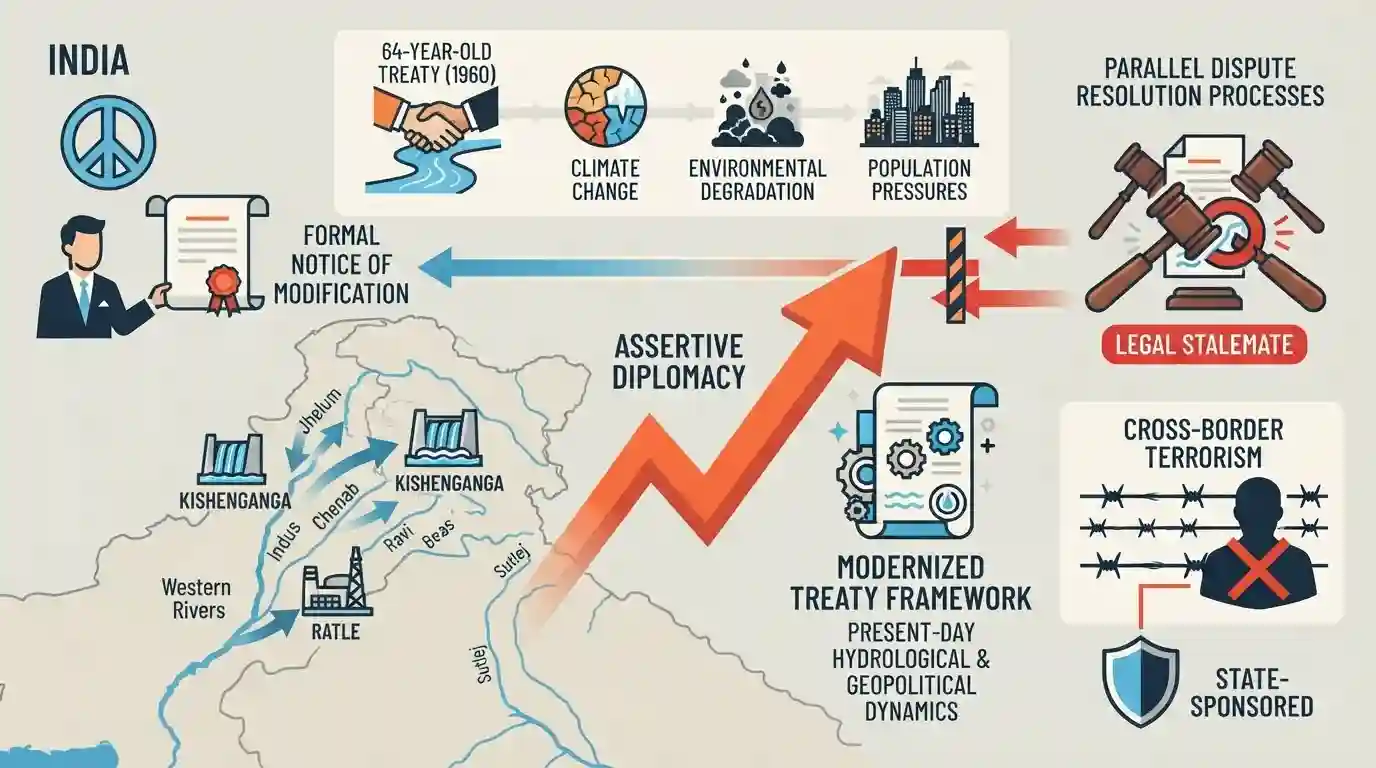
The article analyzes India's formal notice to Pakistan demanding a modification of the 64-year-old Indus Water Treaty (IWT). Although the World Bank-brokered treaty has survived multiple conflicts, it faces acute strain due to Pakistan's "intransigence" and persistent objections to India's run-of-the-river hydroelectric projects, such as Kishenganga and Ratle, on the Western Rivers. Pakistan's pursuit of parallel dispute resolution processes has forced a legal stalemate. India argues that changing contemporary realities—including climate change, environmental degradation, population pressures, and persistent state-sponsored cross-border terrorism—necessitate an update to the 1960 framework. The notice marks an assertive shift in India's regional diplomacy, demonstrating a firm stance that bilateral water cooperation and cross-border terrorism cannot co-exist, and pushing for a modernized treaty that reflects present-day hydrological and geopolitical dynamics.
મુખ્ય મુદ્દા
- India has issued a formal notice to Pakistan seeking the modification of the 1960 Indus Water Treaty under Article XII(3) of the pact.
- The IWT allocates the unrestricted use of the Eastern Rivers (Ravi, Beas, Sutlej) to India, and the Western Rivers (Indus, Jhelum, Chenab) to Pakistan, while permitting India limited non-consumptive usage like run-of-the-river hydroelectric projects.
- India's decision stems from Pakistan's repeated objections to Indian hydroelectric projects (like Kishenganga and Ratle) and its insistence on concurrent dispute resolution mechanisms (Neutral Expert and Court of Arbitration) against the treaty's graded mechanism.
- The demand for revision is also motivated by contemporary challenges that were not factored in 1960, including climate change, shifting hydrology, demographic growth, agricultural demands, and the continuous threat of cross-border terrorism.
- The move signifies a strategic pivot in India's water diplomacy, signaling that mutual cooperation on water sharing cannot proceed normally while Pakistan sponsors terrorism against India.
મહત્વપૂર્ણ શબ્દો
Indus Water Treaty (IWT) 1960

A landmark water-distribution agreement between India and Pakistan, brokered by the World Bank. It grants India unrestricted use of three Eastern rivers (Ravi, Beas, Sutlej) while allocating three Western rivers (Indus, Jhelum, Chenab) to Pakistan with limited Indian use.
UPSC context
GS Paper II (International Relations). Tests bilateral agreements, India-Pakistan dynamics, and cross-border resource management.
World Bank
An international financial institution that facilitated and brokered the 1960 Indus Water Treaty. Under the IWT, it performs procedural roles in dispute resolution, such as appointing a Neutral Expert or a Court of Arbitration chairman when conflicts arise.
UPSC context
GS Paper II (Important International Institutions). Tests the role of global bodies in mediating regional treaties and disputes.
Permanent Indus Commission
A bilateral commission of officials from India and Pakistan established under the IWT to manage water-sharing goals and serve as the first step for conflict resolution. It is mandated to meet at least once annually.
UPSC context
GS Paper II (India & its Neighborhood). Tests institutional mechanisms for bilateral dispute resolution and water diplomacy.
Neutral Expert
A technical expert appointed by the World Bank under the IWT's dispute resolution mechanism to adjudicate differences between India and Pakistan over water projects, typically when technical complexity dictates expert rather than legal intervention.
UPSC context
GS Paper II (International Relations). Tests knowledge of graded dispute resolution frameworks in transboundary agreements.
Court of Arbitration
The highest tier in the IWT's dispute resolution process, typically invoked for legal interpretations of the treaty. Pakistan favored this route for objecting to India's Kishenganga and Ratle projects, resulting in a stalemate over parallel proceedings.
UPSC context
GS Paper II (International Relations). Analyzes legal avenues in transboundary water disputes and India's stance against parallel proceedings.
Run-of-the-River Hydroelectric Projects
Hydropower facilities that generate electricity using the natural flow of a river without creating large reservoirs. The IWT allows India to build such projects on Western Rivers, though Pakistan frequently contests their designs.
UPSC context
GS Paper III (Energy) & GS II (IR). Tests understanding of permitted infrastructure under transboundary water treaties.
પ્રિલિમ્સ ટ્રેપ
Any modification under Article XII(3) requires the tripartite consent and signature of the World Bank alongside India and Pakistan.
Article XII(3) permits modifications solely through a treaty concluded between 'the two Governments'. The World Bank, though a facilitator in 1960, is not a party to bilateral modifications.
સંલગ્ન સ્થિર ખ્યાલો
What is the three-tier dispute resolution mechanism under the Indus Water Treaty?
- Permanent Indus Commission: Deals with daily technical issues and 'questions'. It is a bilateral body meeting at least once a year to exchange data and resolve basic operational concerns.
- Neutral Expert: Invoked when 'questions' elevate to 'differences' of a technical nature, such as dam design parameters (e.g., Kishenganga and Ratle). Appointed by the World Bank.
- Court of Arbitration: Invoked for 'disputes' involving legal interpretations of the treaty itself. Comprises a seven-member panel to deliver binding legal arbitrations.
How are river waters partitioned between India and Pakistan under the 1960 treaty?
- Eastern Rivers: Ravi, Beas, and Sutlej are allocated to India for exclusive and unrestricted use.
- Western Rivers: Indus, Jhelum, and Chenab are allocated to Pakistan. India is prohibited from building storage on them, except for specified non-consumptive and agricultural uses.
- Run-of-the-River Rights: India can build run-of-the-river hydroelectric plants on Western Rivers, meaning power generation without altering the volume or timing of the river flow downstream.
આંતર-વિષય પેટર્ન
Transboundary waters and Climate Change
Explores how mid-20th-century water treaties globally fail to account for climate-induced glacier melt, shifting monsoons, and environmental flows, making static volumetric allocations ecologically unsustainable.
Upper-riparian leverage and national security
Illustrates India's strategic shift toward utilizing its upper-riparian position on the Indus as leverage, linking water sharing to progress on cross-border terrorism.

Multi-statement Prelims question likely to target the exact distinction between 'Neutral Expert' and 'Court of Arbitration' jurisdictions.
સંલગ્ન PYQ · 4
સંલગ્ન PYQ · 4
- 2012MainsGS2
The situation today is far different to that prevalent fifty years back when the Indus Water Treaty was signed." Highlight the complexity of the current challenges on both sides of the border in this regard. Do you think that a review of the Treaty is in India's best interests?
- 2021PrelimsGS1
With reference to the Indus river system, of the following four rivers, three of them pour into one of them which joins the Indus direct. Among the following, which one is such river that joins the Indus direct?
- 2026PrelimsGS1
Identify the river of the Indian sub-continent on the basis of the following information : 1. It has an antecedent drainage system. 2. It flows through three countries. 3. It originates in the Tibetan Plateau and is an important river for irrigation. 4. It does not form distributaries. Select the answer from the following :
- 2026PrelimsGS1
Which of the following pairs of ancient and modern names of rivers is/are correctly matched ? 1. Vitasta : Chenab 2. Asikni : Jhelum 3. Parushni : Ravi 4. Yavyavati : Beas Select the answer using the code given below :
