Revised SOP for Defence Industry Access to Test Facilities
Source:The Hindu ↗
Why It Matters
Testing and validation are major bottlenecks for private defence manufacturers in India. The revised SOP directly addresses critical structural barriers to indigenization and public-private cooperation in the defence ecosystem.
Summary
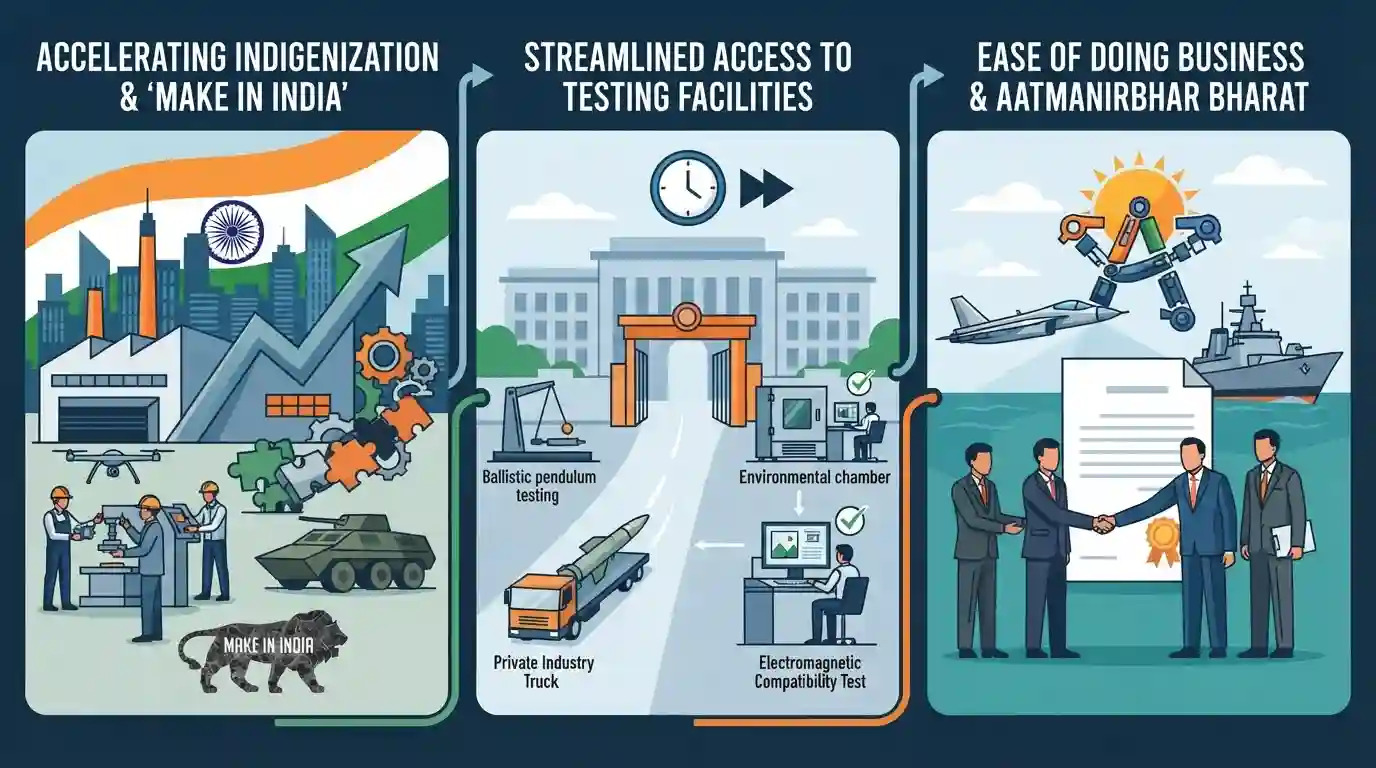
The Ministry of Defence has introduced a revised Standard Operating Procedure (SOP) to facilitate easier and faster access for the domestic defence industry, particularly private players, to government-owned proof ranges and test facilities. This policy aims to overcome hurdles in testing and certification, thereby accelerating indigenous defence production, promoting the 'Aatmanirbhar Bharat' initiative, and enhancing ease of doing business in the critical defence manufacturing sector.
Key Points
- The Ministry of Defence has released a revised Standard Operating Procedure (SOP) to simplify and ease defence industry access to government-owned proof ranges and test facilities.
- The move aims to boost domestic defence manufacturing, promote self-reliance (Aatmanirbhar Bharat), and encourage private sector participation by cutting bureaucratic delays in testing and certification.
- It addresses long-standing industry demands for streamlined infrastructure sharing, enabling private players to validate ammunition, weapons, and equipment locally.
Important Terms
Revised Standard Operating Procedure (SOP) for Defence Industry Access

A streamlined administrative framework introduced by the Ministry of Defence to simplify, standardize, and expedite the domestic defence industry's access to government-owned proof ranges, field firing ranges, and laboratory test facilities.
UPSC context
UPSC GS Paper III (Security): Important for questions on indigenous defence manufacturing, public-private partnerships, and ease of doing business in defence.
Directorate General of Quality Assurance (DGQA)
An inter-service organization under the Department of Defence Production, Ministry of Defence, responsible for quality assurance of military stores, equipment, and indigenous technologies for the armed forces.
UPSC context
UPSC GS Paper III (Security): Tests knowledge of defence institutional architecture, quality control, and indigenous procurement processes.
Prelims Trap
waives proof and testing charges for all commercial and private defence manufacturing projects without exception
The revised SOP waives testing fees specifically for government-backed developmental projects (iDEX, TDF, Make categories), not for all commercial production runs by private entities indiscriminately.
Static Concepts Connected
What are the key institutional bodies governing defence quality assurance and production in India?
- DGQA Role:: Functions under the Ministry of Defence to ensure quality assurance of military stores and equipment produced by ordnance factories and public/private sectors.
- DRDO Mandate:: Apex R&D organization under MoD tasked with designing and developing advanced weapon systems, sensors, and platforms for the armed forces.
- iDEX & TDF:: Initiative launched by MoD to foster innovation and technology development in defence by engaging start-ups and MSMEs.
Cross-Topic Patterns
Defence Indigenization + Public-Private Partnerships
Private sector entry into heavy defence manufacturing intersects with the Fiscal Responsibility and Budget Management (FRBM) Act and capital outlay allocations for domestic procurement.
R&D Commercialization + Defence Technology Ecosystem
Easing testing protocols for iDEX and TDF projects bridges the gap between basic research and commercial military hardware under science and technology policies.

Expect an MCQ combining iDEX waivers, DRDO facility access, and private sector parity in defence testing protocols.
