Brain Drain Reversal Policies and R&D Ecosystem Challenges in India
Source:Indian Express ↗
Why It Matters
Brain drain and the mobilization of the Indian diaspora are recurring themes in UPSC. Understanding the limitations of government schemes aimed at reversing brain drain helps aspirants critically analyze human capital management, policy effectiveness, and the structural reforms needed in India's R&D sector.
Summary
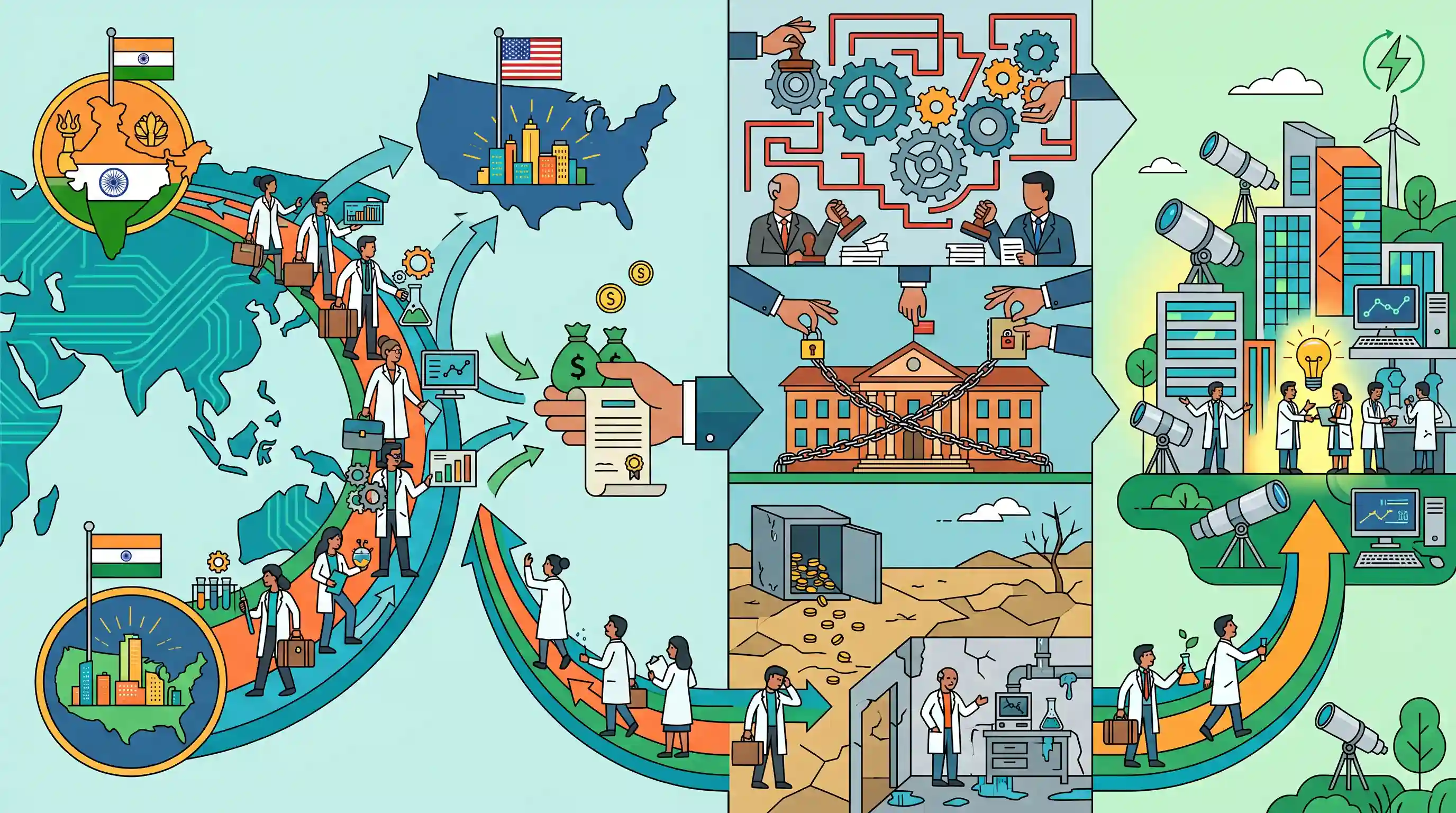
The article evaluates the efficacy of Indian government initiatives aimed at reversing the 'brain drain' of scientific and technological talent to the United States. While acknowledging the value of re-entry schemes and fellowships that offer financial incentives to the Indian diaspora, the author contends that these measures are insufficient on their own. The core challenges lie in India's broader academic and research ecosystem, which suffers from bureaucratic bottlenecks, lack of institutional autonomy, sub-optimal funding, and inadequate infrastructure. A true 'brain gain' requires going beyond monetary incentives to implement systemic reforms that create a more conducive, globally competitive environment for cutting-edge research and innovation in Indian universities and laboratories.
Key Points
- The ongoing migration of highly skilled Indian professionals, particularly scientists and engineers, to the United States constitutes a significant 'brain drain'.
- The Indian government has launched various schemes (e.g., VAIBHAV, VAJRA, Ramanujan Fellowship) providing financial incentives and research opportunities to attract this diaspora back.
- However, these schemes alone are insufficient, as returning scientists often face systemic barriers such as bureaucratic delays, lack of administrative autonomy, and inadequate research infrastructure.
- To effectively achieve 'brain gain', India must undertake deeper structural reforms in its higher education and R&D ecosystem, including increased funding and stronger industry-academia linkages.
Important Terms
VAIBHAV Fellowship

A 2023 scheme (Vaishvik Bharatiya Vaigyanik) connecting the Indian STEMM diaspora with domestic institutions for collaborative research and knowledge sharing through short-term residencies.
UPSC context
GS-II (Diaspora) & GS-III (S&T); tests knowledge of "reverse brain drain" and global scientific integration.
Anusandhan National Research Foundation (ANRF)
An apex statutory body established in 2023 to provide high-level strategic direction, streamline R&D funding, and foster industry-academia-government collaboration in India.
UPSC context
GS-III (S&T/Governance); central to National Education Policy 2020 and modernizing India's research ecosystem.
VAJRA Faculty Scheme
Short for Visiting Advanced Joint Research, this scheme enables overseas scientists (including NRIs/OCIs) to serve as visiting faculty in public-funded Indian academic and research institutions.
UPSC context
GS-III (S&T); focuses on international academic exchange and building institutional research capacity.
Ramanujan Fellowship
A selective fellowship for outstanding Indian or Indian-origin scientists working abroad to return and take up research positions in any scientific field in India.
UPSC context
GS-III (S&T); key program for repatriating top-tier intellectual capital to Indian scientific institutions.
Ramalingaswami Re-entry Fellowship
A Department of Biotechnology (DBT) initiative aimed at attracting life sciences and biotechnology researchers from overseas to return and establish independent research careers in India.
UPSC context
GS-III (Biotechnology/S&T); critical for talent retention in high-impact medical and agricultural research.
Department of Science and Technology (DST)
The nodal Indian government department responsible for formulating science policy, promoting R&D infrastructure, and overseeing national fellowship programs and innovation initiatives.
UPSC context
GS-III (S&T/Governance); core administrative agency for India's scientific and technological development.
Prelims Trap
"The VAIBHAV Fellowship mandates NRI scientists to permanently relocate and take up full-time employment in India."
VAIBHAV is a collaborative 'brain circulation' scheme where diaspora scientists work in India for up to 2 months a year; it does not mandate permanent relocation.
Static Concepts Connected
What is the mandate of the Anusandhan National Research Foundation (ANRF)?
- Statutory Body: Established under the ANRF Act 2023, subsuming the Science and Engineering Research Board (SERB), to seed and promote high-level R&D across academic institutions.
- Private Sector Funding: Aims to inject ₹50,000 crore into research over 5 years, with ~70% of the corpus expected to come from private sector and industry contributions.
- Broadening R&D Base: Shifts focus toward state universities and colleges, which historically received minimal R&D funding compared to premier institutes like IITs and IISc.
How do the major diaspora re-entry fellowships differ?
- Ramanujan Fellowship: Administered by the Department of Science and Technology (DST), it targets highly skilled Indian researchers abroad from any scientific discipline to return to India.
- Ramalingaswami Fellowship: Run by the Department of Biotechnology (DBT), this fellowship specifically targets returning diaspora researchers in life sciences, agriculture, and biotechnology.
- VAJRA Scheme: A visiting faculty scheme led by SERB allowing overseas scientists to work at public-funded Indian institutions for 1-3 months a year.
Cross-Topic Patterns
US Immigration limits & India's Brain Gain
Restrictive US visa regimes (like H-1B caps and green card backlogs) act as push factors, synergizing with India's pull factors (VAIBHAV) to create 'brain circulation' rather than absolute brain drain.
R&D infrastructure + Higher Education Autonomy
Re-entry schemes fail without institutional autonomy. This links directly to the NEP 2020 goal of phasing out affiliation systems and granting graded administrative and financial autonomy to universities.

Expect a GS3 Mains question evaluating whether 'brain circulation' schemes (VAIBHAV) can succeed without ANRF-led structural R&D reforms.
Linked PYQs · 3
Linked PYQs · 3
- 2023MainsGS2
Indian diaspora has scaled new heights in the West. Describe its economic and political benefits for India.
- 2020MainsGS2
Indian diaspora has a decisive role to play in the politics and economy of America and European Countries'. Comment with examples.
- 2014MainsGS3
Scientific rescarch in Indian universities is declining, because a career in science is not as attractive as are business professions, engineering or administration, and the universities are becoming consumer-oriented. Critically comment.
