Revamp of Model Bilateral Investment Treaty and Dispute Settlement
Source:The Hindu ↗
ఇది ఎందుకు ముఖ్యం
The review of India's Model BIT is crucial for UPSC aspirants as it directly impacts India's economic diplomacy, Free Trade Agreement (FTA) negotiations, and its ability to attract critical foreign capital while simultaneously protecting Indian businesses expanding globally.
సారాంశం
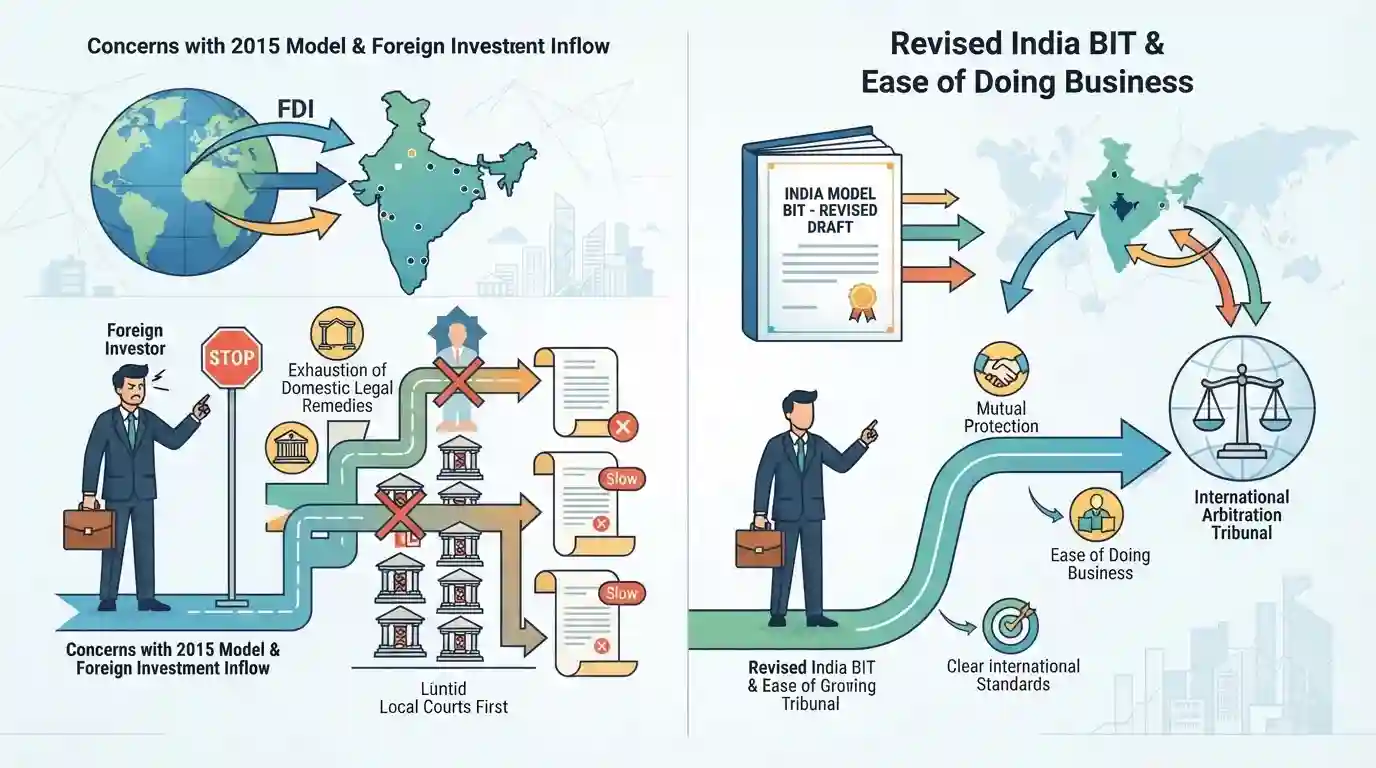
India is finalizing a revamp of its 2015 Model Bilateral Investment Treaty (BIT) to address concerns from developed nations regarding its dispute settlement mechanisms and to ensure mutual protection for both incoming Foreign Direct Investment (FDI) and India's growing Outward Direct Investment (ODI). The 2015 model has faced pushback, notably during negotiations with countries like the UK, primarily due to clauses requiring the exhaustion of domestic legal remedies before foreign investors can pursue international arbitration. The revised draft, focused on enhancing the ease of doing business, will soon be presented to the Cabinet.
ముఖ్య అంశాలు
- The Government of India is overhauling its 2015 Model Bilateral Investment Treaty (BIT) to establish an investor-friendly framework and ease of doing business.
- The revamp is driven not only by the need to attract Foreign Direct Investment (FDI) but also to safeguard India's rising Outward Direct Investment (ODI), which currently averages over $2 billion monthly.
- Developed nations have shown reservations regarding the 2015 Model BIT's dispute resolution mechanism, which mandates the exhaustion of domestic local remedies before seeking international arbitration.
- Unlike trade agreements which utilize state-to-state dispute settlements, investment treaties feature Investor-State Dispute Settlements (ISDS) that allow private entities to take sovereign governments to international arbitration.
ముఖ్యమైన పదాలు
Model Bilateral Investment Treaty (BIT) 2015

India's standardized framework for negotiating investment agreements. It controversially requires foreign investors to exhaust domestic legal remedies for at least five years before pursuing international arbitration—a clause currently being revamped to boost foreign direct investment.
UPSC context
Crucial for GS Paper 3 (Economy/FDI). Highlights the balance between sovereign regulatory rights and ease of doing business.
Investor-State Dispute Settlement (ISDS)
An international arbitration mechanism allowing foreign investors to sue host countries for alleged discriminatory practices affecting their investments. It provides an impartial tribunal to resolve conflicts outside the host nation's domestic court system.
UPSC context
Highly relevant to GS Paper 2 (IR) and GS 3 (Economy). Tests knowledge of international trade law and sovereign immunity.
Bilateral Investment Treaty (BIT)
An agreement between two countries establishing reciprocal terms to protect and promote private investments made by their nationals. It typically outlines dispute resolution mechanisms, fair treatment standards, and protection against nationalization or expropriation.
UPSC context
Essential for GS Paper 2 and 3. Frequently tested in the context of India's free trade negotiations and global FDI inflows.
UNCITRAL
The United Nations Commission on International Trade Law is a UN body that promotes the harmonization of international trade law. It provides globally recognized rules for conducting commercial and investor-state arbitration.
UPSC context
Important for GS Paper 2 (International Institutions). Tests awareness of the multilateral frameworks governing global trade and dispute resolution.
Department of Economic Affairs
A nodal department under India's Ministry of Finance. Its Investment Division formulates FDI policies, handles overseas direct investment matters, and negotiates Bilateral Investment Treaties to foster a favorable macroeconomic environment.
UPSC context
Relevant for GS Paper 2 (Governance/Institutions) and GS 3 (Economy). Tests awareness of the agencies managing India's foreign investment frameworks.
ప్రిలిమ్స్ ఉచ్చు
Under Bilateral Investment Treaties (BITs), only sovereign states can initiate dispute resolution proceedings against other host states.
BITs uniquely feature Investor-State Dispute Settlement (ISDS), which empowers private foreign investors to directly sue sovereign host governments in international tribunals, unlike WTO's purely state-to-state mechanisms.
అనుసంధానమైన స్థిర భావనలు
What is Investor-State Dispute Settlement (ISDS)?
- Private-State litigation: Allows foreign private investors to directly sue sovereign host governments for alleged treaty breaches, bypassing domestic court channels.
- Arbitration forums: Typically resolved under international arbitration rules like UNCITRAL or organizations like the World Bank's ICSID (which India is not a member of).
What is the 'exhaustion of local remedies' principle?
- Domestic priority: Requires foreign investors to exhaust all available judicial or administrative remedies in the host country's courts before initiating international arbitration.
- India's 2015 stance: Mandated investors to seek redress in local courts for at least five years before escalating to international arbitration tribunals.
అంతర-అంశ నమూనాలు
Sovereign regulatory space vs investor protection
Balances foreign capital protection against India's sovereign right to regulate public health, taxation, or environment without triggering retrospective claims under international tribunals.
Capital importer to exporter policy shift
As Indian multinational firms expand globally, India's treaty design must shift from purely defensive sovereignty preservation to actively protecting Indian outward direct investments abroad.

2026 Prelims may test 'exhaustion of local remedies' and ISDS vs SSDS structures as India attempts to balance ODI protection with FDI ease.
అనుసంధాన PYQలు · 3
అనుసంధాన PYQలు · 3
- 2016MainsGS3
Justify the need for FDI for the development of the Indian economy. Why there is gap between MOUs signed and actual FDIs? Suggest remedial steps to be taken for increasing actual FDIs in India.
- 2020MainsGS3
Explain the meaning of investment in an economy in terms of capital formation. Discuss the factors to be considered while designing a concession agreement between a public entity and a private entity.
- 2021PrelimsGS1
Consider the following : 1. Foreign currency convertible bonds 2. Foreign institutional investment with certain conditions 3. Global depository receipts 4. Non-resident external deposits Which of the above can be included in Foreign Direct Investments?
