Reforming Parliamentary Functioning and Legislative Oversight
Source:The Hindu ↗
हे का महत्त्वाचे आहे
Directly addresses core GS2 syllabus requirements regarding the functioning of the Indian Parliament, legislative oversight, and declining standards of debate, aligning strongly with repeated UPSC Mains questions on parliamentary supremacy and committee effectiveness.
सारांश
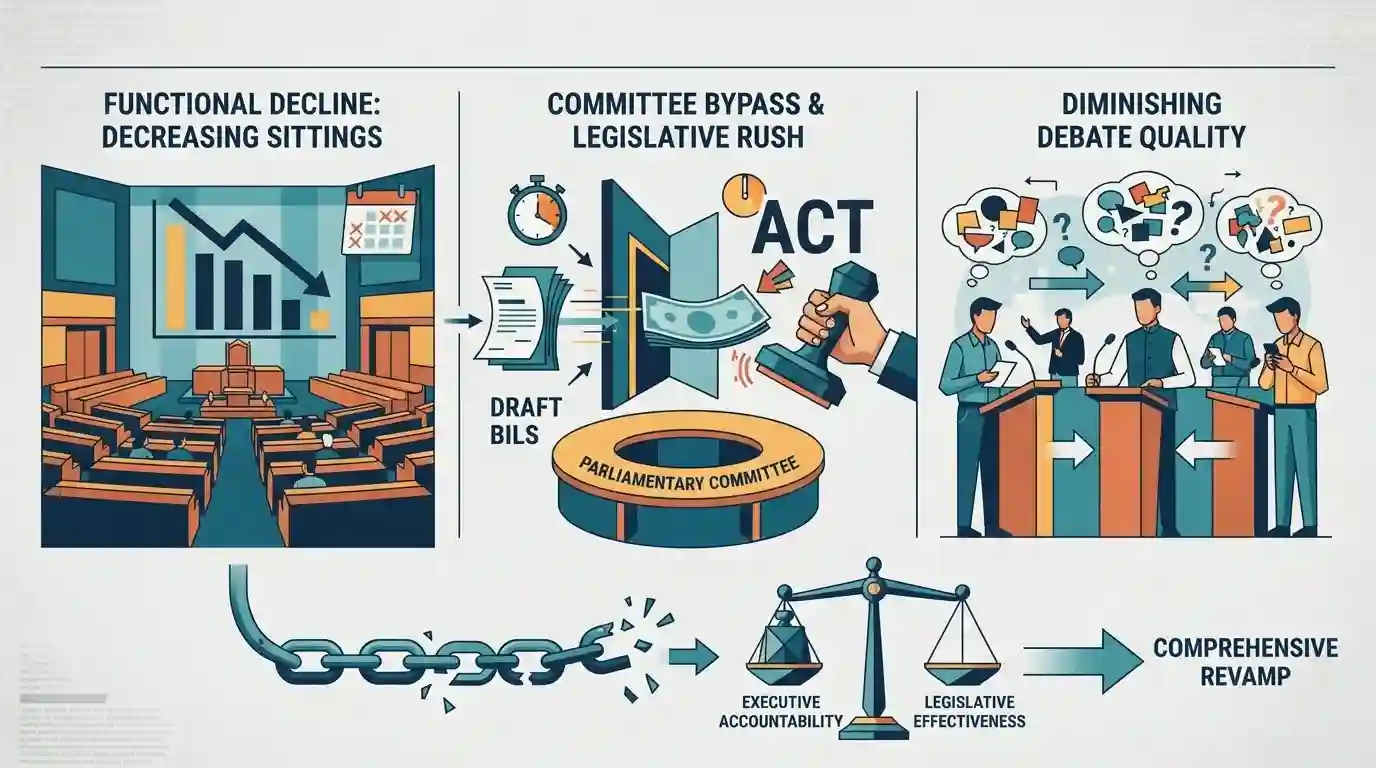
The article examines the structural and functional challenges facing the Indian Parliament, including decreasing sittings, bypass of committees, and diminishing debate quality, calling for a comprehensive revamp to restore executive accountability and legislative effectiveness.
मुख्य मुद्दे
- The article discusses the pressing need to revamp the functioning of the Indian Parliament to address declining standards of debate, reduced sittings, and the marginalization of parliamentary oversight.
- It highlights the declining role of individual parliamentarians as lawmakers and the bypassing of Department-related Parliamentary Standing Committees in scrutinizing legislation.
- Emphasizes reforms such as increasing the number of working days, ensuring rigorous scrutiny of bills, and strengthening accountability mechanisms to restore parliamentary supremacy over the executive.
महत्त्वाच्या संज्ञा
Parliament of India

The supreme legislative body of India comprising the President, Lok Sabha, and Rajya Sabha, responsible for enacting laws, ensuring executive accountability, and representing citizens.
UPSC context
UPSC GS Paper II: Structure, functioning, and conduct of business of the Parliament and issues arising out of these.
Department-related Standing Committees
Permanent parliamentary bodies consisting of members from both Houses, established to scrutinize government ministries, examine bills, and oversee financial grants in detail.
UPSC context
UPSC GS Paper II: Parliamentary Committees and their role in ensuring legislative oversight and executive accountability.
Lok Sabha
The lower house of India's bicameral parliament, directly elected by citizens on the basis of universal adult suffrage, where bills are introduced and government confidence is determined.
UPSC context
UPSC GS Paper II: Structure, power, and functioning of the Lok Sabha and federal legislative dynamics.
Rajya Sabha
The upper house of India's parliament representing the states and union territories, functioning as a permanent house that reviews legislation and safeguards federal interests.
UPSC context
UPSC GS Paper II: Legislative powers, role of the Rajya Sabha, and bicameral checks in Indian polity.
पूर्वपरीक्षा सापळा
All government bills introduced in Parliament must mandatorily be referred to Department-related Parliamentary Standing Committees for scrutiny.
Aspirants often assume that sending a Bill to a Department-related Parliamentary Standing Committee is mandatory before it is passed, but the Constitution does not mandate such reference.
संबंधित स्थिर संकल्पना
What are the constitutional provisions and functional types of Parliamentary Committees in India?
- Constitutional Basis: Articles 105 and 118 empower Parliament to regulate its procedure and committee system.
- Standing Committees: Financial committees (Estimates, Public Accounts, Public Undertakings) and DRSCs examine expenditure and legislation.
- Ad Hoc Committees: Select or Joint Committees are temporary panels formed specifically to deliberate and scrutinize a particular Bill.
आंतर-विषय नमुने
Parliamentary Reforms and Executive Accountability
The decline of legislative sittings and bypassing of standing committees directly affects the constitutional mandate of parliamentary accountability under Article 75(3).

Expect statement-based Qs on Standing Committees: Are they mandatory for all bills? Who constitutes them? (Lok Sabha Speaker/Rajya Sabha Chairman).
संबंधित PYQ · 3
संबंधित PYQ · 3
- 2019MainsGS2
Individual Parliamentarian's role as the national law maker is on a decline, which in turn, has adversely impacted the quality of debates and their outcome. Discuss.
- 2021MainsGS2
Do Department-related Parliamentary Standing Committees keep the administration on its toes and inspire reverence for parliamentary control? Evaluate the working of such committees with suitable examples.
- 2024MainsGS2
“The growth of cabinet system has practically resulted in the marginalisation of the parliamentary supremacy.” Elucidate.
