Circular Economy Integration in Vehicle Scrappage Framework
Source:The Hindu ↗
Why It Matters
Decarbonizing the transport sector is a major component of India's net-zero goals. Understanding the limitations of current scrappage policies and the potential of retrofitting is crucial for Mains GS3 answers on environmental pollution, circular economy, and EV transitions.
Summary
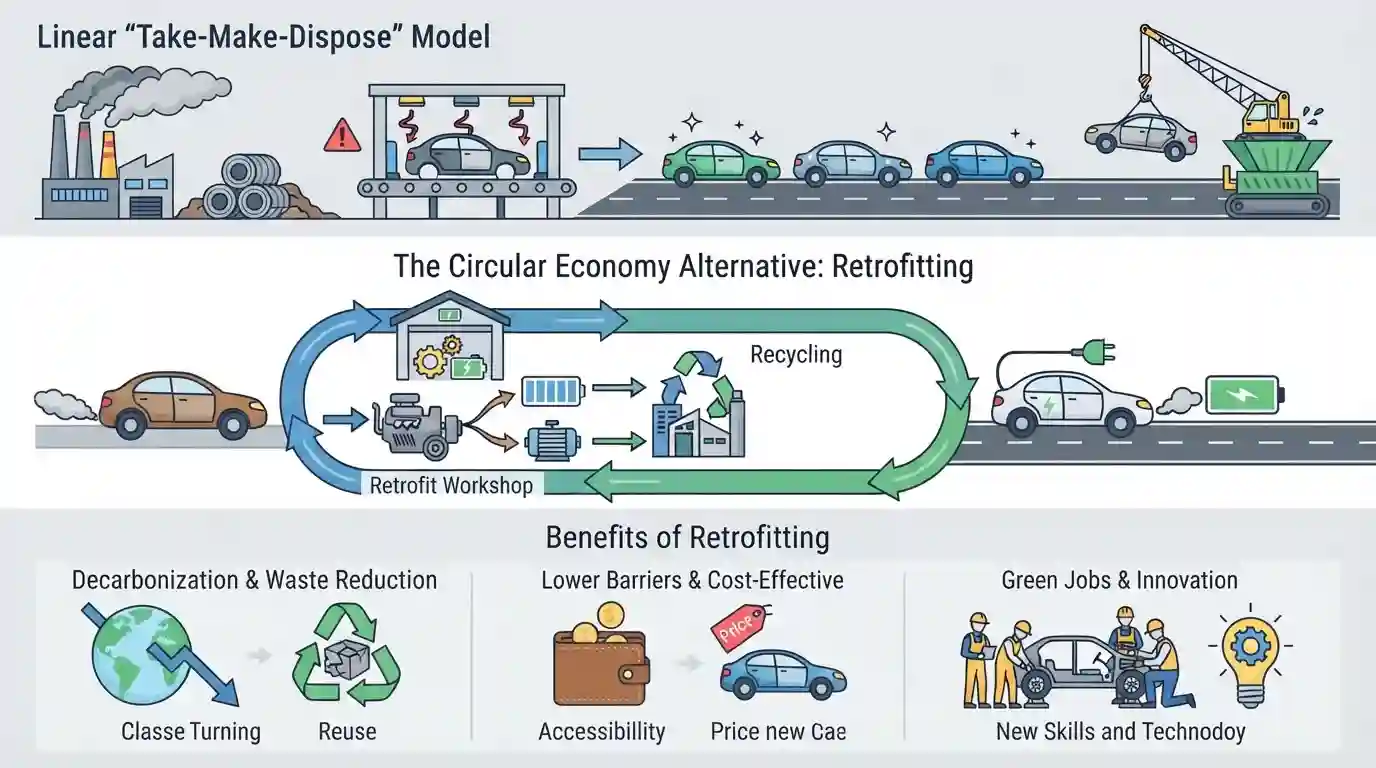
The article argues that India's Vehicle Scrappage Policy currently operates on a linear 'take-make-dispose' model, focusing primarily on scrapping old vehicles and pushing for new purchases. This approach is resource-intensive and ignores the massive embedded emissions in new vehicle manufacturing. The author advocates for 'retrofitting'—upgrading existing ICE vehicles with electric powertrains—as a critical missing link to promote a circular economy. Retrofitting offers a cost-effective pathway to decarbonize the transport sector, reduce automotive waste, and lower the barriers to EV adoption, provided the government introduces supportive regulations, standards, and incentives.
Key Points
- India's current Vehicle Scrappage Policy focuses on discarding old internal combustion engine (ICE) vehicles, which creates material waste and overlooks the embedded carbon footprint of manufacturing new vehicles.
- Retrofitting existing ICE vehicles with electric or alternative-fuel powertrains can serve as a crucial missing link, transitioning the sector toward a circular economy model rather than a linear take-make-dispose one.
- By upgrading old vehicles, retrofitting reduces the high capital cost barrier of electric vehicle (EV) adoption and limits the volume of automotive scrap generated.
- For retrofitting to succeed at scale, the government must update policies to provide clear regulatory standards, certification processes, and financial incentives for conversion kits.
Important Terms
Vehicle Scrappage Policy

An Indian government program launched in 2021 to systematically phase out and recycle unfit, polluting vehicles older than 15-20 years. It offers financial incentives to owners for scrapping to reduce emissions and stimulate automotive demand.
UPSC context
GS Paper 3 (Infrastructure/Environment). Tests knowledge of vehicular pollution mitigation, sustainable transport, and waste management policies.
Retrofitting
The mechanical process of converting a traditional fossil-fuel vehicle into an electric vehicle by replacing its internal combustion engine and fuel system with an electric motor, battery pack, and power control system.
UPSC context
GS Paper 3 (Science & Tech). Tests understanding of electric mobility solutions, circular economy applications, and transport decarbonization strategies.
Circular Economy
An economic model designed to minimize waste and resource consumption by continually reusing, repairing, refurbishing, and recycling materials. It replaces the traditional linear 'take-make-dispose' system to promote long-term environmental sustainability.
UPSC context
GS Paper 3 (Environment/Economy). Crucial for evaluating sustainable industrial policies, resource efficiency, and broader climate change mitigation strategies.
Embedded Emissions
The total greenhouse gas emissions generated during the creation of a product—spanning raw material extraction, manufacturing, and supply-chain transportation—before the product is ever operated by the consumer.
UPSC context
GS Paper 3 (Environment). Important for understanding life-cycle carbon assessments, industrial carbon footprints, and the hidden environmental costs of manufacturing.
Prelims Trap
The Vehicle Scrappage Policy and PM E-DRIVE scheme provide financial subsidies for retrofitting old ICE vehicles into EVs.
This is a trap. Current policies focus on scrapping for material recovery and subsidizing new EV purchases. Retrofitting currently lacks formal financial integration under national EV schemes like PM E-DRIVE.
Static Concepts Connected
What differentiates a Circular Economy from a Linear Economy in manufacturing?
- Linear Model: Follows a "take-make-dispose" approach; relies on continuous extraction of finite resources, generating high end-of-life waste.
- Circular Model: Focuses on maximizing asset lifespan through reuse, refurbishing, and retrofitting, minimizing both raw material extraction and embedded carbon emissions.
Who is responsible for vehicle homologation and certification in India?
- Homologation: The statutory process of certifying that a vehicle or its retrofitted components meet the government's safety, structural, and environmental standards before commercial use.
- Key Agencies: Conducted by testing agencies designated by the Ministry of Road Transport and Highways, prominently ARAI (Pune) and ICAT (Manesar).
Cross-Topic Patterns
Circular Economy + Critical Minerals
EV retrofitting cuts demand for virgin steel, but still requires critical minerals (Lithium, Cobalt) for the battery packs, linking mobility policies directly to India's critical mineral supply chain security.
Embedded Emissions vs Tailpipe Emissions
UPSC increasingly targets full-lifecycle environmental impacts. Distinguishing between 'embedded carbon' (manufacturing emissions) and 'tailpipe emissions' is crucial for evaluating India's net-zero transition strategies.

Expect a multi-statement question on the Vehicle Scrappage Policy contrasting material recycling with the circular economy (retrofitting).
Linked PYQs · 4
Linked PYQs · 4
- 2023MainsGS3
The adoption of electric vehicles is rapidly growing worldwide. How do electric vehicles contribute to reducing carbon emissions and what are the key benefits they offer compared to traditional combustion engine vehicles?
- 2019MainsGS3
Define the concept of carrying capacity of an ecosystem as relevant to an environment. Explain how understanding this concept is vital while planning for sustainable development of a region.
- 2025PrelimsGS1
Consider the following types of vehicles : I. Full battery electric vehicles II. Hydrogen fuel cell vehicles III. Fuel cell-electric hybrid vehicles How many of the above are considered as alternative powertrain vehicles?
- 2021PrelimsGS1
'R2 Code of Practices' constitutes a tool available for promoting the adoption of
