Uttar Pradesh Public Services Tribunal chairman appointed by governor
Source:lawtrend ↗
Why It Matters
This development is highly relevant for UPPSC Prelims as it touches upon state-level quasi-judicial machinery, statutory appointments under the state governor, and the constitutional framework of tribunals under Part XIV-A, which are frequent subjects of polity questions.
Summary
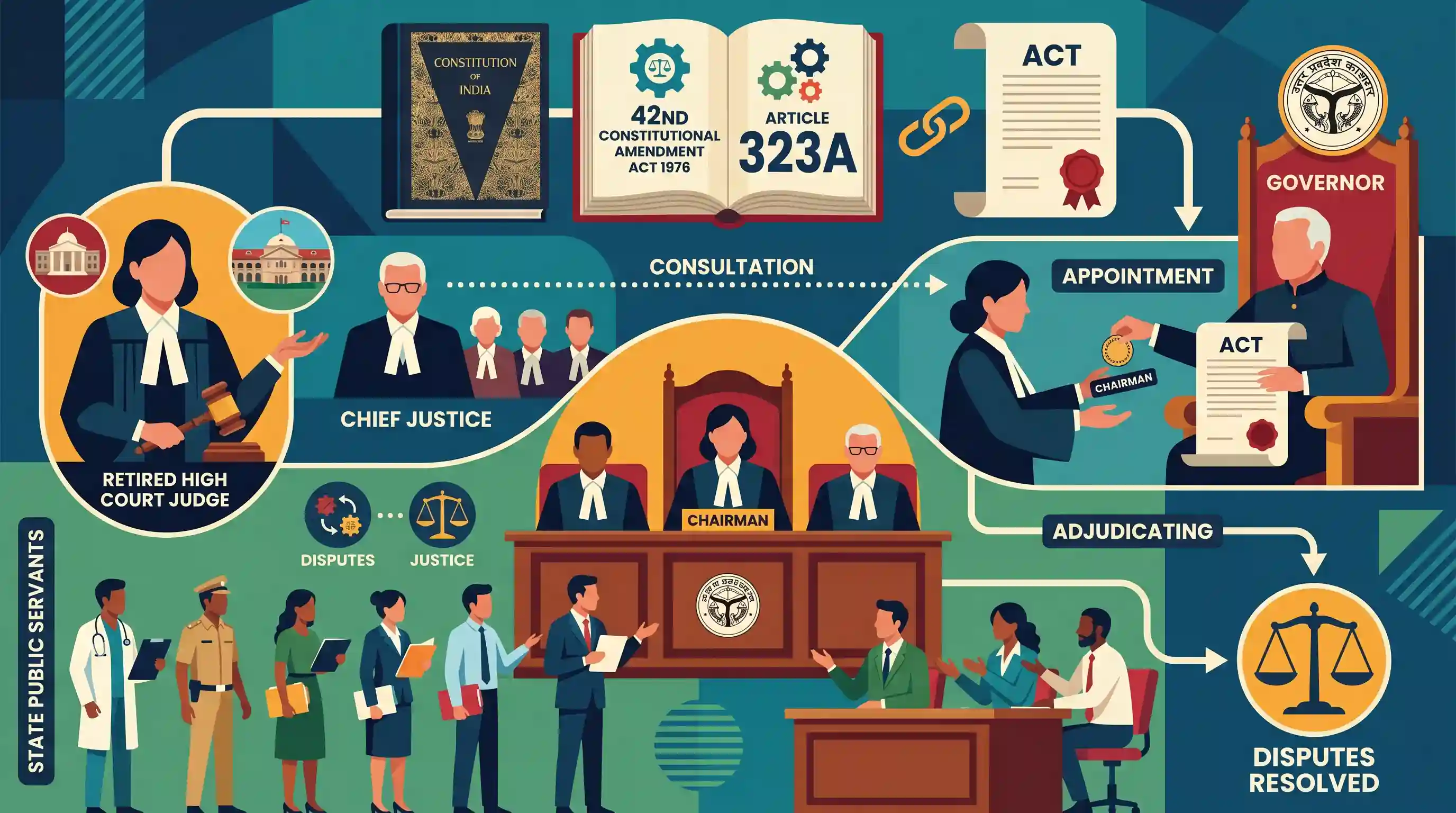
Retired Allahabad High Court Judge, Justice Sadhna Rani (Thakur), has been appointed as the Chairman of the Uttar Pradesh Public Services Tribunal. Appointed by the Governor of Uttar Pradesh in consultation with the Chief Justice of the Allahabad High Court, she will lead the tribunal established under the Uttar Pradesh Public Services (Tribunal) Act, 1976, which adjudicates state public service disputes.
Key Points
- Retired High Court Justice Sadhna Rani (Thakur) was appointed as the Chairman of the Uttar Pradesh Public Services Tribunal on January 9, 2025.
- The Governor of Uttar Pradesh made the appointment following mandatory consultations with the Chief Justice of the Allahabad High Court.
- The Uttar Pradesh Public Services Tribunal was established under the Uttar Pradesh Public Services (Tribunal) Act, 1976 to adjudicate service-related disputes of state government employees.
- Administrative tribunals in India are rooted in Part XIV-A of the Constitution (introduced via the 42nd Constitutional Amendment in 1976), where Article 323A deals specifically with administrative tribunals.
- This judicial appointment aims to streamline and expedite dispute resolution in state public services, thereby relieving the caseload of the Allahabad High Court.
Important Terms
Uttar Pradesh Public Services Tribunal

A specialized quasi-judicial body established in Uttar Pradesh to adjudicate recruitment and service-related disputes of state public servants, thereby reducing civil court pendency.
UPSC context
GS Paper II: Polity (Tribunals); tests knowledge of administrative adjudication and state-level public service grievance mechanisms.
Uttar Pradesh Public Services (Tribunal) Act, 1976
A state legislative act that provides for the establishment, jurisdiction, and functioning of the administrative tribunal to adjudicate employment disputes of Uttar Pradesh state public servants.
UPSC context
GS Paper II: Polity (Statutory Bodies); tests understanding of legislative enactments establishing quasi-judicial bodies at the state level.
Allahabad High Court
The constitutional High Court of Uttar Pradesh, established in 1866, holding original, appellate, writ, and supervisory jurisdictions over subordinate courts and tribunals in the state.
UPSC context
GS Paper II: Judiciary; tests knowledge of High Court structures, writ jurisdictions under Article 226, and superintendence over state tribunals.
Article 323A
A constitutional provision inserted by the 42nd Amendment empowering Parliament to establish administrative tribunals for resolving recruitment and service disputes of public servants.
UPSC context
GS Paper II: Polity (Constitutional Provisions); tests understanding of tribunals, legislative powers, and administrative dispute resolution.
42nd Constitutional Amendment Act, 1976
A landmark constitutional amendment that introduced Part XIV-A (Articles 323A and 323B) to establish tribunals, altering India's administrative and judicial framework.
UPSC context
GS Paper II: Indian Constitution; tests major amendments, historical evolution of the judiciary, and quasi-judicial mechanisms.
Prelims Trap
Members of all administrative tribunals adjudicating state civil service disputes are appointed exclusively by the President of India.
While standard State Administrative Tribunals (SATs) under the 1985 Act have members appointed by the President, state-enacted tribunals (like UP's) feature appointments by the Governor in consultation with the High Court.
Static Concepts Connected
What are the core differences between Article 323A and Article 323B?
- Legislative Authority: Only Parliament can establish tribunals under 323A (for public service matters), whereas both Parliament and State Legislatures can establish them under 323B (for other matters like tax, land reforms).
- Hierarchy: Article 323A allows only one central tribunal and one per state/group of states, whereas Article 323B permits a hierarchical structure of tribunals.
What did the Supreme Court rule in L. Chandra Kumar v. Union of India (1997)?
- Basic Structure: Declared that the power of judicial review under Articles 226/227 and Article 32 is an essential and robust part of the basic structure.
- No Exclusion of HC: Ruled that tribunals cannot act as complete substitutes for High Courts; their decisions are subject to scrutiny by a division bench of the respective High Court.
Cross-Topic Patterns
Tribunalization vs Judicial Separation
The rise of executive-appointed tribunal members often collides with Article 50 (separation of judiciary), raising concerns over judicial independence.
Federalism and Civil Service Adjudication
While Entry 41 of List II allows states to regulate state public services, Article 323A restricts administrative tribunal legislation solely to Parliament, creating a unique constitutional tension.

Expect a 2026 question testing the legislative limits of Parliament under Article 323A versus State Assemblies under Article 323B.
Linked PYQs · 2
Linked PYQs · 2
- 2023UPPSC_PRELIMSGS1
Which among the following (Provision - Part of the Constitution) is not correctly matched?
- 2021UPPSC_PRELIMSGS1
The functions of the State Public Service Commission of Uttar Pradesh can be extended by
