Judicial Panel to Probe Meghalaya Illegal Mine Blast
Source:The Hindu ↗
Why It Matters
Highlights the persistent challenge of unregulated, illegal 'rat-hole' mining in ecologically sensitive and tribal-dominated regions. It reveals the complex intersection of environmental protection (NGT bans), constitutional exemptions (Sixth Schedule), and occupational hazards in the informal sector, serving as a vital case study for environment and governance questions.
Summary
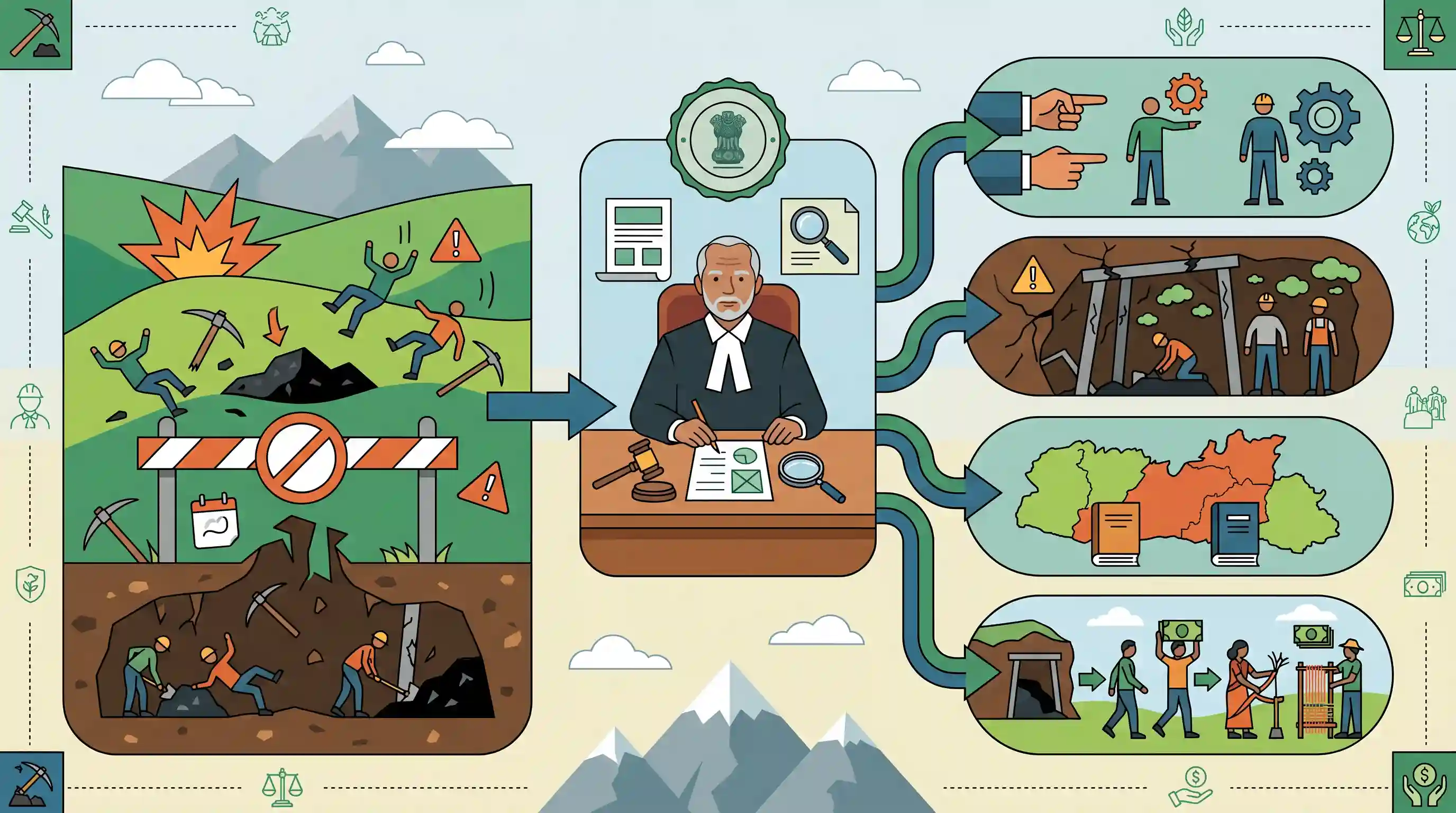
The Meghalaya government has appointed retired High Court judge Justice R.S. Chauhan to lead a one-man judicial probe into the deadly blast at an illegal coal mine in the East Jaintia Hills that claimed 31 lives. Set up under the Commission of Inquiry Act, 1952, the panel will investigate why illegal 'rat-hole' mining continues despite the 2014 National Green Tribunal (NGT) ban. The commission's Terms of Reference include fixing accountability, assessing laborers' working conditions, examining the application of central mining laws in Sixth Schedule areas, and proposing financial rehabilitation for those socio-economically impacted by the NGT ban.
Key Points
- A one-man judicial inquiry panel headed by retired Justice R.S. Chauhan will probe the February 5 blast at an illegal coal mine in Meghalaya that killed 31 people.
- The commission, formed under the Commission of Inquiry Act, 1952, will investigate accountability and the persistent root causes of unregulated mining.
- The panel will examine the socio-economic drivers behind illegal 'rat-hole' mining, which continues despite a 2014 ban by the National Green Tribunal (NGT).
- A key Terms of Reference (ToR) is to evaluate constitutional exemptions and the application of central mining laws in Meghalaya's Sixth Schedule areas.
- The probe will also assess the working conditions of laborers and propose administrative reforms, including financial rehabilitation for communities affected by the NGT ban.
Important Terms
Commission of Inquiry Act, 1952

1952 legislation enabling Central/State governments to appoint commissions for investigating matters of public importance. These commissions possess civil court powers, including summoning witnesses and requisitioning public records.
UPSC context
GS Paper II (Governance/Statutory Bodies). Tests understanding of executive accountability and investigative mechanisms for public interest issues.
Sixth Schedule of the Indian Constitution
Constitutional provision (Articles 244(2) and 275(1)) providing autonomy to tribal areas in Assam, Meghalaya, Tripura, and Mizoram. It establishes ADCs with legislative and judicial powers over land and resources.
UPSC context
GS Paper II (Polity). Essential for understanding federalism, tribal autonomy, and conflicts between local customs and central laws.
National Green Tribunal (NGT)
Specialized statutory body established under the NGT Act, 2010, for the effective and expeditious disposal of cases relating to environmental protection and conservation of forests.
UPSC context
GS Paper III (Environment). Tests knowledge of environmental jurisprudence and the regulatory enforcement of ecological bans.
Rat-hole Mining
An unscientific, hazardous coal extraction method involving digging narrow 3-4 feet tunnels. Banned by NGT in 2014 due to environmental degradation and frequent fatal accidents.
UPSC context
GS Paper III (Disaster Management/Environment). Highlights challenges of illegal mining, occupational safety, and environmental impact assessment.
Autonomous District Councils (ADCs)
Administrative bodies in Sixth Schedule areas empowered to make laws on land, forests, and social customs, and collect royalties on minerals, often creating regulatory overlaps with central acts.
UPSC context
GS Paper II (Polity/Governance). Key to understanding decentralized governance and tribal self-rule in North-East India.
Prelims Trap
Central mining laws like the MMDR Act do not apply to Meghalaya due to the Sixth Schedule.
The Supreme Court ruled (2019) that while tribals privately own sub-soil minerals in Meghalaya, mining must still comply with the MMDR Act and environmental laws.
Static Concepts Connected
How does the Sixth Schedule impact mineral ownership and regulation in Meghalaya?
- Private Ownership: Unlike most of India where minerals vest with the State, land and sub-soil minerals in Meghalaya are privately or community-owned by tribals.
- Regulatory Compliance: Private ownership does not grant exemption from statutory regulations. Mining operations must still comply with central frameworks like the MMDR Act and environmental laws.
What is Acid Mine Drainage (AMD) associated with rat-hole mining?
- Chemical Reaction: Extraction exposes high-sulfur coal to water and atmospheric oxygen, producing sulfuric acid and drastically lowering the pH of surrounding water bodies.
- Ecological Impact: Toxic acid runoff severely pollutes local ecosystems, turning regional rivers like the Kopili, Lukha, and Myntdu highly acidic and incapable of sustaining aquatic life.
Cross-Topic Patterns
Sixth Schedule vs. Central Laws
The conflict between customary tribal ownership of minerals and federal environmental frameworks (MMDR Act/NGT) is a classic polity-environment intersection frequently tested in Mains.
Commissions of Inquiry powers
Connects to Polity. Under the 1952 Act, these panels hold civil court powers to summon witnesses, but their findings remain strictly advisory and are not legally binding on the government.

Expect a 2026 multi-statement question interlinking Sixth Schedule mineral ownership, MMDR Act applicability, and NGT jurisdiction.
Linked PYQs · 3
Linked PYQs · 3
- 2025MainsGS3
Mineral resources are fundamental to the country's economy and these are exploited by mining. Why is mining considered an environmental hazard? Explain the remedial measures required to reduce the environmental hazard due to mining.
- 2014MainsGS3
Environmental Impact Assessment studies are increasingly undertaken before a project is cleared by the Government. Discuss the environmental impacts of coal-fired thermal plants located at coal pitheads.
- 2017MainsGS2
Discuss the role of Public Accounts Committee in establishing accountability of the government to the people.
