Meghalaya Coal Mine Blast Judicial Inquiry Commission
Source:The Hindu ↗
Why It Matters
This incident highlights the recurrent issue of illegal rat-hole mining in India's northeast, sitting at the intersection of environmental conservation (NGT bans), economic dependency, and occupational hazards. It also touches upon Centre-State relations regarding mining laws in constitutionally exempted tribal areas, making it highly relevant for questions on environmental governance and internal security challenges arising from illegal resource extraction.
Summary
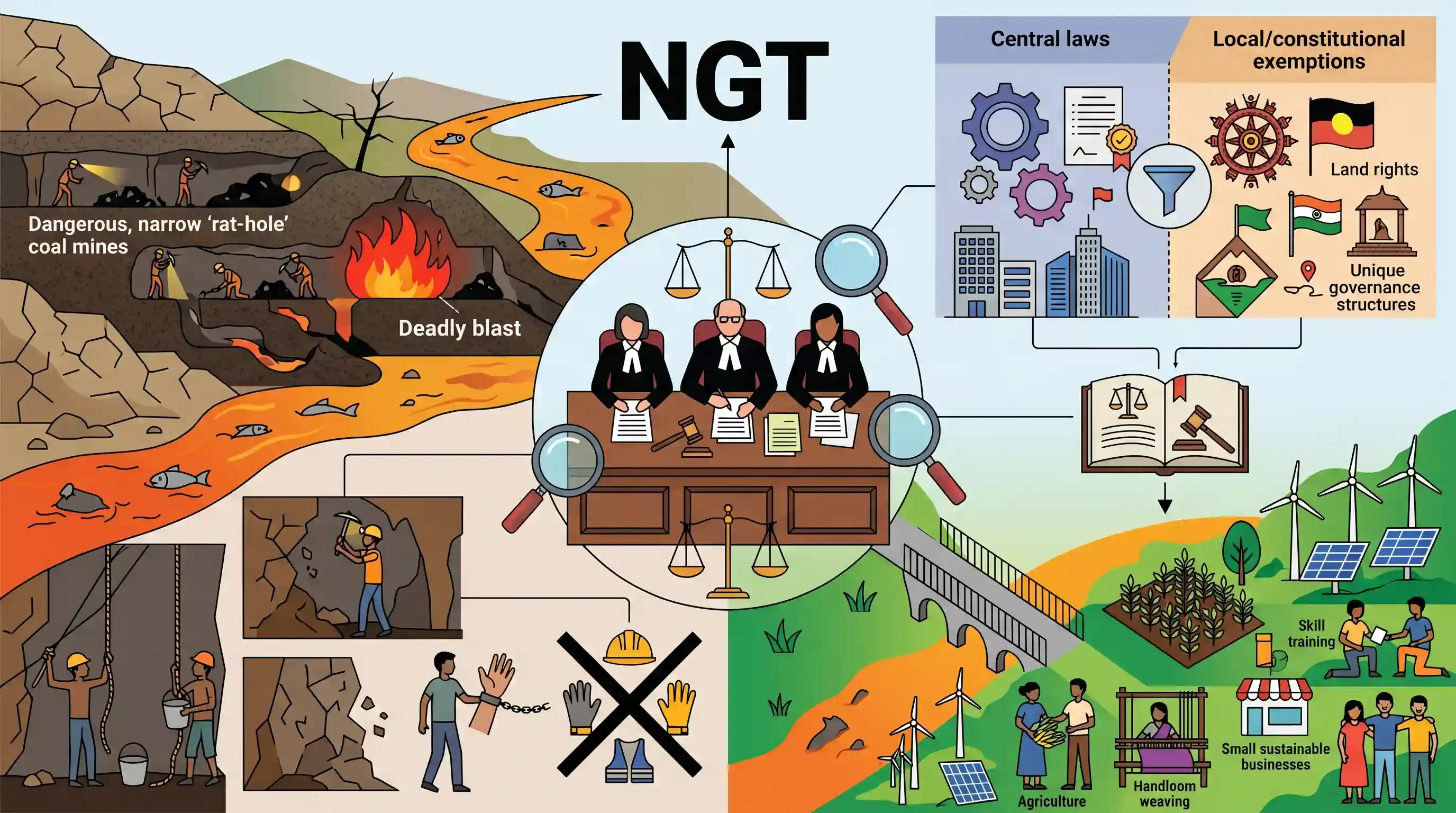
A three-member judicial commission headed by retired High Court Judge Justice R.S. Chauhan has been appointed by the Meghalaya government to probe a deadly blast at an illegal 'rat-hole' coal mine in East Jaintia Hills. Formed under the Commission of Inquiry Act, 1952, the panel will investigate the persistence of illegal mining despite the National Green Tribunal's 2014 ban. Additionally, it will review labour working conditions, examine the applicability of Central mining laws considering constitutional exemptions, and suggest alternative livelihood strategies for those economically impacted by the ban.
Key Points
- The Meghalaya government has appointed a three-member judicial commission, led by retired High Court Judge R.S. Chauhan, to investigate a fatal blast at an illegal coal mine in East Jaintia Hills that killed 31 people.
- Constituted under the Commission of Inquiry Act, 1952, the panel will probe the causes, fix accountability, and identify omissions by authorities.
- The commission is tasked with examining the root causes of the persistence of illegal 'rat-hole' coal mining despite a 2014 ban by the National Green Tribunal (NGT).
- It will also review the working conditions of mining labourers, examine constitutional exemptions to Central mining laws, and recommend financial rehabilitation for those who lost livelihoods due to the NGT ban.
Important Terms
Rat-hole Mining

A primitive coal extraction method involving narrow tunnels (3–4 feet high) dug manually to reach thin seams. It is notorious for lack of safety gear and child labor.
UPSC context
GS3: Environment and Disaster Management; tests understanding of illegal mining impacts and human rights in resource-rich tribal belts.
National Green Tribunal (NGT)
A statutory body established under the NGT Act 2010 for effective and expeditious disposal of cases relating to environmental protection and conservation of forests.
UPSC context
GS2: Statutory Bodies; GS3: Environmental Governance. Tests the role of quasi-judicial bodies in regulatory enforcement.
Sixth Schedule of the Constitution
Constitutional provisions under Articles 244(2) and 275(1) providing for the administration of tribal areas in Assam, Meghalaya, Tripura, and Mizoram through Autonomous District Councils.
UPSC context
GS2: Polity and Governance. Crucial for topics on federalism, tribal autonomy, and conflicts between local and central laws.
Commissions of Inquiry Act, 1952
Legislation empowering the Central or State governments to appoint a commission to investigate any definite matter of public importance, granting the panel civil court powers.
UPSC context
GS2: Governance and Executive. Tests the mechanism of accountability and the legal framework for public fact-finding missions.
Mines and Minerals (Development and Regulation) Act, 1957
The primary legislation governing the mining sector in India, detailing licensing, mineral concessions, and the regulation of major and minor minerals.
UPSC context
GS2/GS3: Economy and Governance. Essential for understanding resource allocation and the center-state distribution of legislative power over minerals.
Prelims Trap
"Tribal autonomy in Sixth Schedule areas exempts them from the MMDR Act and central environmental laws."
The Supreme Court ruled in 2019 that tribal land ownership under the Sixth Schedule does not grant immunity from central environmental regulations or the MMDR Act.
Static Concepts Connected
What are the powers and limitations under the Commission of Inquiry Act, 1952?
- Civil Court Powers: Possesses powers of a civil court to summon witnesses, requisition public records, and take evidence on oath.
- Jurisdictional Restraint: A State cannot legally establish a parallel commission if the Central Government has already formed one on the exact same matter, unless approved.
- Non-Binding Nature: The commission's findings are purely recommendatory. They do not hold binding legal authority over the government's subsequent actions.
Why is rat-hole mining prevalent in Meghalaya and how does it trigger Acid Mine Drainage?
- Geological Factors: Practiced primarily because Meghalaya's coal seams are extremely thin (often under 2 meters), making modern open-cast mining economically unviable.
- Acid Mine Drainage: Unscientific extraction exposes sulphur in coal to water and air, producing sulphuric acid that severely degrades aquatic ecosystems.
- Ecological Impact: Toxic AMD runoff has devastated local water bodies, notably turning rivers like the Kopili and Lukha highly acidic.
Cross-Topic Patterns
Sixth Schedule vs. Central Environmental Laws
The clash between tribal autonomy over mineral-rich land and overriding central statutes like the MMDR Act remains a core federalism debate in environmental governance.
Acid Mine Drainage (AMD) and Water Pollution
Acid Mine Drainage connects directly to geography topics on water pollution; it affects not just Meghalaya's Kopili and Lukha rivers but abandoned mining towns globally.

A multi-statement question combining Sixth Schedule mineral ownership limits, NGT bans, and Acid Mine Drainage is highly likely in 2026.
Linked PYQs · 3
Linked PYQs · 3
- 2025MainsGS3
Mineral resources are fundamental to the country's economy and these are exploited by mining. Why is mining considered an environmental hazard? Explain the remedial measures required to reduce the environmental hazard due to mining.
- 2017MainsGS1
In spite of adverse environmental impact, coal mining is still inevitable for development." Discuss.
- 2019MainsGS3
Coastal sand mining, whether legal or illegal, poses one of the biggest threats to our environment. Analyze the impact of sand mining along the Indian coasts, citing specific examples.
