Tribal Women Inheritance Rights and Customary Law Reform
Source:The Hindu ↗
Why It Matters
The conflict between gender equality and minority/tribal cultural protections is a core theme in UPSC GS2 (Polity and Social Justice). It is highly relevant for questions concerning the Uniform Civil Code, women's empowerment, and the harmonization of customary laws with Fundamental Rights.
Summary
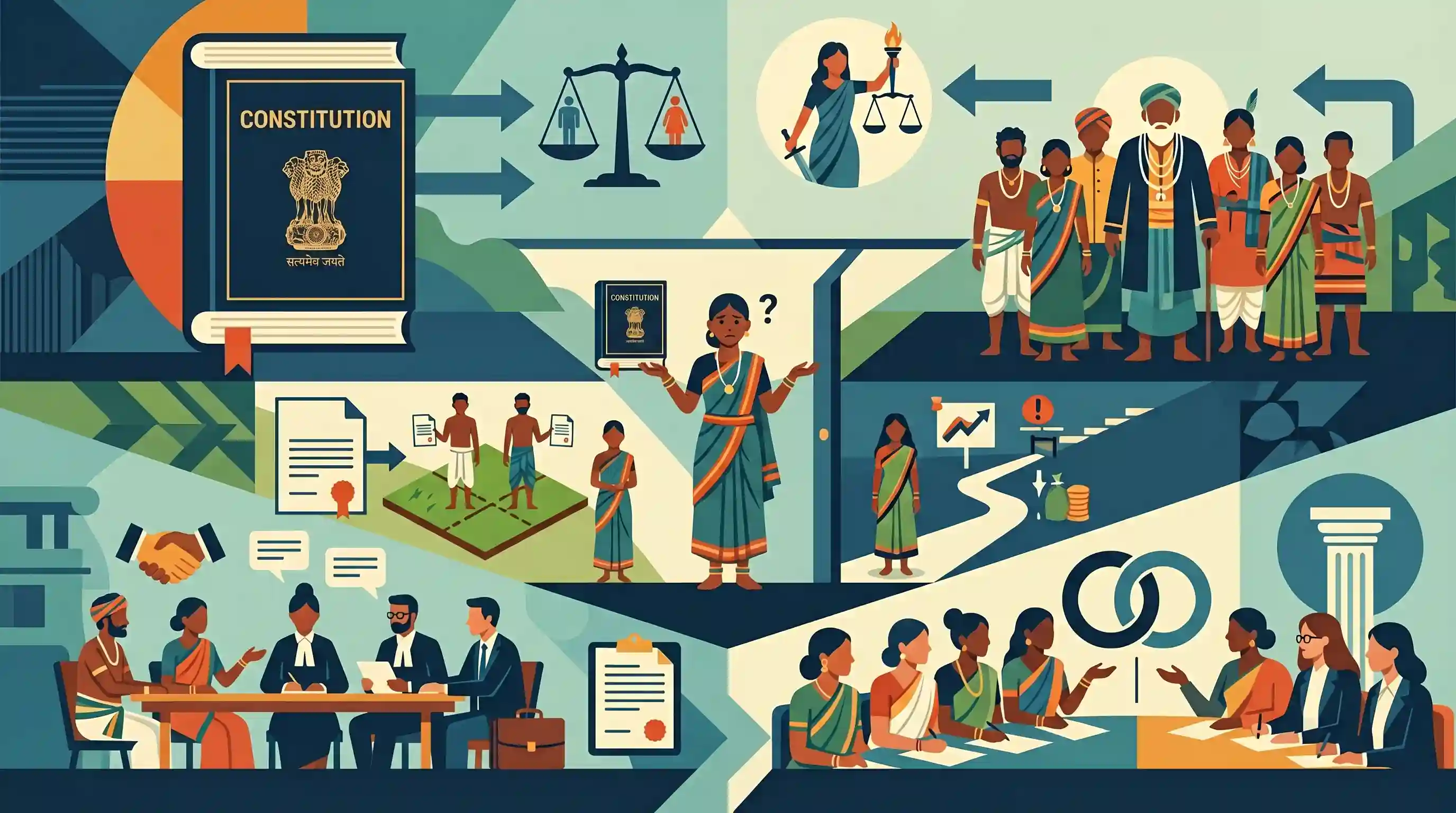
The article scrutinizes the complex intersection of tribal customary laws, gender justice, and inheritance rights in India. Scheduled Tribes are currently exempted from the Hindu Succession Act under Section 2(2), a provision intended to preserve cultural practices but which often results in the disenfranchisement of tribal women from property and land inheritance. This creates a stark constitutional dilemma between guaranteeing the fundamental rights to equality and life, and protecting the cultural autonomy of marginalized tribes. Resolving this tension demands a nuanced approach—such as the careful codification of progressive customary laws or integrating these concerns into the Uniform Civil Code (UCC) debate—to ensure economic security for tribal women while safeguarding their unique community identities.
Key Points
- Section 2(2) of the Hindu Succession Act, 1956 specifically exempts Scheduled Tribes from its provisions to protect their traditional customs.
- Many tribal customary laws are deeply patriarchal and deny women equal inheritance and property rights, making them economically vulnerable.
- A constitutional friction exists between fundamental rights to equality and gender justice (Articles 14, 15) and the protections afforded to tribal cultural autonomy and customary practices.
- The ongoing discourse around the Uniform Civil Code (UCC) has reignited the debate on reforming or codifying tribal customary laws to ensure gender parity without eroding indigenous identities.
Important Terms
Hindu Succession Act, 1956

Enacted to govern inheritance among Hindus, Buddhists, Jains, and Sikhs, it notably exempts Scheduled Tribes under Section 2(2) unless centrally notified, preventing tribal women from automatically claiming equal coparcenary rights.
UPSC context
GS2: Social Justice. Essential for questions on gender-discriminatory provisions in personal laws and exemptions for vulnerable sections.
Indian Succession Act, 1925
A consolidated law governing testamentary and intestate succession for Christians, Parsis, and Jews. Section 3 empowers state governments to exempt specific tribes, reinforcing the primacy of customary law over statutory codes.
UPSC context
GS2: Polity. Tests understanding of legal pluralism and the state's power to manage diverse social customs.
Uniform Civil Code (UCC)
A proposed common set of personal laws for all citizens regardless of religion, as envisioned under Article 44. It is debated as a solution for gender justice vs. tribal cultural autonomy.
UPSC context
GS2: DPSP. Tests the balance between Article 44 (Uniformity) and Articles 25-29 (Cultural Rights).
Constitution of India
The framework balancing fundamental rights to equality (Articles 14, 15) and life (Article 21) against special protections for Scheduled Tribes under Article 342 and the Fifth/Sixth Schedules.
UPSC context
GS2: Basic Structure. Vital for analyzing the 'Equality vs. Diversity' constitutional dilemma in tribal governance.
Supreme Court of India
Acting as the final arbiter, the Court has historically protected tribal women's livelihood (Madhu Kishwar case, 1996) while recently reaffirming that only Parliament can remove statutory exemptions for tribes (Nawang v. Bahadur, 2025).
UPSC context
GS2: Judiciary. Focuses on judicial activism and its limits in personal law and tribal customs.
Law Commission of India
An executive body that researches legal reform; its reports (like the 174th) have been pivotal in advocating for gender-neutral inheritance laws, though tribal inclusion remains a pending recommendation.
UPSC context
GS2: Statutory Bodies. Tests the role of advisory bodies in legislative evolution and social reform.
Prelims Trap
The Hindu Succession (Amendment) Act, 2005 guarantees equal inheritance rights to all women in India, including Scheduled Tribes.
STs are explicitly exempted under Section 2(2) of the Hindu Succession Act. Their inheritance remains governed by uncodified customary laws.
Static Concepts Connected
What is the constitutional friction between customary laws and Fundamental Rights?
- Articles 14 & 15: These guarantee equality and non-discrimination, which often clash directly with patriarchal tribal customs that deny land inheritance to women.
- Madhu Kishwar Case (1996): The Supreme Court refrained from striking down discriminatory tribal succession customs to prevent social disruption and tribal land fragmentation.
How does the Constitution protect tribal customary laws and land rights?
- Fifth & Sixth Schedules: These schedules create specialized administrative frameworks that protect tribal autonomy, prevent land alienation, and preserve customary laws in designated areas.
- PESA Act, 1996: This act explicitly empowers Gram Sabhas to safeguard and preserve the traditions, customs, and cultural identity of scheduled tribes.
- Article 19(5): Allows the state to make special provisions for STs, including restrictions on the freedom of movement and property to protect their interests.
Cross-Topic Patterns
Land alienation and Left Wing Extremism
Fear of tribal land passing to non-tribals drives strict inheritance customs. Simultaneously, unresolved land disputes and poverty fuel LWE, linking gender justice to internal security.
Feminisation of Agriculture vs Land Titles
Without legal land titles, female tribal farmers cannot access institutional credit, collateral-based loans, or state subsidies like PM-KISAN, heavily exacerbating rural poverty.

Expect a multi-statement Prelims question on the Hindu Succession Act's applicability to STs and the Madhu Kishwar judgement in 2026.
Linked PYQs · 4
Linked PYQs · 4
- 2023MainsGS2
Explain the constitutional perspectives of Gender Justice with the help of relevant Constitutional Provisions and case laws.
- 2022MainsGS1
Given the diversities among tribal communities in India, in which specific contexts should they be considered as a single category ?
- 2021PrelimsGS1
What is the position of the Right to Property in India?
- 2019PrelimsGS1
Under which Schedule of the Constitution of India can the transfer of tribal land to private parties for mining be declared null and void?
