Global immigration policies in the contemporary age of exclusion
Source:The Hindu ↗
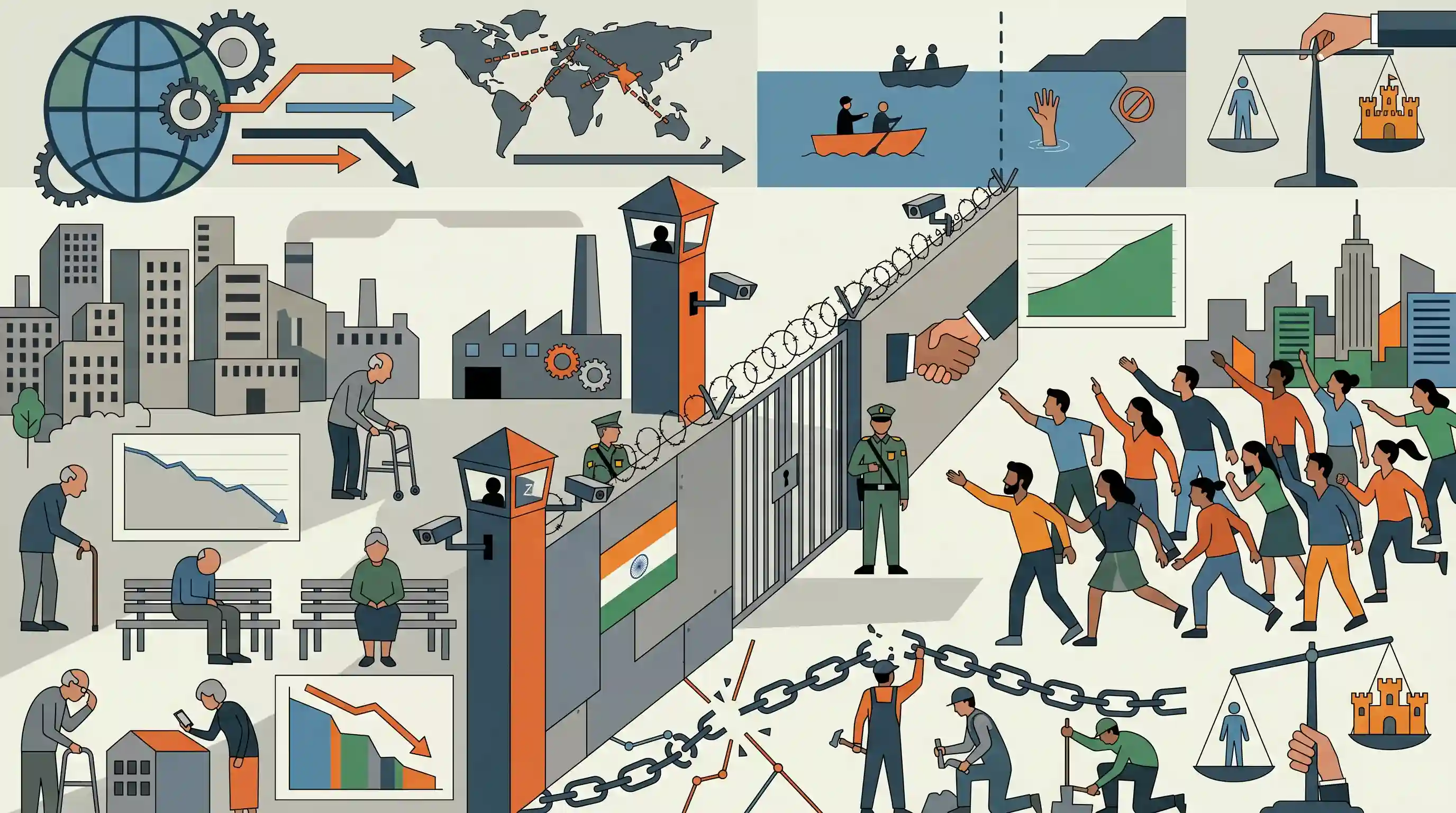
Why It Matters
Immigration and refugee policies sit at the critical intersection of GS1 (demographics), GS2 (IR and diaspora), and GS4 (ethics). Understanding the tension between 'sovereign nationalism' and the economic necessity of migration is vital for answering Mains questions on globalization's decline, demographic shifts, and human rights.
Summary
The article examines the contemporary 'age of exclusion', highlighting a global paradigm shift where sovereign nationalism and protectionist policies are driving harsh immigration controls. Despite the economic realities of a 'demographic winter' in the Global North—characterized by aging populations and severe labor shortages—developed nations are prioritizing border security and cultural protectionism over globalization. This exclusionary approach undermines global labor mobility, disproportionately affects the demographic dividend of developing nations like India, and raises profound ethical concerns regarding the treatment of refugees. The piece calls for rethinking immigration frameworks to balance national sovereignty with economic interdependence and fundamental human rights.
Key Points
- The global landscape is witnessing a reversal of globalization, as developed nations increasingly adopt 'sovereign nationalism' and enforce stringent border controls.
- There is a stark paradox between the exclusionary immigration policies of the Global North and their impending 'demographic winter', which creates a structural necessity for foreign labor to sustain economic growth.
- Restrictive visa regimes and protectionist policies directly impede developing countries like India from fully realizing their demographic dividend and impact remittance flows.
- The 'age of exclusion' presents severe ethical dilemmas, highlighting the hypocrisy of democratic nations that turn away refugees and asylum seekers facing persecution.
- A paradigm shift is required in global governance to treat immigration not merely as a security threat, but as an economic necessity and a humanitarian obligation.
Important Terms
1951 Refugee Convention

A UN multilateral treaty defining who is a refugee and the legal obligations of states to protect them, centered on the core principle of non-refoulement.
UPSC context
GS-II: International Treaties; GS-IV: Ethics. Crucial as India is a non-signatory despite hosting large refugee populations.
Demographic Winter
A severe, long-term population decline caused by sub-replacement fertility rates (below 2.1), leading to a shrinking workforce and an aging society with high dependency ratios.
UPSC context
GS-I: Population and Associated Issues. Tests understanding of demographic transitions in developed versus developing nations.
Demographic Dividend
The economic growth potential resulting from a shift in a population's age structure, specifically when the share of the working-age population is larger than the non-working-age share.
UPSC context
GS-III: Indian Economy. Vital for analyzing India's labor market potential and human capital development.
Sovereign Nationalism
A resurgence of states prioritizing national interests, borders, and domestic identity over global cooperation, often characterized by a retreat from multilateralism and globalization.
UPSC context
GS-II: International Relations. Relevant to questions on deglobalization, trade wars, and the crisis of global institutions.
Protectionism
Economic policy of shielding domestic industries from foreign competition by restricting imports through tariffs, quotas, and government regulations.
UPSC context
GS-III: Economy/Trade. Key for discussing the "backlash against globalization" and India’s Atmanirbhar Bharat initiative.
Prelims Trap
"India is a signatory to the 1951 Refugee Convention and its 1967 Protocol."
India is not a signatory to the 1951 Convention or the 1967 Protocol, despite hosting large refugee populations and adhering to the customary principle of non-refoulement.
Static Concepts Connected
What characterizes a 'Demographic Winter' compared to a 'Demographic Dividend'?
- Demographic Dividend: Surge in economic growth potential resulting from an expanding working-age population (15-64 years) relative to the dependent population.
- Demographic Winter: Persistent sub-replacement fertility rates leading to an aging population, shrinking domestic workforce, and severely strained social security systems.
- Economic Impact: The "Winter" structurally requires labor imports, while the "Dividend" requires large-scale job creation, making migration a mutually beneficial economic necessity.
What is the principle of 'Non-refoulement' in international law?
- Core Meaning: It forbids a country from returning asylum seekers to a territory where they would likely face persecution based on race, religion, nationality, or political opinion.
- Customary Law: It is considered a binding norm of customary international law, meaning it applies even to countries that haven't signed the 1951 Refugee Convention.
- Ethical Dimension: It is the central concept invoked in GS-4 (Ethics in IR) when analyzing the morality of strict border closures by developed nations against refugees.
Cross-Topic Patterns
MMPAs and BoP Stability
India's bilateral Migration and Mobility Partnership Agreements (MMPAs) with European nations are structurally critical for sustaining its $120B+ remittance inflows, which act as a vital cushion for the Current Account Deficit.
Deglobalization of Labor vs WTO Mode 4
While global capital and data mobility face regulatory fragmentation, labor mobility is encountering outright sovereign nationalism. This directly contradicts the liberalized trade objectives of WTO's GATS Mode 4 (movement of natural persons).

Expect a GS-2 mains question contrasting the Global North's 'demographic winter' with India's push for Migration Agreements (MMPAs).
Linked PYQs · 5
Linked PYQs · 5
- 2025MainsGS2
"With the waning of globalization, post-Cold War world is becoming a site of sovereign nationalism.” Elucidate.
- 2024MainsGS1
What is the concept of a 'demographic winter'? Is the world moving towards such a situation? Elaborate.
- 2021MainsGS4
“Refugees should not be turned back to the country where they would face persecution or human right violation.” Examine the statement with reference to ethical dimension being violated by the nation claiming to be democratic with open society.
- 2020MainsGS2
Indian diaspora has a decisive role to play in the politics and economy of America and European Countries'. Comment with examples.
- 2015MainsGS1
Discuss the changes in the trends of labour migration within and outside India in the last four decades.
