Sodium Ion Technology Strategy for Indian Energy Storage
Source:The Hindu ↗
Why It Matters
Transitioning to sustainable energy relies heavily on viable storage solutions. For UPSC aspirants, understanding the alternatives to lithium-ion technology is crucial for answering questions on energy security, critical mineral supply chains, and the strategic indigenization of clean technologies under the 'Make in India' initiative.
Summary
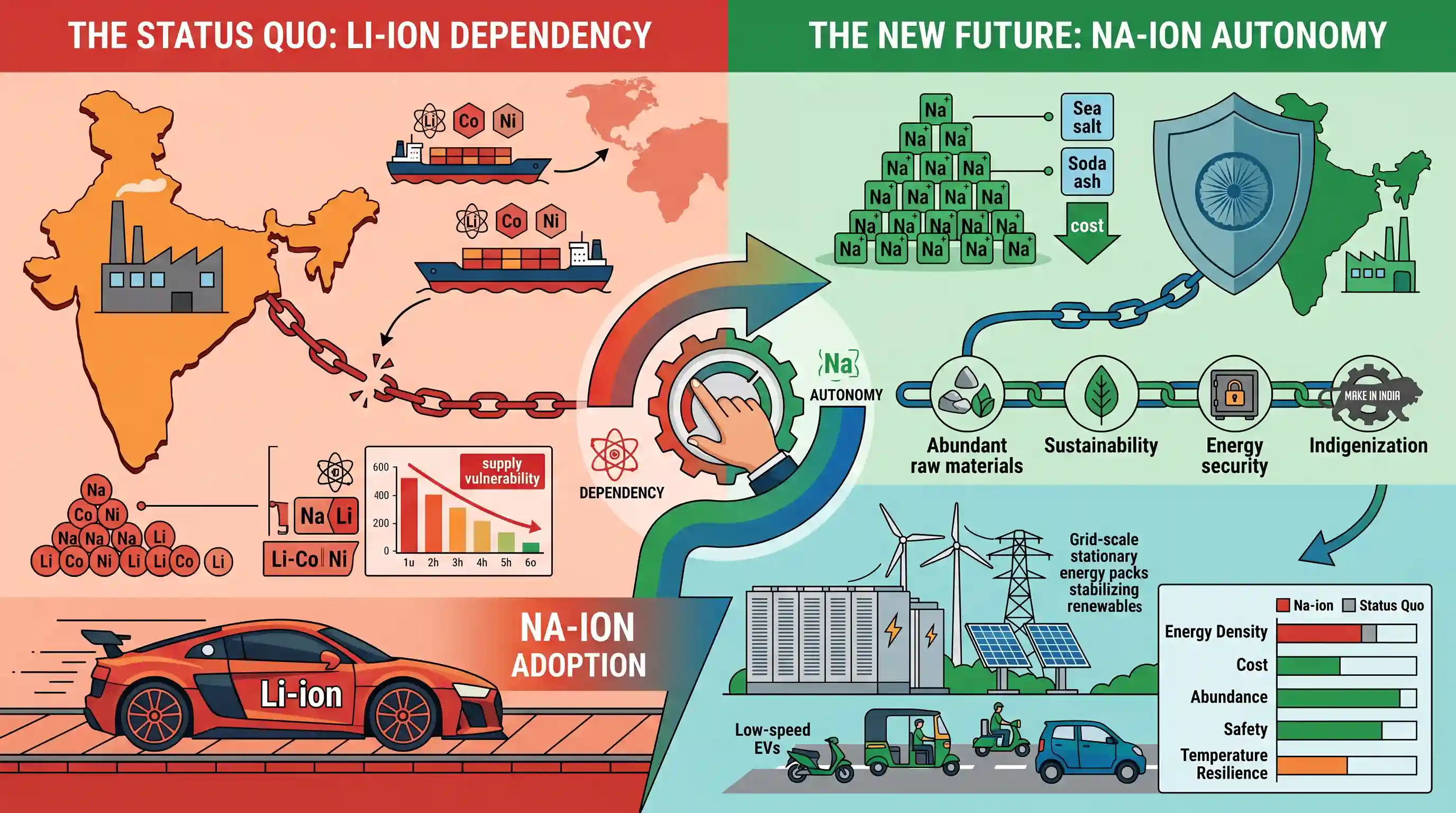
The article advocates for a strategic shift in India's energy storage policy from a heavy reliance on lithium-ion batteries to embracing sodium-ion technology. Driven by the scarcity and geopolitical concentration of lithium, cobalt, and nickel reserves, India's current trajectory exposes it to significant supply chain vulnerabilities and import burdens. Sodium-ion batteries, utilizing highly abundant and cheaper sodium, offer a sustainable and secure alternative. While they present a trade-off in energy density, their advantages in safety, temperature resilience, and cost make them highly suitable for stationary energy storage and low-speed electric mobility. Investing in the sodium-ion ecosystem can accelerate India's green transition while ensuring energy security and strategic autonomy.
Key Points
- India's rapid transition towards electric mobility and renewable energy storage heavily relies on lithium-ion batteries, creating vulnerabilities due to high import dependence and concentrated global supply chains.
- Sodium-ion battery technology offers a strategic alternative as sodium is globally abundant, significantly cheaper, and bypasses the need for critical minerals like lithium, cobalt, and nickel.
- Although sodium-ion batteries generally have lower energy density compared to lithium-ion counterparts, they boast superior safety, better performance at extreme temperatures, and a longer lifecycle.
- Prioritizing sodium-ion technology is ideal for stationary grid storage and light electric vehicles (like two- and three-wheelers), helping India achieve self-reliance (Aatmanirbharta) in its clean energy transition.
Prelims Trap
Sodium-ion batteries are replacing Lithium-ion in long-range EVs because they offer higher energy density and lighter weight.
Sodium-ion batteries actually have LOWER energy density and are heavier than Lithium-ion. They are suited for stationary grid storage and low-speed mobility, not long-range EVs.
Static Concepts Connected
How do Sodium-ion batteries functionally differ from Lithium-ion batteries?
- Energy Density: Na-ion has lower specific energy, making the batteries heavier and bulkier for the exact same charge capacity compared to Li-ion.
- Safety & Temperature: Na-ion exhibits superior thermal stability, significantly lower thermal runaway (fire) risk, and better operational performance in extreme cold and heat.
- Raw Materials: Na-ion relies on highly abundant sodium, completely eliminating the need for geopolitically concentrated and expensive metals like Lithium, Cobalt, and Nickel.
Where are the world's major reserves of critical battery minerals located?
- Lithium: Dominated by the "Lithium Triangle" in South America (Chile, Argentina, Bolivia) and Australia.
- Cobalt: Highly concentrated geopolitically, with the Democratic Republic of Congo (DRC) holding the vast majority of global reserves and production.
- Nickel: Major global reserves and rapidly expanding processing capabilities are located in Indonesia, alongside Australia and Russia.
Cross-Topic Patterns
Minerals Security Partnership (MSP) hedging
While India leverages the US-led MSP to secure global Li/Co supply chains, domestic indigenization via Na-ion technology acts as a strategic hedge against China's absolute monopoly in battery mineral processing.
Renewable intermittency and Grid Storage (BESS)
Meeting India's 500GW non-fossil target requires massive Battery Energy Storage Systems (BESS) to manage solar/wind intermittency. Na-ion's low cost and safety make it perfect for this stationary storage.

Expect a multi-statement Prelims question comparing Na-ion and Li-ion on energy density, thermal runaway risk, and grid vs EV use-cases.
Linked PYQs · 4
Linked PYQs · 4
- 2025PrelimsGS1
In the context of electric vehicle batteries, consider the following elements : I. Cobalt II. Graphite III. Lithium IV. Nickel How many of the above usually make up battery cathodes?
- 2025PrelimsGS1
Consider the following statements : I. India has joined the Minerals Security Partnership as a member. II. India is a resource-rich country in all the 30 critical minerals that it has identified. III. The Parliament in 2023 has amended the Mines and Minerals (Development and Regulation) Act, 1957 empowering the Central Government to exclusively auction mining lease and composite license for certain critical minerals. Which of the statements given above are correct?
- 2023MainsGS3
The adoption of electric vehicles is rapidly growing worldwide. How do electric vehicles contribute to reducing carbon emissions and what are the key benefits they offer compared to traditional combustion engine vehicles?
- 2025PrelimsGS1
Consider the following types of vehicles : I. Full battery electric vehicles II. Hydrogen fuel cell vehicles III. Fuel cell-electric hybrid vehicles How many of the above are considered as alternative powertrain vehicles?
