India US Bilateral Trade Agreement Protectionism and WTO Tariffs
Source:Indian Express ↗
Why It Matters
Provides a critical analysis of how unbalanced bilateral trade agreements can undermine domestic economic stability. It links international relations directly with domestic concerns like the trade deficit, currency depreciation, and the survival of the agricultural sector (MSP), which are high-yield areas for UPSC Mains GS2 and GS3.
Summary
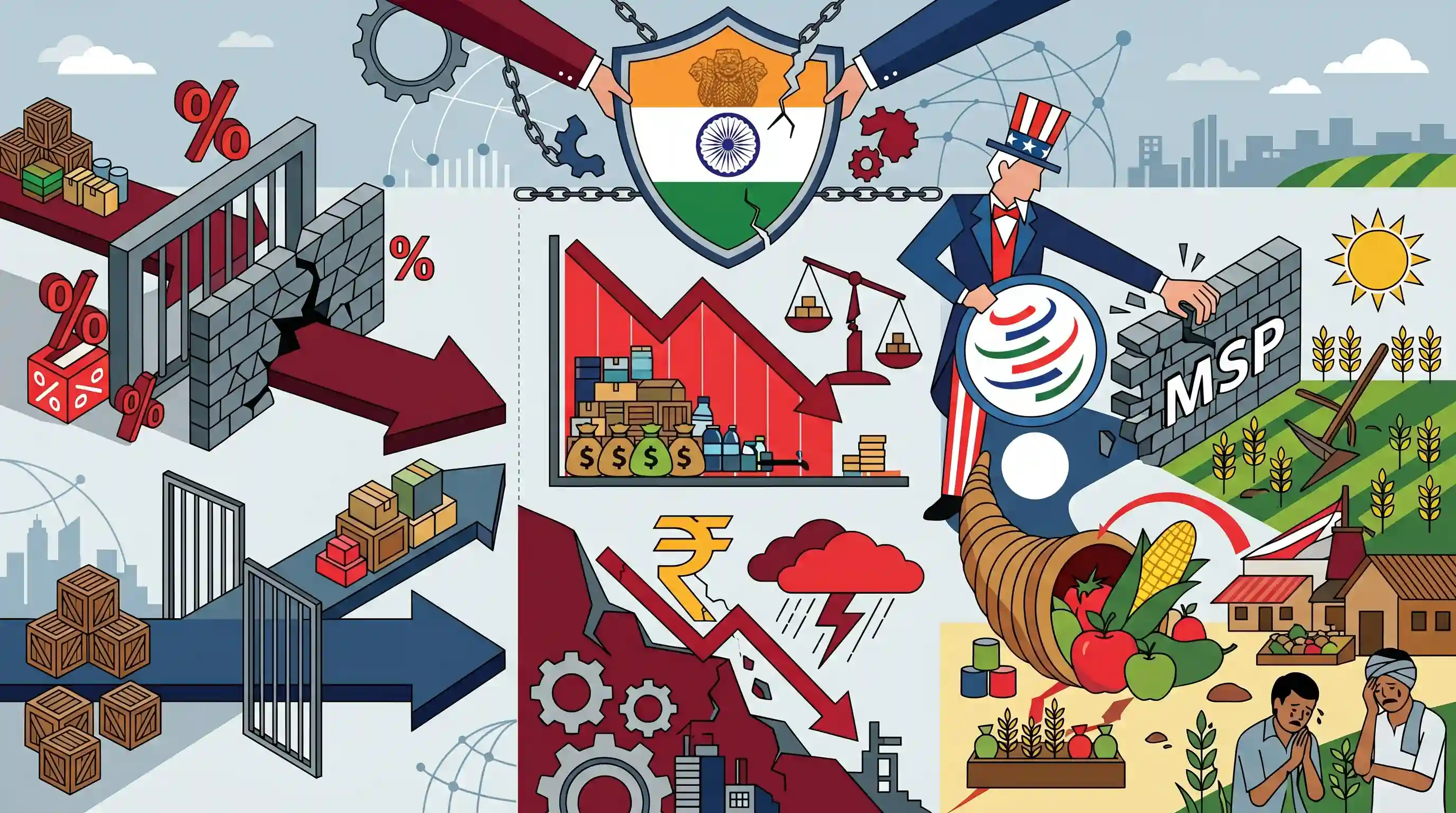
The article critically examines the proposed India-US Interim Trade Agreement, highlighting severe economic and strategic risks for India. Under the deal, India is expected to eliminate tariffs on most US exports while facing an 18% reciprocal tariff on its own goods. The author warns that yielding to US pressure—such as committing to $500 billion in US imports over five years—could severely widen India's trade deficit and precipitate a rupee depreciation crisis. Furthermore, US demands to dismantle India's Minimum Support Price (MSP) regime at the WTO and force imports of American agricultural products pose a direct threat to Indian farmers. The piece concludes that accepting these protectionist and unequal terms would severely compromise India's strategic autonomy.
Key Points
- India and the US are reportedly negotiating an Interim Trade Agreement, which entails India dropping tariffs on a majority of US exports in exchange for an 18% reciprocal tariff on Indian goods in the US.
- The deal may involve an informal commitment by India to import $500 billion worth of US goods and services over five years, potentially exacerbating India's trade deficit and triggering a rupee depreciation crisis.
- US demands at the WTO to alter India's Minimum Support Price (MSP) regime, alongside pressure to import American dairy, meat, and poultry, threaten domestic agricultural livelihoods.
- The legality of the US reciprocal tariff framework is questionable following recent US Supreme Court rulings, and the US has already proposed additional 12.5% punitive tariffs on India under Section 301.
- Tethering India's economic policies to US political and commercial interests through such a deal risks severely restricting India's strategic and economic autonomy.
Important Terms
India-US Interim Trade Agreement

An 'early harvest' pact (Feb 2026) aimed at de-escalating trade tensions by realigning tariffs—lowering US reciprocal duties to 18% in exchange for India's market access in agriculture and energy.
UPSC context
GS-II (Bilateral Relations). Tests understanding of economic diplomacy and the trade-offs between market access and domestic sector protection.
Minimum Support Price (MSP)
India's market intervention mechanism ensuring guaranteed prices for farmers; currently a flashpoint at the WTO where the US and others challenge its 'trade-distorting' nature as excessive subsidies.
UPSC context
GS-III (Agriculture). Tests knowledge of food security, the 'Peace Clause,' and the conflict between domestic welfare and WTO rules.
Section 301 (US Trade Act)
A US law allowing unilateral trade sanctions against countries with 'unfair' practices; 2026 probes target India's policies on forced labor and overcapacity to pressure for trade concessions.
UPSC context
GS-III (External Sector). Tests awareness of protectionist tools and their impact on India’s export competitiveness and digital trade policy.
World Trade Organization (WTO)
The global trade arbiter; currently facing a crisis due to US-India clashes over the e-commerce moratorium, Most Favoured Nation (MFN) principles, and the paralyzed Appellate Body.
UPSC context
GS-II (International Orgs). Tests understanding of multilateralism vs. unilateralism and the shift toward fragmented global trade rules.
Strategic Autonomy
The ability of a state to pursue independent foreign and economic policies; challenged by US trade demands regarding energy (Russia) and domestic agricultural support.
UPSC context
GS-II (Foreign Policy). A core tenet of Indian diplomacy; tests the impact of transactional trade deals on sovereign decision-making.
US Supreme Court
In Feb 2026, it invalidated the legal basis for 'reciprocal tariffs,' forcing India and the US to renegotiate the trade deal's specific tariff architecture.
UPSC context
GS-II (Global Legal Issues). Tests awareness of how partner nations' domestic legal systems can influence bilateral executive agreements.
Prelims Trap
Section 301 tariffs are a WTO-authorized retaliatory measure against unfair trade practices.
Section 301 is a unilateral US domestic law (Trade Act of 1974). Imposing tariffs through it bypasses the WTO dispute settlement body and violates multilateral rules.
Static Concepts Connected
How are agricultural subsidies classified under the WTO Agreement on Agriculture?
- Amber Box: Trade-distorting price support subsidies like India's MSP. They are subject to a 10% de minimis limit of the total value of agricultural production for developing nations.
- Green Box: Non-trade-distorting support such as R&D, infrastructure, and direct income transfers (e.g., PM-KISAN). These face no financial reduction limits.
- Blue Box: Amber box subsidies combined with conditions designed to limit production volume. Currently, these also face no financial limits.
How do massive import surges impact domestic macroeconomic stability?
- Widening CAD: Forced massive import commitments structurally imbalance trade equations, sharply widening the Current Account Deficit (CAD).
- Rupee Depreciation: Increased demand for US Dollars to pay for imports floods the forex market with Rupees, causing the domestic currency to depreciate.
- Imported Inflation: A weaker Rupee makes inelastic, essential imports like crude oil, edible oils, and fertilizers disproportionately expensive, stoking domestic inflation.
Cross-Topic Patterns
Protectionism vs. WTO Obligations
The US leveraging domestic tools like Section 301 for unilateral reciprocal tariffs directly undermines the WTO's multilateral dispute framework and the foundational Most-Favored-Nation (MFN) principle.
RCEP Exit & Strategic Autonomy
India's reluctance to yield to asymmetrical US trade demands mirrors its 2019 exit from RCEP, highlighting a consistent foreign policy of shielding domestic farmers and manufacturing from structural dependencies.

Section 301 unilateral tariffs vs WTO MFN obligations will likely appear as a multi-statement conceptual Prelims question in 2026.
Linked PYQs · 5
Linked PYQs · 5
- 2012MainsGS2
Discuss the likely negative impact of the protectionist measures proposed by the US on India's software industry.
- 2023MainsGS3
What are the direct and indirect subsidies provided to farm sector in India? Discuss the issues raised by the World Trade Organization (WTO) in relation to agricultural subsidies.
- 2021PrelimsGS1
Consider the following statements : The effect of devaluation of a currency is that it necessarily 1. improves the competitiveness of the domestic exports in the foreign markets 2. increases the foreign value of domestic currency 3. improves the trade balance Which of the above statements is/are correct?
- 2022PrelimsGS1
With reference to the Indian economy, consider the following statements: 1. If the inflation is too high, Reserve Bank of India (RBI) is likely to buy government securities. 2. If the rupee is rapidly depreciating, RBI is likely to sell dollars in the market. 3. If interest rates in the USA or European Union were to fall, that is likely to induce RBI to buy dollars. Which of the statements given above are correct?
- 2018MainsGS3
What do you mean by Minimum Support Price (MSP)? How will MSP rescue the farmers from the low income trap?
