Artificial intelligence integration in educational pedagogy and ethics
Source:The Hindu ↗
Why It Matters
AI integration in education is a dual-use topic spanning GS2 (Social Justice/Education) and GS3 (Science & Tech). For UPSC aspirants, understanding both the transformative potential and the ethical/cognitive pitfalls of EdTech is essential for writing balanced answers on the National Education Policy and digital learning initiatives.
Summary
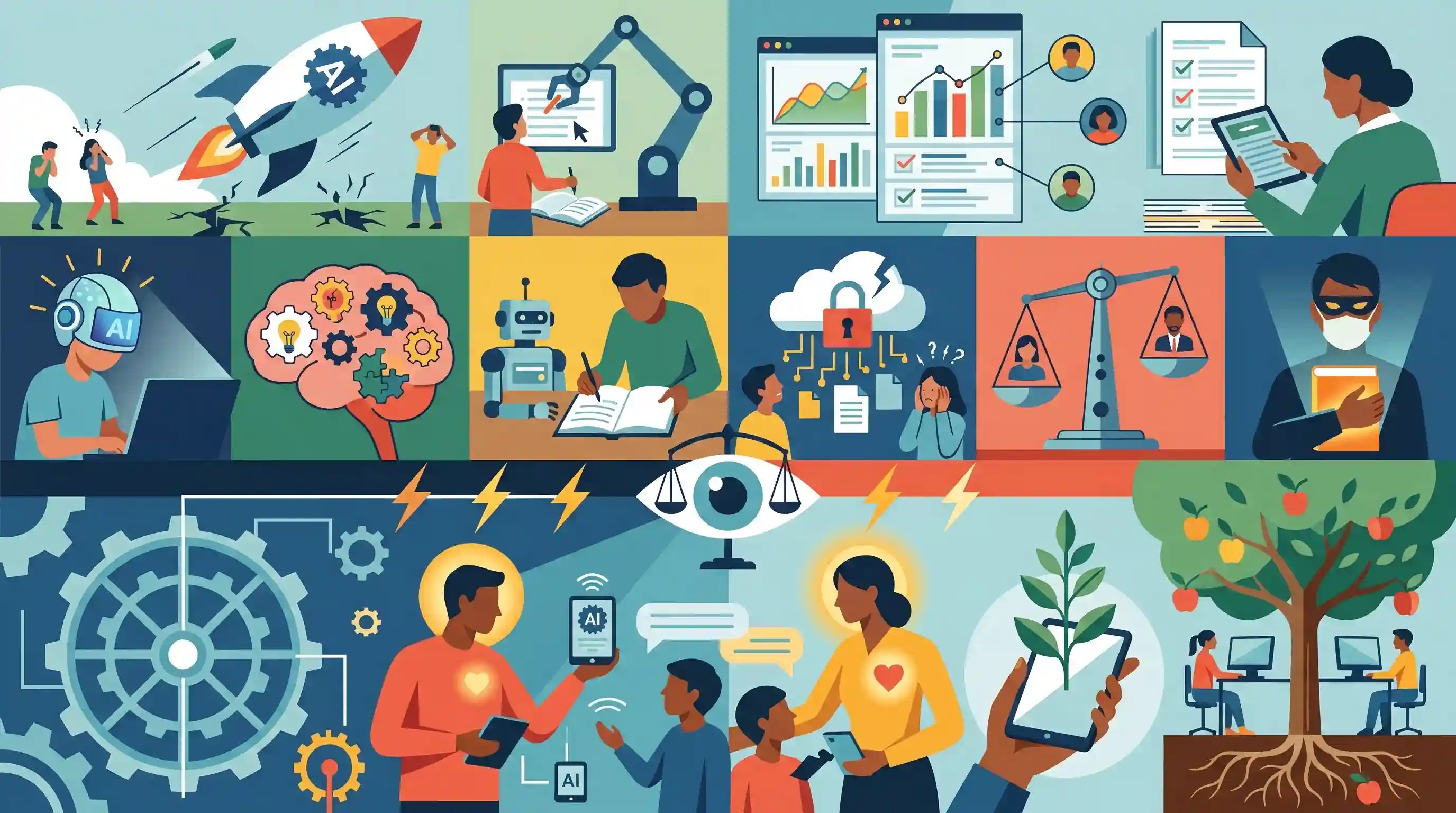
The article critically examines the rapid integration of Artificial Intelligence (AI) in the education sector, advocating for a thoughtful and balanced approach. It warns against the uncritical adoption of AI tools, highlighting that over-reliance could diminish students' critical thinking, creativity, and problem-solving abilities. Key ethical concerns are raised, including threats to academic integrity, risks to student data privacy, and inherent algorithmic biases in educational technology. The author emphasizes that while AI can personalize learning and streamline administrative tasks, it cannot substitute the empathy, emotional intelligence, and mentorship provided by human teachers. Ultimately, the piece calls for robust regulatory frameworks and pedagogical alignment to ensure AI serves as an equitable supplement that enhances, rather than undermines, the educational experience.
Key Points
- Evaluates the integration of Artificial Intelligence (AI) in education, advocating for a cautious, pedagogically aligned approach rather than uncritical technological adoption.
- Highlights the risks of 'cognitive offloading' where over-reliance on AI tools may erode students' critical thinking, creativity, and independent problem-solving skills.
- Raises significant ethical concerns surrounding academic integrity, student data privacy, and the potential for algorithmic biases in automated grading and learning systems.
- Emphasizes that AI must augment rather than replace human educators, underscoring the irreplaceable value of emotional intelligence, empathy, and mentorship in the teacher-student dynamic.
- Underlines the necessity of bridging the digital divide and creating robust regulatory frameworks so that AI integration does not exacerbate existing educational inequalities.
Important Terms
National Education Policy (NEP) 2020

A framework transforming India's education system, emphasizing technology-driven pedagogy, AI literacy from middle school, and the creation of a National Educational Technology Forum (NETF) for digital reform.
UPSC context
GS Paper 2 (Education/Social Justice). Tests understanding of government policy reforms and technology-enabled learning ecosystems.
AI Ethics
The study of moral principles ensuring AI systems are fair, transparent, and accountable. In education, it focuses on preventing over-reliance, protecting student data, and maintaining the human teacher-student bond.
UPSC context
GS Paper 4 (Ethics). Tests ability to apply ethical frameworks to emerging technologies and digital governance.
Algorithmic Bias
Systematic errors in AI outputs occurring when training data reflects historical prejudices (race, gender, or class), leading to unfair predictions or discriminatory outcomes in student assessment and admissions.
UPSC context
GS Paper 3 (Science & Technology) and Paper 4 (Ethics). Evaluates understanding of socio-technical challenges in technology.
Digital Divide
The gap between populations with access to digital tools/internet and those without. It remains a major hurdle for equitable AI integration, especially across India's urban-rural divide.
UPSC context
GS Paper 2 (Social Justice). Relevant for discussing inclusivity in social sector services and digital public infrastructure.
Academic Integrity
The moral code of academia involving honesty and original work. Generative AI threatens this through "cognitive offloading" and automated plagiarism, necessitating new frameworks for evaluating student merit.
UPSC context
GS Paper 4 (Ethics/Education). Relates to character building and ethical challenges posed by technology in schools.
Personalized Learning
An educational approach using AI to tailor lessons, pacing, and feedback to individual student needs, aiming to move away from traditional "one-size-fits-all" teaching methods.
UPSC context
GS Paper 2 (Human Resource Development). Tests knowledge of technological interventions to improve learning quality and equity.
Prelims Trap
AI-driven educational platforms eliminate inherent social biases through objective, automated grading and assessment.
AI models often amplify existing societal biases (like caste or gender) if they are trained on non-diverse historical datasets. They are not inherently objective.
Static Concepts Connected
What are the key provisions for technology integration under NEP 2020?
- NETF Creation: Establishes the National Educational Technology Forum to provide independent advice on the deployment of tech in education.
- Blended Learning: Promotes a mix of traditional and digital learning, firmly ensuring that human teachers remain central to the educational ecosystem.
- Divyang Accessibility: Mandates the development of inclusive, AI-powered software and digital tools tailored for students with disabilities.
What is 'algorithmic bias' in the context of Artificial Intelligence?
- Definition: Systematic and repeatable errors in an AI system that create unfair outcomes, such as privileging one demographic over another.
- Root Causes: Primarily stems from unrepresentative training data, historical societal inequalities, or the unconscious prejudices of developers.
- Impact in Education: Can lead to discriminatory automated grading or flawed learning paths that marginalize socio-economically disadvantaged students.
Cross-Topic Patterns
EdTech infrastructure and the digital divide
AI-heavy educational platforms require high bandwidth and smart devices, linking GS3 AI ethics directly to GS2 infrastructural schemes like BharatNet and the socio-economic digital divide.
AI's impact on human capital and skilling
'Cognitive offloading' impairs critical thinking and problem-solving. This connects GS3 technology adoption to GS2 human resource development and the quality of India's demographic dividend.

Mains GS2/GS4 will likely ask to evaluate AI in education, balancing personalized learning against 'cognitive offloading' risks.
Linked PYQs · 3
Linked PYQs · 3
- 2024MainsGS4
The application of Artificial Intelligence as a dependable source of input for administrative rational decision-making is a debatable issue. Critically examine the statement from the ethical point of view.
- 2023MainsGS3
Introduce the concept of Artificial Intelligence (AI). How does Al help clinical diagnosis? Do you perceive any threat to privacy of the individual in the use of Al in healthcare?
- 2025MainsGS2
e-governance projects have a built-in bias towards technology and back-end integration than user-centric designs. Examine.
