Critique of Greenwashing and Symbolic Environmental Actions
Source:The Hindu ↗
Why It Matters
Evaluates the shift from symbolic environmental gestures to substantive ecological policies. This is a critical analytical theme for Mains questions concerning greenwashing, the ecological impact of afforestation policies, and corporate environmental responsibility.
Summary
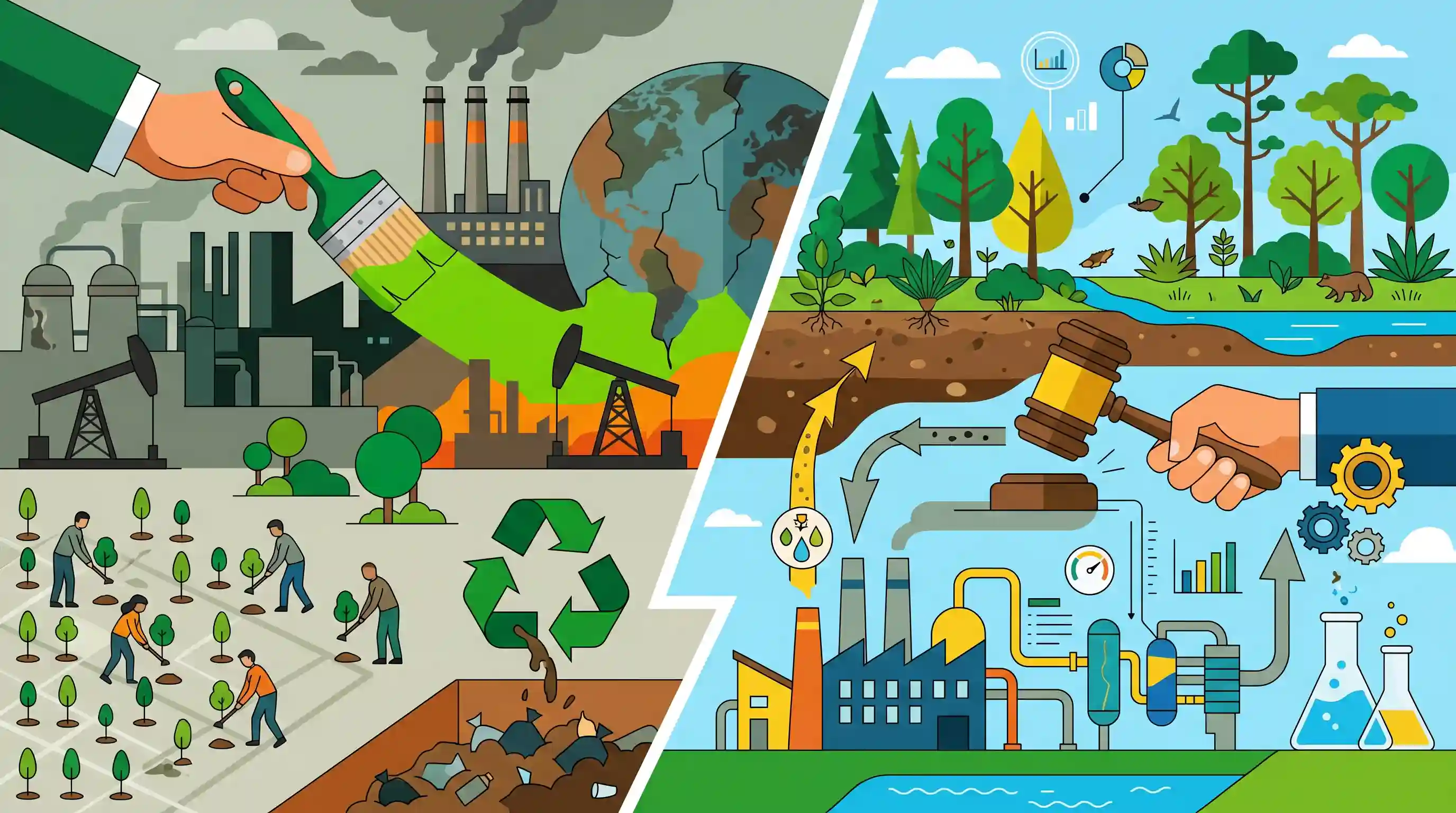
The article critiques the global over-reliance on simplistic symbols of environmental responsibility—such as mass tree-planting drives and generic recycling campaigns—arguing that they frequently serve as "greenwashing" tools rather than effective climate solutions. While these symbols are useful for raising public awareness, they often mask the lack of systemic changes in industrial production and fossil fuel consumption. The author calls for rethinking these symbols, advocating instead for measurable, science-backed interventions like restoring native ecosystems (rather than monoculture plantations) and strictly enforcing extended producer responsibility (EPR) to hold polluters accountable.
Key Points
- Simplistic environmental actions (e.g., token tree planting, recycling labels) often create a false sense of accomplishment while distracting from core structural issues like fossil fuel emissions.
- Mass afforestation is widely used as a symbol of green action, but poorly planned drives (such as monoculture plantations or planting in grasslands) can harm local biodiversity and deplete groundwater.
- Corporations frequently exploit environmental symbols (such as recycling logos or nominal carbon offsets) as greenwashing tools to project a sustainable image without adopting true circular economy practices.
- Effective environmental responsibility requires a shift from symbolic gestures to systemic solutions, including stringent Extended Producer Responsibility (EPR) norms and science-backed ecological restoration.
Important Terms
Mission LiFE (Lifestyle for Environment)

An India-led global mass movement introduced at COP26 to nudge individuals and communities toward mindful consumption and sustainable lifestyles, aiming to replace 'use-and-dispose' habits with a circular economy.
UPSC context
GS Paper 3 (Environment); tests India’s global climate leadership and strategies for individual-level mitigation and behavioral change.
Extended Producer Responsibility (EPR)
A policy approach holding producers financially and physically responsible for the entire lifecycle of their products, particularly the collection and recycling of post-consumer waste.
UPSC context
GS Paper 3 (Pollution and Degradation); evaluates understanding of 'polluter pays' principle and corporate accountability in waste management.
Kyoto Protocol
A 1997 UNFCCC treaty that committed developed nations to legally binding emission reduction targets, based on the principle of 'Common But Differentiated Responsibilities' (CBDR).
UPSC context
GS Paper 3 (Climate Change); focuses on international environmental agreements and the historical evolution of global climate policy.
Greenwashing
A deceptive practice where organizations make misleading or exaggerated environmental claims to appear eco-friendly, often masking continued unsustainable industrial practices or fossil fuel consumption.
UPSC context
GS Paper 3 (Environmental Impact Assessment); tests critical evaluation of corporate sustainability claims and the effectiveness of mitigation strategies.
Monoculture Plantations
The cultivation of a single tree species over a large area. While popular for rapid afforestation, it lacks the biodiversity and carbon sequestration efficiency of diverse native ecosystems.
UPSC context
GS Paper 3 (Conservation); assesses knowledge of ecological restoration principles versus simplified afforestation strategies.
Prelims Trap
Mass afforestation universally improves local groundwater tables and enhances native biodiversity across all terrestrial ecosystems.
Planting trees in native grasslands (often misclassified as 'degraded') or using monocultures (like Eucalyptus) destroys habitats, creates "green deserts," and actively depletes groundwater.
Static Concepts Connected
What is Extended Producer Responsibility (EPR) under India's waste management framework?
- Core Principle: A policy approach making producers, importers, and brand owners (PIBOs) financially and physically responsible for the post-consumer disposal of their products.
- Applicability: It covers plastic packaging, e-waste, battery waste, and waste tires under specific MoEFCC rules.
- Market Mechanism: EPR operates on a market mechanism where targets can be met by purchasing tradable EPR certificates from registered recyclers.
How do monoculture plantations impact ecological stability compared to natural forests?
- Water Depletion: Fast-growing commercial species like Eucalyptus and Pine have high transpiration rates, which can severely deplete local groundwater aquifers.
- Biodiversity Loss: Uniform tree canopies create "green deserts" offering minimal ecological niches, drastically reducing native flora and fauna populations.
- Soil Degradation: The lack of diverse, decomposable leaf litter alters soil chemistry, reducing nutrient cycling and microbial diversity.
Cross-Topic Patterns
Greenwashing and Consumer Rights
The Central Consumer Protection Authority (CCPA) recently issued guidelines to curb greenwashing, linking environmental claims directly to GS2 consumer protection, misleading advertisements, and corporate governance.
Compensatory Afforestation vs. Forest Rights
State-led monoculture plantation drives (often using CAMPA funds) frequently conflict with local tribal land rights under the Forest Rights Act (FRA, 2006) and disrupt traditional agro-forestry dependencies.

Expect a 2026 Prelims question mixing EPR compliance certificates with carbon market trading to test the nuances of greenwashing.
Linked PYQs · 4
Linked PYQs · 4
- 2021PrelimsGS1
'R2 Code of Practices' constitutes a tool available for promoting the adoption of
- 2022MainsGS3
Discuss global warming and mention its effects on the global climate. Explain the control measures to bring down the level of greenhouse gases which cause global warming, in the light of the Kyoto Protocol, 1997.
- 2019MainsGS3
Define the concept of carrying capacity of an ecosystem as relevant to an environment. Explain how understanding this concept is vital while planning for sustainable development of a region.
- 2025MainsGS3
What is Carbon Capture, Utilization and Storage (CCUS)? What is the potential role of CCUS in tackling climate change?
