Retail Inflation Trends and Monetary Policy Adjustments
Source:Indian Express ↗
Why It Matters
Inflation dynamics and the RBI's monetary policy responses are foundational concepts in the UPSC Economics syllabus. Understanding how CPI data influences the repo rate and impacts the broader economy (growth vs. inflation trade-off) is critical for both Prelims (conceptual clarity on MPC, CPI vs WPI) and Mains (evaluating RBI's effectiveness in inflation targeting).
Summary
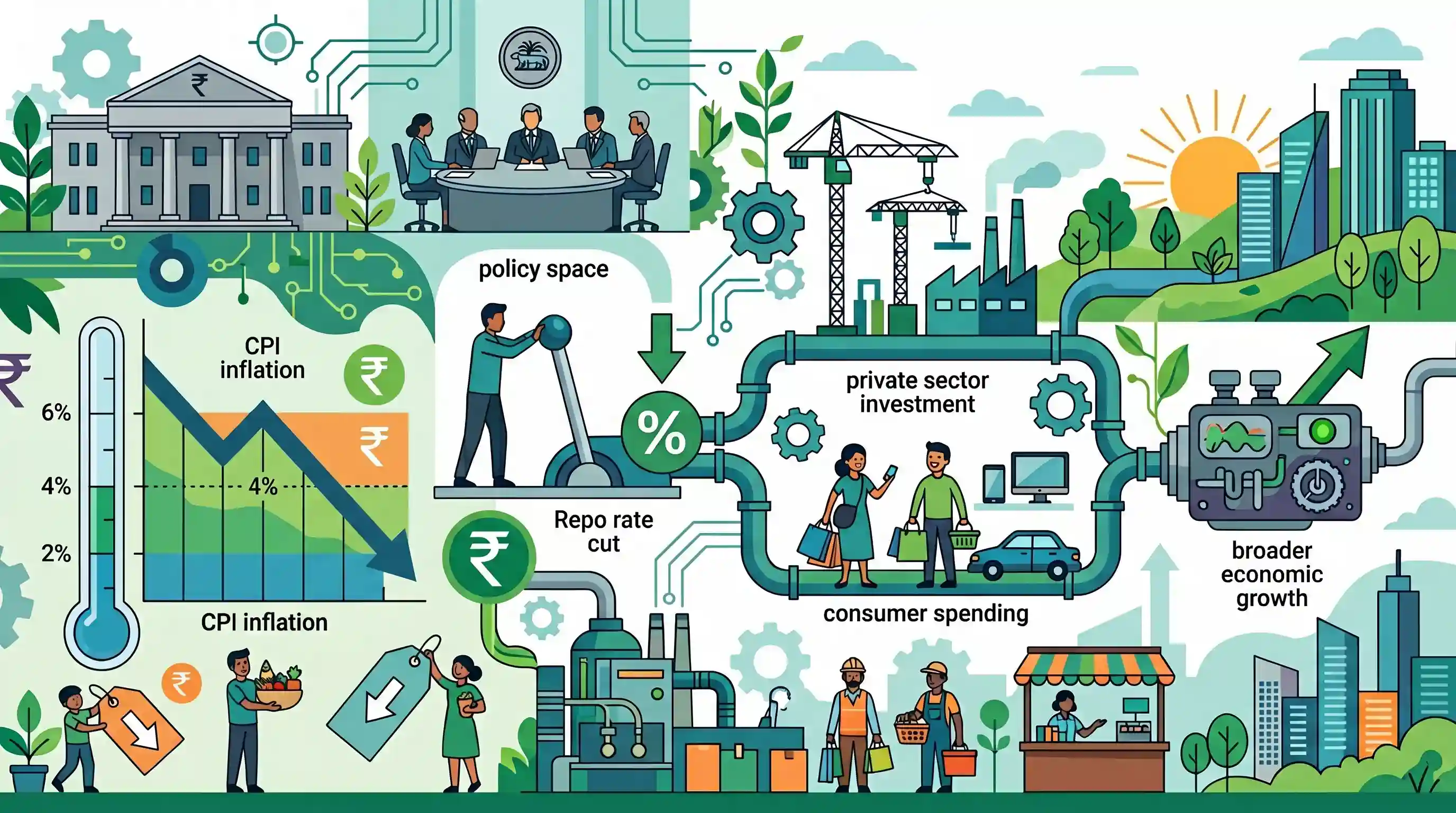
India's retail inflation, gauged by the Consumer Price Index (CPI), cooled to 2.1% in June. This significant deceleration places inflation near the bottom of the Reserve Bank of India's statutory tolerance band of 2% to 6% and well below the 4% median target. The easing of price pressures creates a favorable macroeconomic environment, giving the RBI's Monetary Policy Committee (MPC) the policy space needed to cut the repo rate. Such monetary easing would lower the cost of borrowing, which can help spur private sector investment, boost consumer spending, and drive broader economic growth without the immediate risk of overheating.
Key Points
- Retail inflation (measured by the Consumer Price Index or CPI) decelerated to 2.1% in June, bringing it very close to the lower limit of the RBI's 2-6% tolerance band.
- This moderation in inflation provides the Reserve Bank of India (RBI) significant leeway to consider reducing benchmark interest rates (repo rate) in upcoming monetary policy reviews.
- A potential rate cut would aim to lower borrowing costs, thereby stimulating credit growth, private investment, and overall economic expansion.
- The sustained easing of retail price pressures is a positive indicator for macroeconomic stability and reflects effectively managed supply-side dynamics.
Important Terms
Monetary Policy Committee (MPC)

A 6-member statutory body established under the RBI Act, 1934, responsible for determining the policy interest rate (repo rate) to achieve India's inflation target.
UPSC context
GS Paper III: Monetary policy and economic growth. Tests understanding of institutional decision-making for price stability.
Flexible Inflation Targeting (FIT) Framework
A monetary policy regime where the RBI aims to keep headline inflation (CPI) at 4% within a 2-6% tolerance band, balancing price stability with growth.
UPSC context
GS Paper III: Macroeconomic stability. Tests knowledge of the legal mandate and accountability mechanisms for inflation control.
Consumer Price Index (CPI)
A metric that tracks the change in retail prices of a basket of goods and services; it is the RBI’s primary tool for inflation targeting.
UPSC context
GS Paper III: Economic indicators. Key for comparing retail vs. wholesale inflation (WPI) and measuring cost of living.
Repo Rate
The interest rate at which the Reserve Bank of India lends short-term funds to commercial banks, used as a primary tool to regulate liquidity and inflation.
UPSC context
GS Paper III: Monetary policy tools. Tests how interest rate adjustments influence money supply, investment, and consumption.
National Statistical Office (NSO)
The nodal agency under the Ministry of Statistics and Programme Implementation (MoSPI) responsible for compiling and releasing official statistics like CPI and GDP.
UPSC context
GS Paper III: Economic planning and data. Tests awareness of the institutional framework for India's official economic statistics.
Prelims Trap
The RBI uses the Wholesale Price Index (WPI) to benchmark its flexible inflation targeting framework.
The Urjit Patel committee shifted the nominal anchor for monetary policy from WPI to CPI (Combined). The 4% (+/-2%) target applies exclusively to retail inflation.
Static Concepts Connected
What is the Flexible Inflation Targeting (FIT) framework?
- Target band: The RBI Act mandates a CPI target of 4%, with an upper tolerance of 6% and a lower tolerance of 2%.
- Failure criteria: FIT is considered breached if average inflation stays outside the 2-6% band for three consecutive quarters.
- Accountability: Upon failure, the RBI must submit a report to the Centre explaining the breach and remedial actions.
How do repo rate cuts theoretically impact the broader economy?
- Borrowing costs: Commercial banks get cheaper funds from the RBI, ideally passing on lower lending rates to retail consumers.
- Investment boost: Lower interest rates reduce the cost of capital, encouraging private companies to borrow and expand capacities.
- Currency impact: Rate cuts can lower domestic bond yields, potentially leading to foreign capital outflow and currency depreciation.
Cross-Topic Patterns
Low inflation + Bond Yields
Decelerating CPI and impending repo rate cuts generally lower government bond yields, heavily impacting G-Sec prices and debt mutual fund returns.
Real Interest Rate dynamics
As retail inflation drops to 2.1% without an immediate repo rate cut, India's real interest rate spikes, potentially stifling consumer demand if sustained.

Expect a 2026 Prelims multi-statement question interlinking CPI weightages (food vs core), repo rate cuts, and their impact on bond yields.
Linked PYQs · 3
Linked PYQs · 3
- 2020PrelimsGS1
Consider the following statements: 1. The weightage of food in Consumer Price Index (CPI) is higher than that in Wholesale Price Index (WPI). 2. The WPI does not capture changes in the prices of services, which CPI does. 3. Reserve Bank of India has now adopted WPI as its key measure of inflation and to decide on changing the key policy rates. Which of the statements given above is/are correct?
- 2022PrelimsGS1
In India, which one of the following is responsible for maintaining price stability by controlling inflation?
- 2024MainsGS3
What are the causes of persistent high food inflation in India? Comment on the effectiveness of the monetary policy of the RBI to control this type of inflation.
