September Retail Inflation Rises on Food Pressures
Source:The Hindu ↗
Why It Matters
Retail inflation crossing multi-month highs due to food pressures directly impacts household purchasing power and challenges the RBI's inflation-targeting framework, making it a core topic for GS3 Indian Economy questions.
Summary
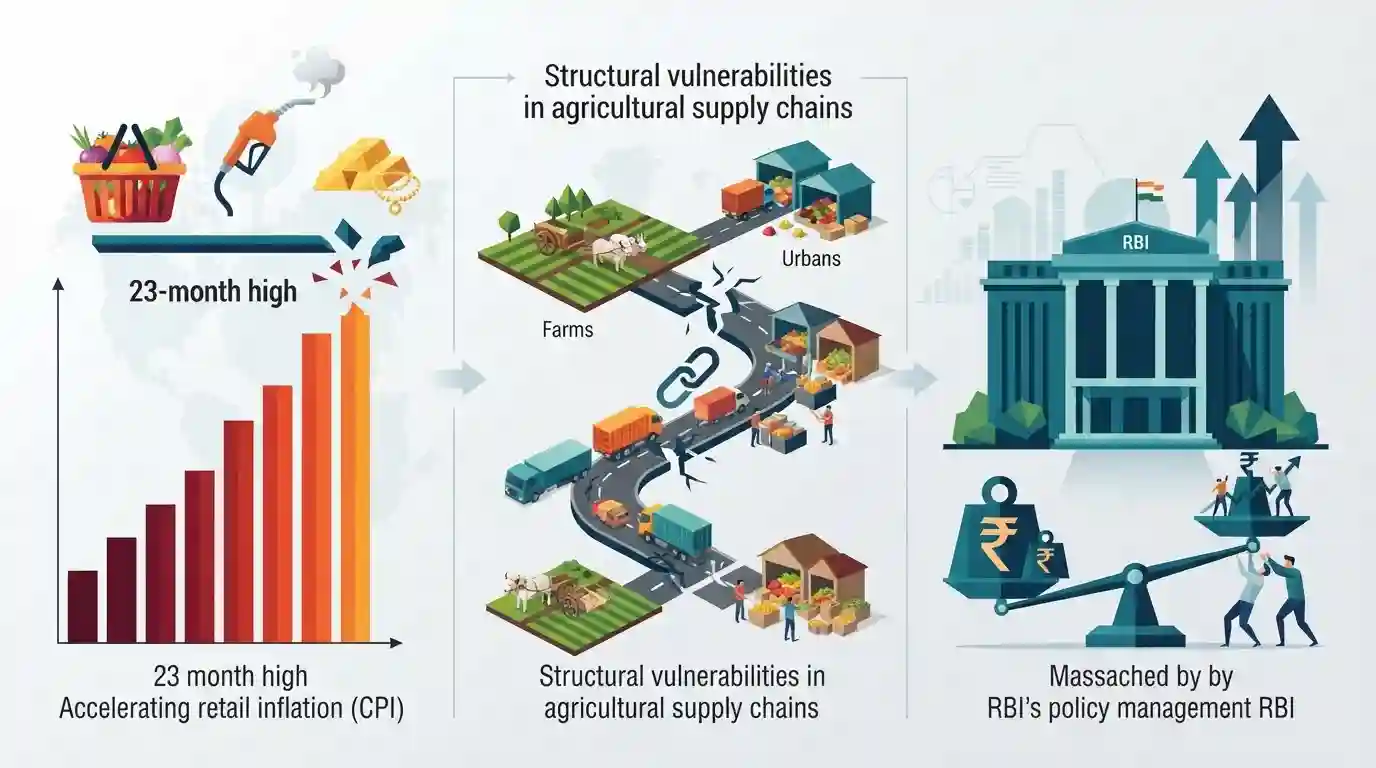
India's retail inflation, measured by the Consumer Price Index (CPI), accelerated to a 23-month high of 5.5% in September, driven primarily by rising prices of food items, fuel, and precious metals. This persistent food-led inflation highlights structural vulnerabilities in agricultural supply chains and poses challenges for the Reserve Bank of India's monetary policy management.
Key Points
- Retail inflation based on the Consumer Price Index (CPI) rose to a 23-month high of 5.5% in September.
- The surge was primarily driven by costlier food items, fuel, and precious metals.
- Food inflation witnessed a notable acceleration, underscoring the vulnerability of headline inflation to supply-side food shocks.
- High inflation pressures complicate the monetary policy choices of the RBI's Monetary Policy Committee regarding interest rate cuts.
Important Terms
Flexible Inflation Targeting Framework

A monetary policy framework where the central bank targets a specific inflation rate (4% with a ±2% tolerance band) using policy rates, balancing price stability with growth.
UPSC context
UPSC CSE GS Paper III (Indian Economy): crucial for understanding RBI's mandate, inflation management, and monetary policy tools.
Reserve Bank of India
The central banking institution of India that controls monetary policy, currency issuance, and banking regulation under the Reserve Bank of India Act, 1934.
UPSC context
UPSC CSE GS Paper III: core institution for Indian Economy, monetary policy, banking sector oversight, and financial stability.
National Statistical Office
An office under the Ministry of Statistics and Programme Implementation (MoSPI) responsible for collecting macroeconomic data and releasing consumer price index (CPI) inflation numbers.
UPSC context
UPSC CSE GS Paper III: tests knowledge of key statistical bodies, data indicators, and economic monitoring mechanisms in India.
Monetary Policy Committee
A statutory six-member body headed by the RBI Governor responsible for determining the benchmark policy repo rate to achieve the inflation target.
UPSC context
UPSC CSE GS Paper III (Indian Economy): tests institutional mechanisms of monetary policymaking and interest rate decisions.
Prelims Trap
Food items carry identical weightage in both the Consumer Price Index and the Wholesale Price Index.
Aspirants often confuse CPI (retail) and WPI (wholesale) weights; food has a much higher weight in CPI (~46%) than in WPI.
Static Concepts Connected
How is retail inflation measured in India and what is the statutory mandate of the MPC?
- Published By:: Published monthly by the National Statistical Office (NSO) under the Ministry of Statistics and Programme Implementation.
- MPC Mandate:: Statutorily mandated to maintain CPI inflation at 4% with a band of +/- 2% under the RBI Act, 1934.
- Basket Weight:: Food and beverages carry the highest weight (~45.86%) in the combined CPI basket.
Cross-Topic Patterns
Food Inflation + Agricultural MSP Policy
Food-led inflation spikes directly increase rural distress and wage pressures, complicating MNREGS wage indexing and agricultural MSP policy trade-offs.
Retail Inflation + Monetary Policy Transmission
Persistent headline CPI above the 4% target forces the MPC to maintain higher real interest rates, impacting capital formation and credit growth.

CPI inflation components, MPC mandate under the RBI Act, and base-effect impacts are frequent match-the-following or statement traps.
Linked PYQs · 3
Linked PYQs · 3
- 2020PrelimsGS1
Consider the following statements: 1. The weightage of food in Consumer Price Index (CPI) is higher than that in Wholesale Price Index (WPI). 2. The WPI does not capture changes in the prices of services, which CPI does. 3. Reserve Bank of India has now adopted WPI as its key measure of inflation and to decide on changing the key policy rates. Which of the statements given above is/are correct?
- 2022PrelimsGS1
In India, which one of the following is responsible for maintaining price stability by controlling inflation?
- 2024MainsGS3
What are the causes of persistent high food inflation in India? Comment on the effectiveness of the monetary policy of the RBI to control this type of inflation.
