Retail Inflation Breaches Target Amid Supply Side Pressures
Source:The Hindu ↗
Why It Matters
This article provides real-time economic data showcasing how external geopolitical factors and domestic weather patterns can drive retail inflation past the RBI's 4.0% target. It is highly useful for answering questions on the structural limitations of monetary policy, the mechanics of the CPI-Combined index, and the impact of non-monetary shocks (like fuel prices and import duties) on macroeconomic stability in India.
Summary
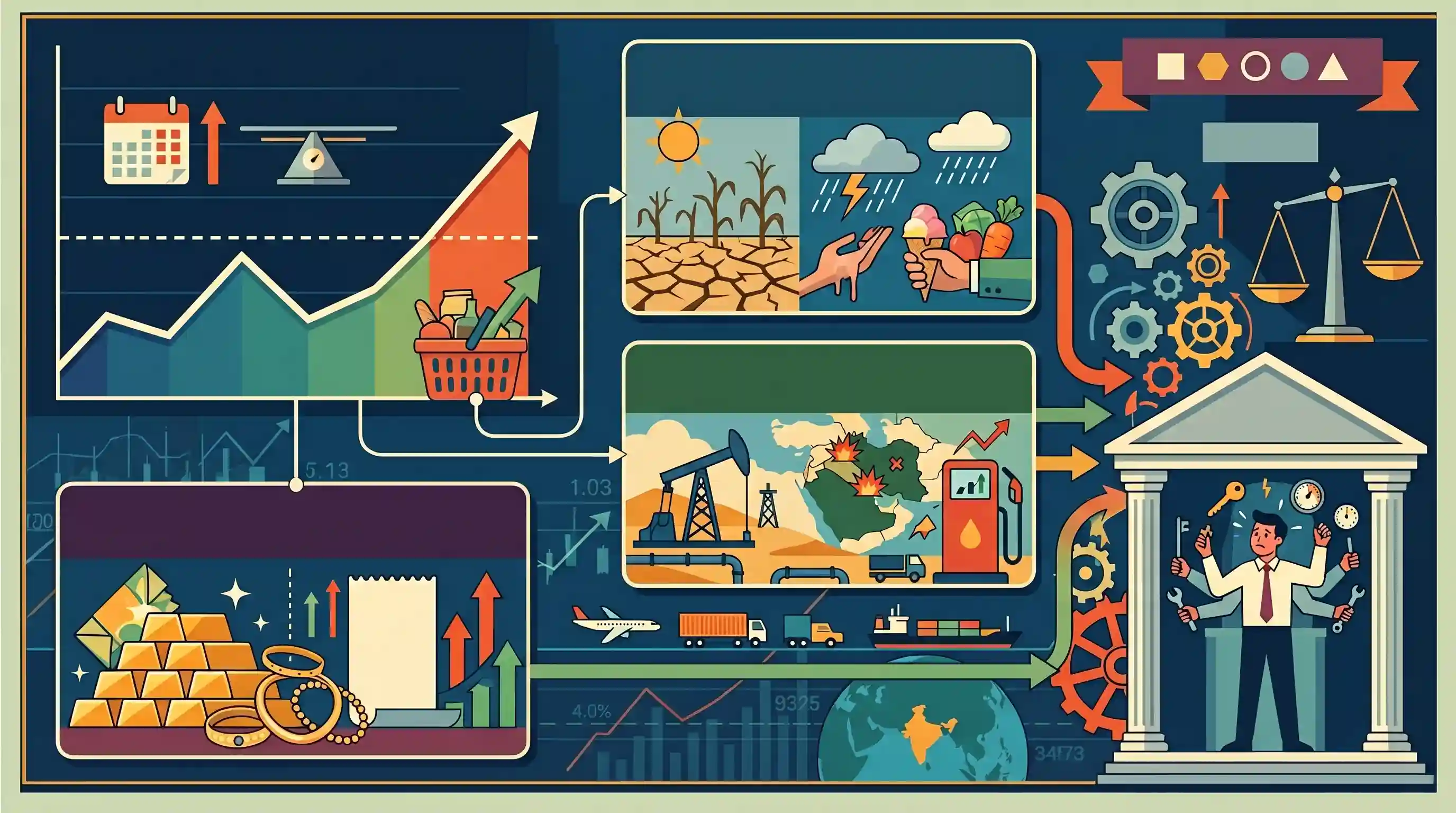
India's retail inflation, measured by the Consumer Price Index (CPI), surged to an 18-month high of 4.4% in June 2026. This is the first time since December 2024 that inflation has crossed the Reserve Bank of India's (RBI) medium-term target of 4.0%. The escalation was predominantly caused by supply-side disruptions, including a spike in food inflation to over 5% due to monsoonal irregularities, and a rise in transport/fuel segment inflation to 4.3% driven by geopolitical issues in West Asia and subsequent domestic price hikes. Additionally, high import duties and rising precious metal prices caused the miscellaneous consumer segment to spike by 16.7%. These supply-driven factors present complex challenges for the RBI's monetary management framework.
Key Points
- Retail inflation in India hit an 18-month high of 4.4% in June 2026, breaching the Reserve Bank of India’s (RBI) medium-term target of 4.0% for the first time since December 2024.
- The main drivers of the surge are rising food and fuel prices, alongside supply-side shocks and geopolitical tensions.
- Food inflation crossed 5% in June 2026, representing the highest food inflation level in the new series of the Consumer Price Index (CPI), triggered by a weaker-than-normal or uneven monsoon.
- Transport and fuel segment inflation rose sharply to 4.3% in June 2026 (from 1.7% in May) as oil marketing companies hiked prices due to geopolitical risks in West Asia.
- The 'personal care, social protection and miscellaneous goods & services' basket witnessed a major spike of 16.7% inflation, driven by soaring gold and silver prices combined with high import duties.
- Economists predict that food inflation may intensify further in July 2026, putting pressure on the RBI's monetary stance and challenging the central bank's price stability goals.
Important Terms
Consumer Price Index

A macroeconomic indicator measuring the average change over time in prices paid by ultimate consumers for a basket of retail goods and services.
UPSC context
GS Paper III: Indian Economy. Tests understanding of retail inflation, base-year revisions, and its role as the primary monetary policy anchor.
Reserve Bank of India
India's central bank and regulatory body responsible for regulating the banking system, controlling monetary policy, and maintaining price stability.
UPSC context
GS Paper III: Indian Economy. Tests knowledge of monetary management, central banking tools, and the Monetary Policy Committee's functioning.
Flexible Inflation Targeting
A monetary policy framework where the central bank adjusts policy rates to keep inflation within a target range while also supporting economic growth.
UPSC context
GS Paper III: Indian Economy. Tests institutional frameworks, statutory inflation targets (4%±2%), and the Urjit Patel Committee recommendations.
ICRA
A leading independent Indian credit rating agency that evaluates and rates the creditworthiness of corporate debt instruments and financial institutions.
UPSC context
GS Paper III: Indian Economy. Tests financial market regulators, credit risk assessments, and the role of rating agencies.
Wholesale Price Index
An economic index that tracks the average change in the prices of goods at the wholesale level, capturing producer-side inflation.
UPSC context
GS Paper III: Indian Economy. Tests comparisons between retail and wholesale inflation, commodity price cycles, and structural economic issues.
Prelims Trap
The RBI fails its statutory mandate if CPI inflation deviates from the 4% target for three consecutive quarters.
The failure condition triggers only when headline inflation falls outside the 2% to 6% tolerance band, not the 4% target itself.
Static Concepts Connected
What constitutes a statutory 'failure' of inflation targeting for the RBI?
- Legal mandate: Under Section 45ZA of the RBI Act, the central government, in consultation with the RBI, sets the inflation target every five years.
- Failure definition: Failure is defined as headline CPI inflation remaining outside the 2% to 6% tolerance band for three consecutive quarters.
- Required response: The RBI must send a written report to the government explaining failure reasons, corrective actions, and recovery timelines.
How did the CPI 2024 series structurally shift from the 2012 series?
- Food weight reduction: Food and Beverages weight dropped from 45.86% to 36.75% based on modern consumption data.
- Rural housing inclusion: Unlike the urban-only 2012 series, the 2024 series incorporates rural housing rentals for better national representation.
- Expanded basket: The commodity basket expanded from 299 to 358 items following the HCES 2023-24 findings.
Cross-Topic Patterns
Monsoons, food inflation, and MSP dilemma
Erratic monsoons spike food inflation, forcing the government to balance consumer price stability via export bans against producer interests like higher Minimum Support Prices.
Geopolitics and imported inflation
External conflicts disrupt global energy supply chains and drive gold import costs, feeding directly into domestic transport and miscellaneous CPI sub-indices, bypassing local monetary controls.

Questions on the structural revision of CPI (base 2024) and its impact on the efficacy of RBI's monetary policy are highly likely.
Linked PYQs · 3
Linked PYQs · 3
- 2020PrelimsGS1
Consider the following statements: 1. The weightage of food in Consumer Price Index (CPI) is higher than that in Wholesale Price Index (WPI). 2. The WPI does not capture changes in the prices of services, which CPI does. 3. Reserve Bank of India has now adopted WPI as its key measure of inflation and to decide on changing the key policy rates. Which of the statements given above is/are correct?
- 2022PrelimsGS1
In India, which one of the following is responsible for maintaining price stability by controlling inflation?
- 2024MainsGS3
What are the causes of persistent high food inflation in India? Comment on the effectiveness of the monetary policy of the RBI to control this type of inflation.
