Retail Inflation Decline and Macroeconomic Monetary Policy Trends
Source:The Hindu ↗
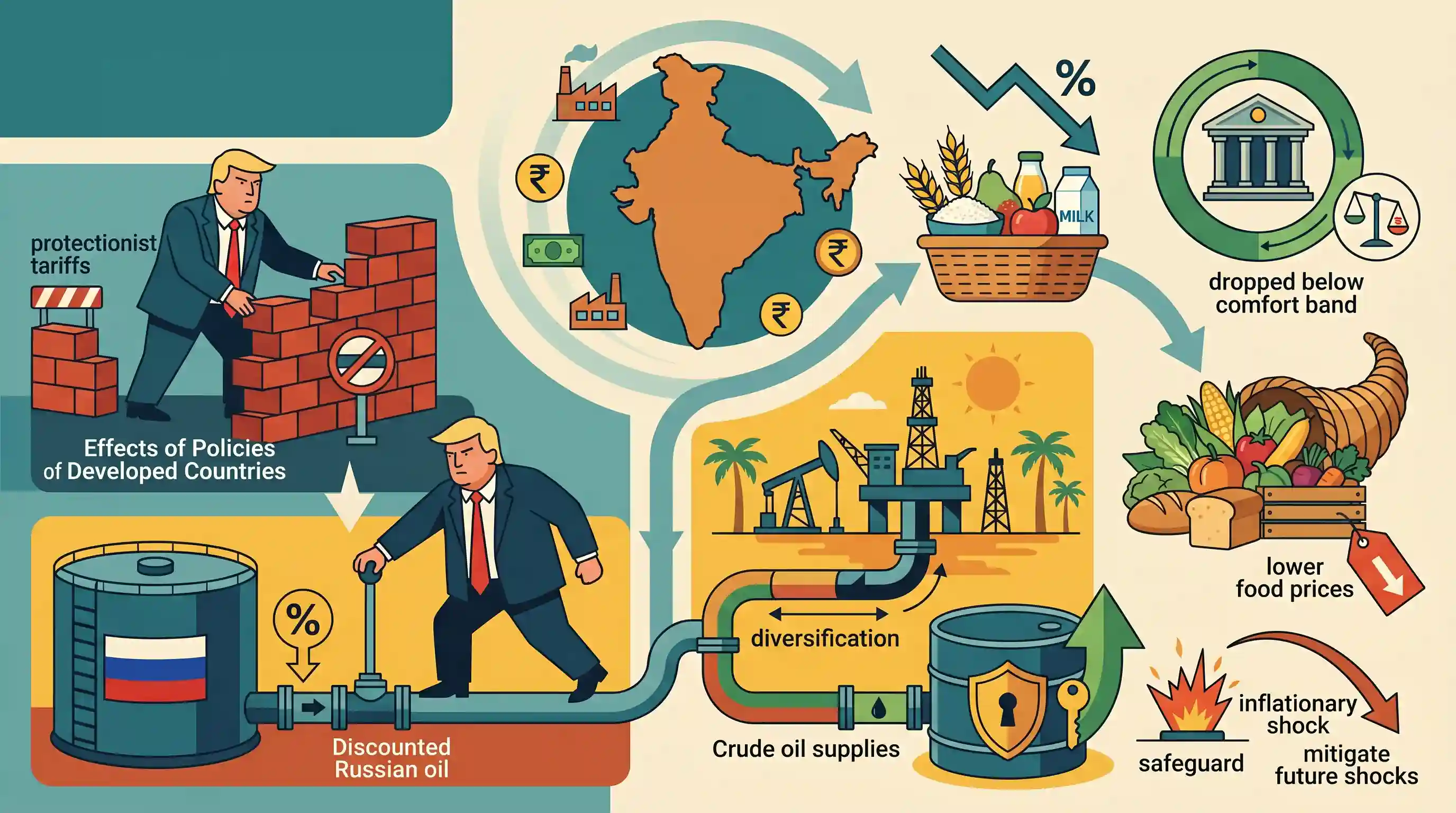
Why It Matters
Inflation is a core topic in the UPSC syllabus, closely tied to the RBI's monetary policy and overall macroeconomic stability. This article highlights the interplay between domestic factors (food prices, base effect) and international dynamics (geopolitics, oil imports, protectionism) that drive inflation, which is crucial for answering questions on economic policy, food security, and international relations.
Summary
India's retail inflation dropped to an eight-year low of 1.55% in July 2025, primarily due to falling food prices and a favorable base effect. This marks a significant dip below the Reserve Bank of India’s (RBI) comfort band of 2-6%. Food and beverage inflation contracted by 0.8%, while core inflation eased to 4.1%. Despite this domestic respite, India faces external macroeconomic risks, including potential global protectionist tariffs and pressure from US President Donald Trump to halt discounted Russian oil purchases. In response, India is looking to diversify its energy imports by increasing crude oil supplies from Middle Eastern countries like Kuwait and Iraq to safeguard its energy security and mitigate future inflationary shocks.
Key Points
- Retail inflation in India fell to an 8-year low of 1.55% in July 2025, dipping below the RBI's 2-6% tolerance band.
- The decline was largely driven by a 0.8% contraction in food and beverage prices and a strong base effect.
- Core inflation (excluding food and energy) moderated slightly to 4.1%.
- Global headwinds persist, including protectionist tariffs and US pressure on India to stop buying discounted Russian oil.
- To ensure energy security and manage import costs, India is exploring diversifying its crude oil supplies by increasing imports from Kuwait and Iraq.
Important Terms
Inflation Targeting Framework

A monetary policy regime where the central bank targets a specific inflation rate (4% ± 2% in India) to ensure price stability while supporting growth. It is legally mandated under the RBI Act, 1934.
UPSC context
GS-III Indian Economy. Tests understanding of RBI's statutory mandate for price stability and the 4% target.
Consumer Price Index (CPI)
An index measuring the weighted average prices of a basket of consumer goods and services. It is the primary tool used in India to measure retail inflation and is published monthly by MoSPI.
UPSC context
GS-III Indian Economy. Measures retail price changes; essential for understanding real income and monetary policy anchors.
Base Effect
The distortion in a current inflation figure resulting from abnormally high or low price levels in the same month of the previous year. It significantly influences year-on-year inflation calculations.
UPSC context
GS-III Economy. Crucial for interpreting growth and inflation data fluctuations in Prelims and Mains analysis.
Core Inflation
A measure of inflation that excludes volatile items like food and fuel to reflect the underlying long-term price trend in the economy. It helps policymakers identify persistent demand-driven price pressures.
UPSC context
GS-III Economy. Differentiates temporary supply shocks from structural inflation; vital for policy critique.
Monetary Policy Committee (MPC)
A statutory six-member committee headed by the RBI Governor that determines India's benchmark interest rates (Repo Rate) to maintain retail inflation within the mandated 2-6% target band.
UPSC context
GS-III Indian Economy. Tests knowledge of institutional frameworks for monetary governance and interest rate-setting mechanisms.
Energy Security
The reliable and uninterrupted availability of energy sources at affordable prices. For India, it involves domestic production, strategic petroleum reserves, and diversifying energy imports to mitigate geopolitical risks.
UPSC context
GS-III Infrastructure/Energy. Covers strategic imports, diversification, and the impact of global geopolitics on India's growth.
Prelims Trap
A CPI inflation rate dropping below 2% means RBI has successfully contained price rise and requires no further statutory action.
Falling below the 2% lower band for three consecutive quarters constitutes a 'failure' to achieve the target under the RBI Act, requiring a written report to the Central Government.
Static Concepts Connected
What are the statutory provisions governing the RBI's Flexible Inflation Targeting framework?
- Legal Backing: Introduced via the amended RBI Act, 1934, it empowers the Centre to set the inflation target in consultation with the RBI every five years.
- Target Band: The headline CPI target is currently set at 4%, with an upper tolerance limit of 6% and a lower tolerance limit of 2%.
- Failure Condition: Breaching either the upper (6%) or lower (2%) tolerance limit for three consecutive quarters triggers a mandatory explanation report to the Central Government.
What distinguishes core inflation from headline inflation, and what is the 'base effect'?
- Headline CPI: Measures the total inflation within an economy, including highly volatile commodities like food and energy. It is the primary anchor for RBI policy.
- Core CPI: Excludes food and energy, revealing underlying long-term macroeconomic price trends that are less susceptible to temporary supply-side shocks.
- Base Effect: A statistical phenomenon where a high price index level in the previous year artificially dampens the current year's percentage inflation rate.
Cross-Topic Patterns
Imported Inflation & Strategic Autonomy
US pressure to halt discounted Russian oil forces India to recalibrate Middle Eastern supplies, directly linking geopolitical strategic autonomy to domestic current account deficits and imported inflation dynamics.
Agriculture shocks masking Core trends
A contraction in food prices heavily skews headline CPI downward due to its ~46% weightage, often masking sticky core inflation components that dictate the MPC's long-term interest rate trajectory.

Expect a multi-statement Prelims question testing the statutory definition of MPC "failure" alongside the weightage of CPI components.
Linked PYQs · 5
Linked PYQs · 5
- 2020PrelimsGS1
Consider the following statements: 1. The weightage of food in Consumer Price Index (CPI) is higher than that in Wholesale Price Index (WPI). 2. The WPI does not capture changes in the prices of services, which CPI does. 3. Reserve Bank of India has now adopted WPI as its key measure of inflation and to decide on changing the key policy rates. Which of the statements given above is/are correct?
- 2022PrelimsGS1
In India, which one of the following is responsible for maintaining price stability by controlling inflation?
- 2011PrelimsGS1
A rapid increase in the rate of inflation is sometimes attributed to the “base effect”. What is “base effect”?
- 2024MainsGS3
What are the causes of persistent high food inflation in India? Comment on the effectiveness of the monetary policy of the RBI to control this type of inflation.
- 2018MainsGS3
How would the recent phenomena of protectionism and currency manipulations in world trade affect macroeconomic stability of India?
