Retail Inflation Rises Amid Higher Food and Fuel Prices
Source:The Hindu ↗
આ શા માટે મહત્વનું છે
Inflation metrics (CPI/WPI) and the RBI's inflation-targeting mandate are core pillars of the UPSC Economy syllabus. Understanding the distinct causes of inflation (demand-pull vs. supply-push, specifically food and fuel) is essential for answering questions on macroeconomic stability and monetary policy limitations.
સારાંશ
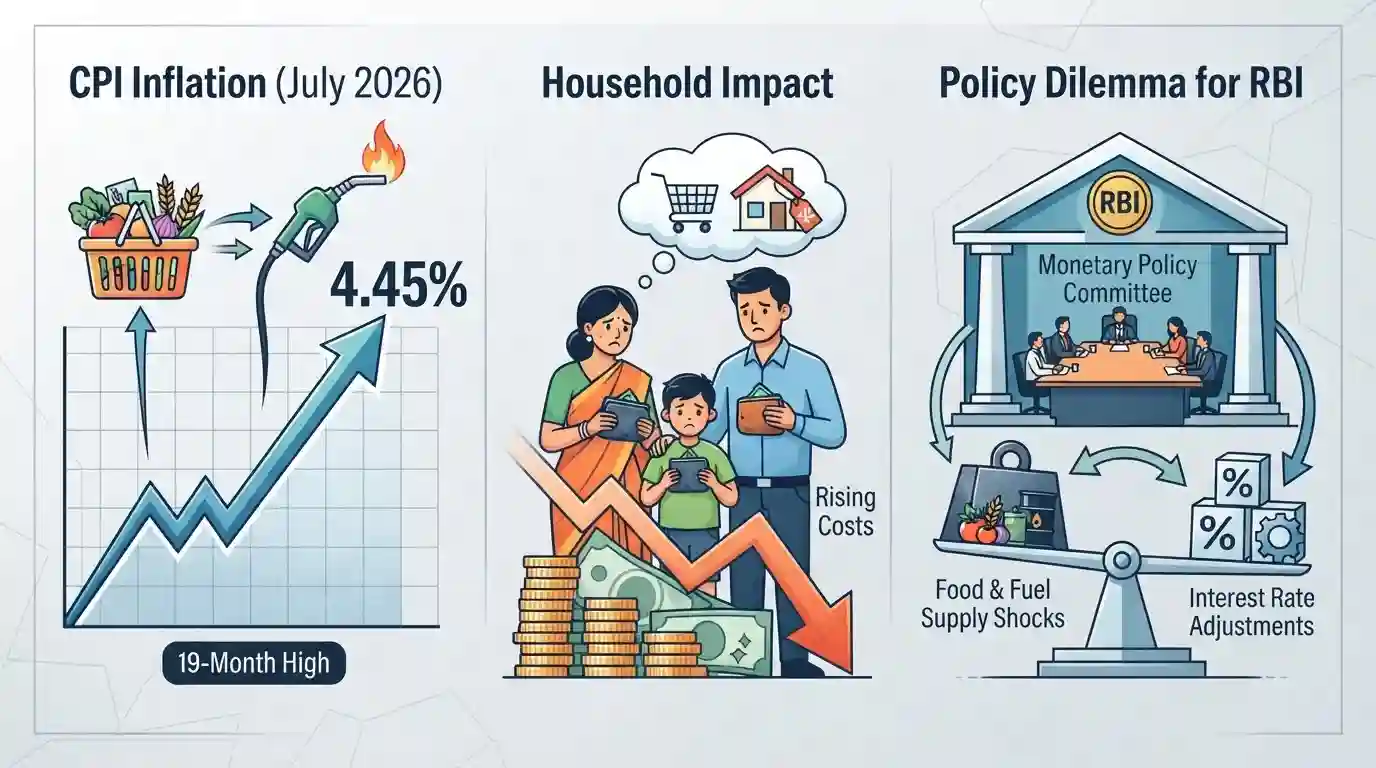
India's retail inflation, as tracked by the Consumer Price Index (CPI), accelerated to a 19-month high of 4.45% in July 2026. The increase was largely fueled by rising prices for essential food items and fuel. This inflationary trend complicates the macroeconomic environment, placing a heavier burden on household finances. It also poses a policy dilemma for the Reserve Bank of India's Monetary Policy Committee, as traditional interest rate adjustments are often less effective in curbing supply-side inflation stemming from food and fuel price shocks.
મુખ્ય મુદ્દા
- Retail inflation in India, measured by the Consumer Price Index (CPI), surged to a 19-month high of 4.45% in July 2026.
- The inflationary spike was primarily driven by rising prices in the food and fuel baskets.
- Persistent food and fuel inflation poses a significant challenge for the Reserve Bank of India (RBI), as these supply-side pressures are less responsive to monetary policy tightening.
- Prolonged high retail inflation stresses household budgets, potentially suppressing aggregate consumer demand and impacting overall economic growth.
મહત્વપૂર્ણ શબ્દો
Consumer Price Index (CPI)

A measure of changes in the average retail prices of a fixed basket of goods and services consumed by households. It reflects the inflation experienced directly by consumers.
UPSC context
Crucial for GS Paper 3 (Economy). It is the primary inflation metric used by the RBI for its inflation-targeting framework.
National Statistical Office (NSO)
The central statistical agency under MoSPI, formed by merging the CSO and NSSO. It compiles national macroeconomic data, including the GDP and the Consumer Price Index (CPI).
UPSC context
Important for GS Paper 3. Tests knowledge of the institutional framework behind India's macroeconomic data and surveys.
Monetary Policy Committee (MPC)
A six-member statutory committee constituted under the RBI Act. It is tasked with determining the benchmark policy interest rate (repo rate) required to achieve the government's official inflation target.
UPSC context
Core GS Paper 3 topic. Repeatedly tested in Prelims and Mains regarding its composition, mandate, and inflation-targeting role.
Ministry of Statistics and Programme Implementation (MoSPI)
The nodal union ministry responsible for official statistics, monitoring central sector schemes, and releasing key macroeconomic indicators like the Consumer Price Index and national GDP.
UPSC context
Relevant for GS Papers 2 and 3. Tests awareness of government ministries and the source of official economic data.
Reserve Bank of India (RBI)
India's central bank, responsible for regulating the banking system and formulating monetary policy. It manages liquidity and money supply to maintain price stability while supporting economic growth.
UPSC context
Foundational for GS Paper 3. Questions frequently target its monetary policy tools, inflation management, and regulatory functions.
પ્રિલિમ્સ ટ્રેપ
The Reserve Bank of India targets Core CPI inflation to filter out volatile food and fuel prices while executing its monetary policy mandate.
Aspirants often confuse Core inflation (which excludes volatile food/fuel) with Headline inflation. Under the statutory framework, the RBI targets Headline CPI-C, not Core CPI.
સંલગ્ન સ્થિર ખ્યાલો
What are the structural differences between CPI and WPI in India?
- Weight of Food: CPI assigns a very high weight to food (~45.86%), making it sensitive to agricultural shocks, whereas WPI's food weight is significantly lower (~24%).
- Services Coverage: CPI includes services like education, health, and transport, whereas WPI tracks only physical goods, completely excluding services.
- Publishing Agency: CPI is compiled by the National Statistical Office (NSO, MoSPI), while WPI is released by the Office of the Economic Adviser (DPIIT, Ministry of Commerce).
How does Core Inflation differ from Headline Inflation, and which one does the RBI target?
- Volatile Elements: Headline inflation measures price rises across the entire basket, while Core inflation excludes volatile food and fuel categories to capture structural economic pricing.
- Target Metric: Under the flexible inflation targeting framework, the RBI is statutorily mandated to target Headline CPI-Combined (4% +/- 2%), not Core CPI.
આંતર-વિષય પેટર્ન
Agri-trade policy + Domestic CPI
High food-driven retail inflation frequently triggers domestic trade interventions, such as sudden export bans or minimum export prices, linking monetary stability to external trade policies.
Climate-induced shocks + Monetary Policy
Frequent climate anomalies (El Nino, unseasonal rains) disrupt agricultural supply chains, highlighting the limits of RBI's demand-side monetary tools to counter supply-induced inflation.

UPSC will likely test the divergence of CPI/WPI weights alongside the structural limits of RBI's demand-side tools on food shocks.
સંલગ્ન PYQ · 4
સંલગ્ન PYQ · 4
- 2020PrelimsGS1
Consider the following statements: 1. The weightage of food in Consumer Price Index (CPI) is higher than that in Wholesale Price Index (WPI). 2. The WPI does not capture changes in the prices of services, which CPI does. 3. Reserve Bank of India has now adopted WPI as its key measure of inflation and to decide on changing the key policy rates. Which of the statements given above is/are correct?
- 2024MainsGS3
What are the causes of persistent high food inflation in India? Comment on the effectiveness of the monetary policy of the RBI to control this type of inflation.
- 2022PrelimsGS1
In India, which one of the following is responsible for maintaining price stability by controlling inflation?
- 2021PrelimsGS1
With reference to Indian economy, demand-pull inflation can be caused/ increased by which of the following? 1. Expansionary policies 2. Fiscal stimulus 3. Inflation-indexing wages 4. Higher purchasing power 5. Rising interest rates Select the correct answer using the code given below.
