Retail Inflation Breach of RBI Upper Tolerance Limit
Source:The Hindu ↗
Why It Matters
Crucial for understanding monetary policy transmission, inflation targeting by the RBI, and the macro-economic stability of India, particularly regarding food price volatility.
Summary
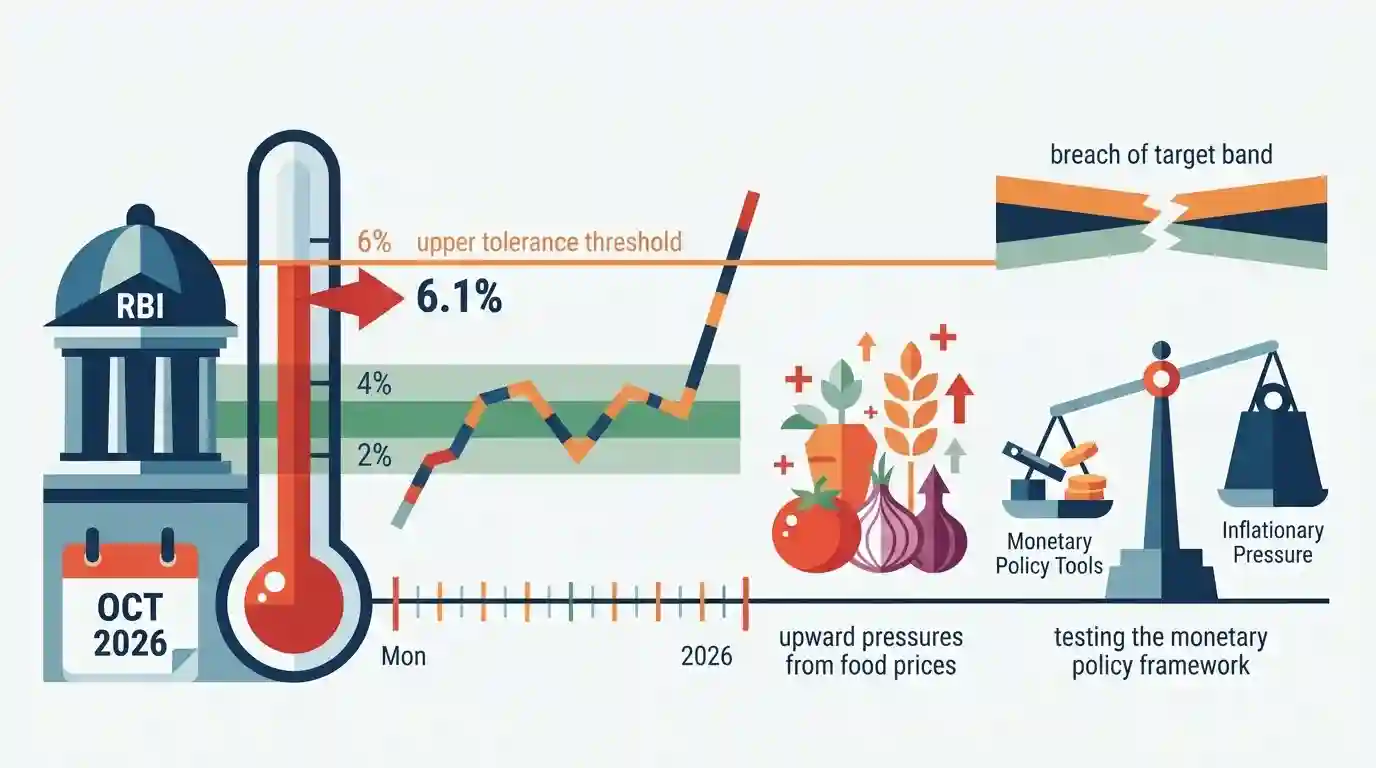
Retail inflation in India crossed the Reserve Bank of India's upper tolerance threshold of 6%, touching 6.1% in October 2026 due to upward pressures primarily from food prices. This development marks the first breach of the target band in two years, testing the efficacy of the central bank's monetary policy framework and inflation-targeting mandate.
Key Points
- Retail inflation based on the Consumer Price Index (CPI) rose to 6.1% in October 2026, breaching the Reserve Bank of India's upper tolerance limit of 6% for the first time in two years.
- The spike was largely driven by rising food inflation, posing fresh challenges to the central bank's monetary policy stance.
- Under the flexible inflation targeting framework, the RBI is mandated to maintain retail inflation at 4% with a band of +/- 2 percentage points.
Static Concepts Connected
What are the key statutory provisions and accountability mechanisms of India's Flexible Inflation Targeting (FIT) framework?
- RBI Act Amendment: Statutory Mandate: Established via an amendment to the RBI Act, 1934 in 2016, setting a target of 4% CPI inflation with a +/- 2% band.
- Consecutive Quarters: Failure Definition: Failing to meet the target means inflation remains outside the 2%-6% range for three consecutive quarters.
- Government Report: Accountability Report: The RBI must submit a report to the Central Government explaining reasons for failure and remedial actions to be taken.
Cross-Topic Patterns
Inflation Targeting vs Growth Trade-off
Monetary policy tightening to combat food-driven headline inflation directly impacts capital expenditure cycles and economic growth momentum.
Monetary Policy Transmission and Supply Shocks
Structural food inflation volatility reveals the limitations of repo-rate adjustments in managing agricultural supply shocks.

Expect a statement-based question combining the RBI Act Section 45ZA statutory inflation target, MPC voting, and accountability failure rules.
Linked PYQs · 1
Linked PYQs · 1
- 2024MainsGS3
What are the causes of persistent high food inflation in India? Comment on the effectiveness of the monetary policy of the RBI to control this type of inflation.
