New Consumer Price Index Series and Inflation Dynamics in India
Source:Indian Express ↗
Why It Matters
Understanding the nuances of inflation measurement, including base year revisions and the composition of the CPI basket, is crucial for analyzing India's macroeconomic health and the RBI's monetary policy stance.
Summary
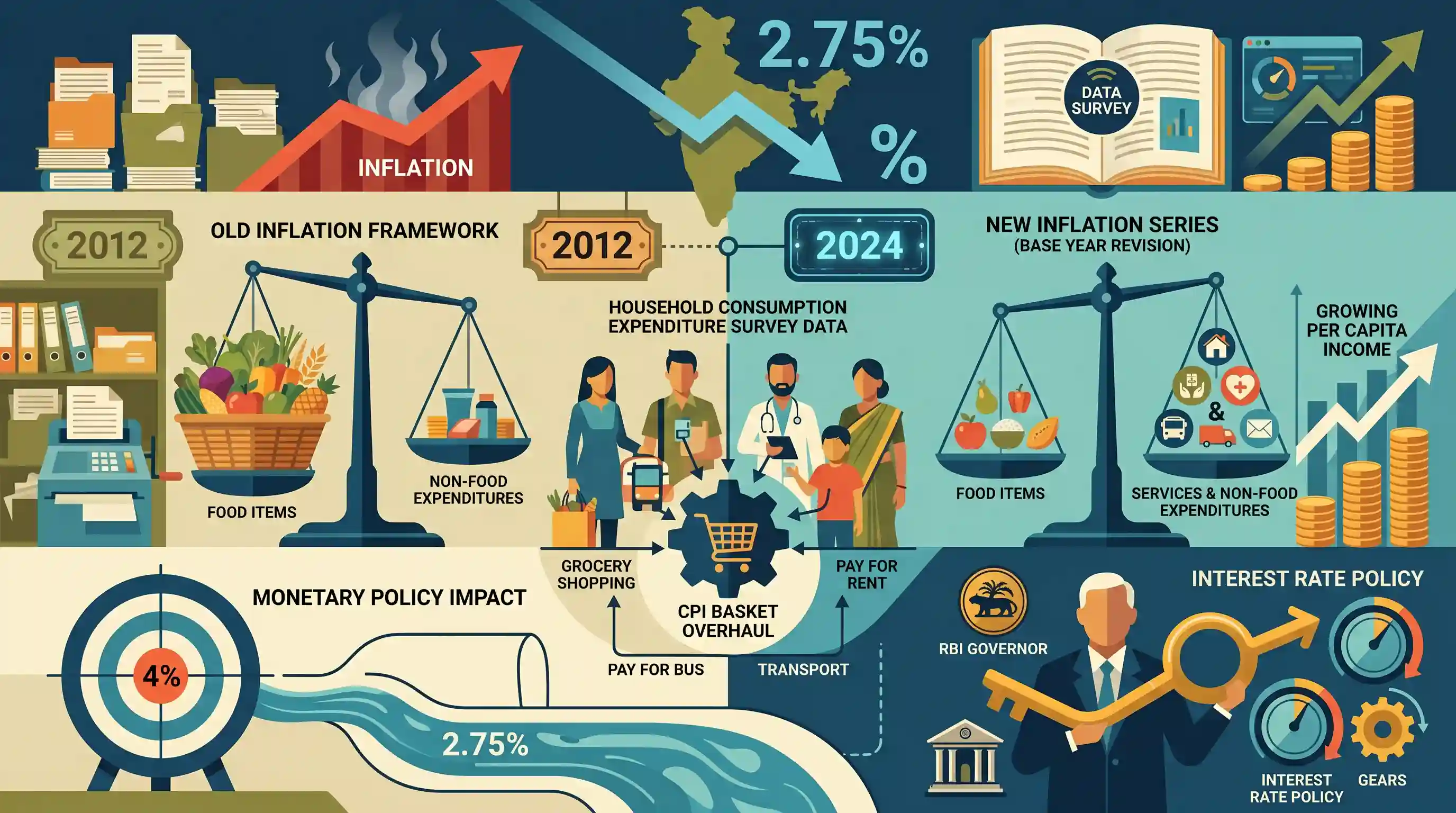
India's retail inflation cooled to 2.75% in January, measured under the newly introduced Consumer Price Index (CPI) data series. The updated series overhauls the inflation measurement framework by revising the base year and the basket of goods and services to reflect current consumer behavior. Driven by recent Household Consumption Expenditure Survey data, the new basket reduces the weightage of food items while increasing the focus on services and non-food expenditures, acknowledging the rise in per capita income and changing expenditure patterns. This structural adjustment in inflation tracking not only provides a more accurate picture of living costs but also grants the RBI greater flexibility in formulating its monetary policy, as the inflation print is well below the 4% target.
Key Points
- Retail inflation (CPI) for January printed at 2.75% under the newly introduced CPI data series, remaining comfortably within the RBI's 2-6% target band.
- The new CPI series updates the base year and the consumption basket to more accurately reflect contemporary household spending patterns in India.
- A significant shift in the new series is the reduction in the weightage of food and beverages, aligning with recent Household Consumption Expenditure Survey (HCES) findings that show a declining share of income spent on food.
- The revised basket increases the relative weightage of non-food items, including services, health, education, and consumer durables.
- This structural change in inflation tracking and the resultant lower inflation print provide the RBI with a favorable macroeconomic backdrop for future monetary policy decisions.
Important Terms
Consumer Price Index (CPI)

A macroeconomic indicator measuring the weighted average of retail prices for a fixed basket of goods and services consumed by households.
UPSC context
GS Paper III (Economy). Key nominal anchor for India's flexible inflation targeting framework (4% +/-2%).
Household Consumption Expenditure Survey (HCES)
A quinquennial survey conducted to collect data on household spending patterns, used to update the weights of items in the CPI basket.
UPSC context
GS Paper III (Economy). Essential for understanding shifts in consumption, poverty estimation, and recalibrating economic indices.
Reserve Bank of India (RBI)
India's central bank and regulatory body responsible for managing the country's monetary policy, currency issuance, and banking supervision.
UPSC context
GS Paper III (Economy). Tested on its role in price stability, financial regulation, and as 'lender of last resort'.
Monetary Policy Committee (MPC)
A statutory body under the RBI Act, 1934, mandated to fix the benchmark interest rate (Repo Rate) to maintain price stability.
UPSC context
GS Paper III (Economy). Crucial for questions on inflation management, institutional accountability, and macroeconomic stability.
National Statistical Office (NSO)
The nodal statistical agency of India, formed by merging CSO and NSSO, responsible for compiling national accounts, GDP, and CPI data.
UPSC context
GS Paper II & III. Important for understanding the institutional framework of India's official statistics and data transparency.
Base Year
A specific reference year used as a benchmark (indexed at 100) to measure and compare changes in economic variables over time.
UPSC context
GS Paper III (Economy). Understanding real vs nominal growth and the 'base effect' in inflation and GDP calculations.
Ministry of Statistics and Programme Implementation (MoSPI)
The Union ministry responsible for statistical policy, coordination, and administrative oversight of the NSO and major national surveys.
UPSC context
GS Paper II (Governance). Tested on its role in providing the evidence base for national planning and policymaking.
Prelims Trap
The new 2024 CPI series increases the weightage of food items to capture post-pandemic food inflation realities.
It is the exact opposite. Following Engel's Law, rising per capita income reduces the proportional expenditure on food. The new series actively reduces food weightage while increasing non-food and services.
Static Concepts Connected
What is the RBI's Flexible Inflation Targeting (FIT) framework?
- The Target: Under the amended RBI Act, the MPC is tasked with keeping CPI (Combined) inflation at 4%, with a tolerance band of +/- 2%.
- Failure Accountability: If inflation breaches the 2-6% band for three consecutive quarters, the RBI must submit a report to the Central Government explaining the failure and remedial actions.
What is Engel's Law in economics?
- Core Principle: As household income increases, the percentage of income spent on food decreases, even if the absolute expenditure on food rises.
- UPSC Significance: It is a primary indicator of economic development, structurally justifying why India's revised CPI basket assigns a lower weight to food and beverages than the 2012 series.
Cross-Topic Patterns
Inflation tracking & RBI interest rates
A lower structural food weightage reduces CPI volatility from monsoon shocks, giving the RBI more stable core-like inflation metrics to justify rate cuts and growth-accommodative stances.
HCES data and poverty line debates
The HCES 2023-24 data driving this CPI update also fundamentally alters multidimensional poverty estimates, linking inflation indices directly to NITI Aayog's poverty and inequality tracking methodologies.

A 2026 question contrasting the 2012 and 2024 CPI baskets is highly probable, specifically testing reduced food weight and UN COICOP.
Linked PYQs · 2
Linked PYQs · 2
- 2020PrelimsGS1
Consider the following statements: 1. The weightage of food in Consumer Price Index (CPI) is higher than that in Wholesale Price Index (WPI). 2. The WPI does not capture changes in the prices of services, which CPI does. 3. Reserve Bank of India has now adopted WPI as its key measure of inflation and to decide on changing the key policy rates. Which of the statements given above is/are correct?
- 2024MainsGS3
What are the causes of persistent high food inflation in India? Comment on the effectiveness of the monetary policy of the RBI to control this type of inflation.
