Child Malnutrition and Public Healthcare Systems in India
Source:The Hindu ↗
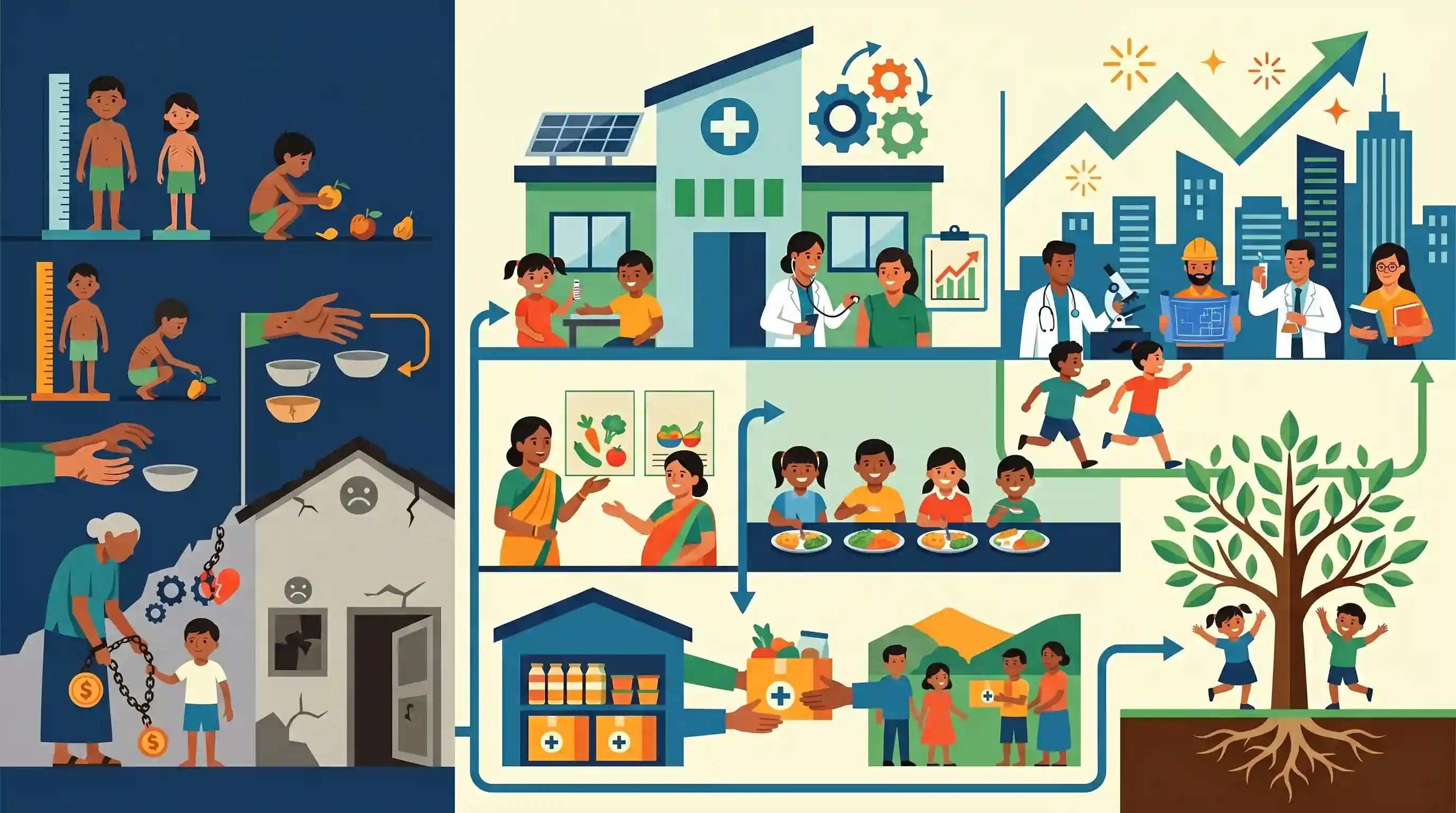
Why It Matters
Child malnutrition, human capital development, and public healthcare are core topics in UPSC GS2. Questions frequently evaluate the effectiveness of schemes like ICDS/Poshan Abhiyaan and the broader socio-economic impacts of failing to address early childhood health.
Summary
The article underscores the critical need to secure the health and nutritional rights of children in India, arguing that child well-being is foundational to national development. Despite various initiatives like PM POSHAN and the Integrated Child Development Services (ICDS), persistent challenges such as child stunting, wasting, and inadequate public health infrastructure remain. It calls for a rights-based approach to early childhood care, emphasizing that strengthening grassroots healthcare—especially Anganwadis and Primary Health Centres—is essential to break the intergenerational cycle of poverty and malnutrition and properly develop India's human capital.
Key Points
- The health and nutritional rights of children must be treated as an actionable priority rather than mere welfare provisions.
- Despite economic growth, high rates of child malnutrition, stunting, wasting, and infant mortality highlight a glaring gap in early childhood care.
- Grassroots public healthcare systems, including Anganwadi centers and Primary Health Centres (PHCs), need substantial capacity-building and better funding.
- Investments in maternal health and early childhood nutrition are critical for building long-term human capital and harnessing the demographic dividend.
- Breaking the vicious cycle of poverty and malnutrition requires a multi-sectoral approach linking sanitation, food security, and primary healthcare.
Important Terms
Integrated Child Development Services (ICDS)

A flagship centrally sponsored program providing an integrated package of six services—including supplementary nutrition and pre-school education—to children under six and mothers to ensure holistic early childhood development.
UPSC context
GS-II Welfare Schemes; foundational for analyzing social sector interventions targeting vulnerable sections and human resource development.
PM POSHAN Scheme
Formerly the Mid-Day Meal Scheme, this centrally sponsored program provides one hot cooked meal daily to children in government schools and pre-schools to enhance nutrition and educational outcomes.
UPSC context
GS-II Issues Relating to Poverty and Hunger; evaluates state intervention in food security and its impact on school enrollment.
POSHAN Abhiyaan (National Nutrition Mission)
A mission-mode initiative to improve nutritional outcomes for children, pregnant women, and lactating mothers by reducing stunting, under-nutrition, anemia, and low birth weight through multi-sectoral convergence and technology.
UPSC context
GS-II Health/Social Sector; central to discussions on the 'First 1,000 Days' and mission-mode governance against malnutrition.
Anganwadi Services
Rural child and maternal care centers in India that serve as the primary delivery point for ICDS services, managed by community-based frontline workers called Anganwadi Workers.
UPSC context
GS-II Social Sector/Health; focuses on decentralized service delivery, grassroots governance, and the role of frontline health workers.
National Health Mission (NHM)
A central initiative merging the Rural and Urban Health Missions to strengthen health systems, specifically addressing reproductive, maternal, neonatal, child, and adolescent health (RMNCH+A) and public infrastructure.
UPSC context
GS-II Health/Governance; critical for understanding public health infrastructure and India's progress toward Universal Health Coverage.
Ministry of Women and Child Development (MWCD)
The nodal government body responsible for formulating and implementing policies and programs aimed at the holistic development and welfare of women and children in India.
UPSC context
GS-II Governance/Institutions; essential for identifying the executive framework behind major social welfare schemes and legislative protections.
Prelims Trap
Article 47 explicitly guarantees the Right to Nutrition as a Fundamental Right for children.
Article 47 is a Directive Principle (non-justiciable duty of the State). The Right to Health is a Fundamental Right only via judicial interpretation under Article 21.
Static Concepts Connected
How are the primary clinical indicators of child malnutrition classified?
- Stunting: Measures height-for-age. It indicates chronic undernutrition and reflects long-term developmental failure, often permanent.
- Wasting: Measures weight-for-height. It indicates acute undernutrition, reflecting recent and severe weight loss, usually from starvation or disease.
- Underweight: Measures weight-for-age. It is a composite index that reflects both stunting and wasting in a single metric.
What are the core services integrated under the ICDS framework?
- Target Demographics: Children (0-6 years), pregnant women, and lactating mothers.
- Six Core Services: Supplementary nutrition, pre-school non-formal education, nutrition/health education, immunization, health check-ups, and referral services.
- Delivery Node: Anganwadi Centres (AWCs) act as the primary grassroots delivery node, managed by Anganwadi Workers (AWWs).
Cross-Topic Patterns
Malnutrition and WASH infrastructure
Nutrition schemes often fail without sanitation; recurrent waterborne diseases (like diarrhoea) cause environmental enteropathy, preventing nutrient absorption even if a child's caloric intake is adequate.
Nutrition as an economic multiplier
Early childhood stunting permanently impairs cognitive development, directly capping future labor productivity and neutralizing India's demographic dividend window before individuals even enter the workforce.

Expect a 2026 prelims question interlinking PM POSHAN mandates, ICDS beneficiaries, and the clinical definitions of stunting vs wasting.
Linked PYQs · 5
Linked PYQs · 5
- 2024MainsGS2
Poverty and malnutrition create a vicious cycle, adversely affecting human capital formation. What steps can be taken to break the cycle ?
- 2021MainsGS2
“Besides being a moral imperative of a Welfare State, primary health structure is a necessary precondition for sustainable development.” Analyze.
- 2016PrelimsGS1
Which of the following is/are the indicator/indicators used by IFPRI to compute the Global Hunger Index Report? 1. Undernourishment 2. Child stunting 3. Child mortality Select the correct answer using the code given below.
- 2017PrelimsGS1
Which of the following are the objectives of 'National Nutrition Mission'? 1. To create awareness relating to malnutrition among pregnant women and lactating mothers. 2. To reduce the incidence of anaemia among young children, adolescent girls and women. 3. To promote the consumption of millets, coarse cereals and unpolished rice. 4. To promote the consumption of poultry eggs. Select the correct answer using the code given below:
- 2024MainsGS2
In a crucial domain like the public healthcare system the Indian State should play a vital role to contain the adverse impact of marketisation of the system. Suggest some measures through which the State can enhance the reach of public healthcare at the grassroots level.
