Central Vista Redevelopment and Decolonization of Governance Spaces
Source:Indian Express ↗
Why It Matters
This event represents a significant symbolic and structural shift in India's governance architecture. For UPSC aspirants, it highlights the government's ongoing push to decolonize public administration spaces (Panch Pran) while modernizing the infrastructure of the highest executive offices.
Summary
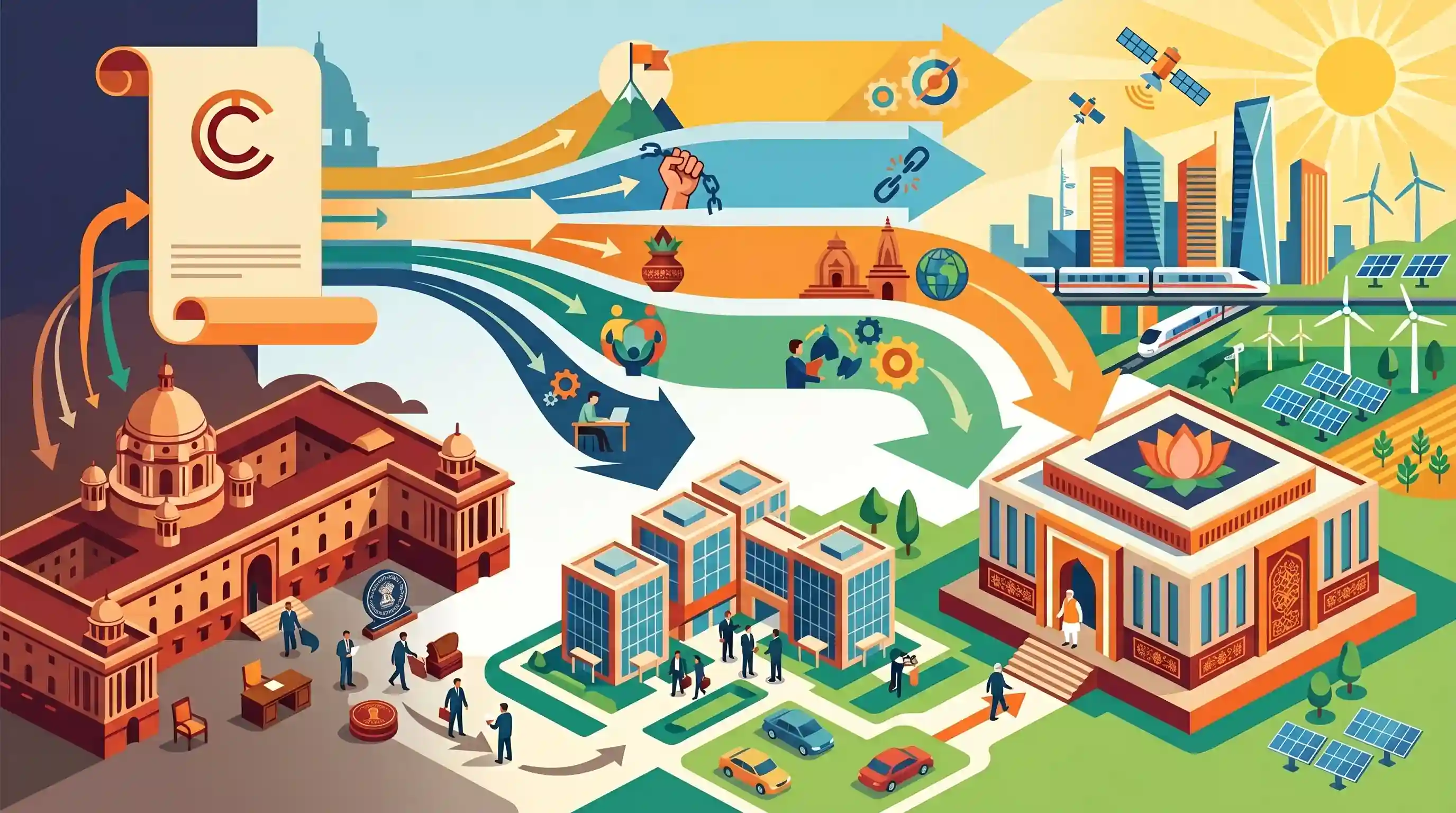
The Union Cabinet has passed a resolution to relocate the Prime Minister’s Office (PMO) to a newly developed 'Seva Teerth' and shift other key ministries to 'Kartavya Bhavans', phasing out the colonial-era North and South Blocks. Hailing the historical significance of the South Block, the resolution frames the relocation as a crucial step in fulfilling the 'Panch Pran' vision aimed at erasing colonial vestiges and laying the groundwork for a 'Viksit Bharat' (developed India).
Key Points
- The Union Cabinet adopted a resolution to shift the Prime Minister's Office (PMO) to a new complex called 'Seva Teerth'.
- Key ministries will be relocated from the colonial-era North Block to 'Kartavya Bhavans'.
- The transition is framed as part of the 'Panch Pran' vision to shed colonial legacies and work towards a 'Viksit Bharat'.
- The Cabinet acknowledged the historical role of South Block, which served as the center of government for 8 decades, witnessing India's journey from independence to modern policy milestones.
Important Terms
Panch Pran

Five resolves for 'Amrit Kaal' (2022-2047) targeting national development, erasing colonial mindsets, taking pride in heritage, fostering unity, and fulfilling civic duties to transform India by its centenary.
UPSC context
GS II/IV; tests understanding of national vision, decolonization of governance, and ethics.
Viksit Bharat
The government's roadmap to transform India into a developed nation by 2047, aiming for a $30-40 trillion economy, inclusive growth, and enhanced global standing through structural reforms.
UPSC context
GS III; relevant for economic planning and long-term development strategies.
Seva Teerth
The newly developed official complex for the Prime Minister’s Office (PMO) within the Central Vista’s Executive Enclave, representing a shift from colonial-era South Block to service-oriented governance.
UPSC context
GS I/II; relates to administrative architecture and shedding colonial legacies.
Prime Minister’s Office (PMO)
An extra-constitutional staff agency providing secretarial assistance to the PM. It is the nodal body for high-level policy coordination, monitoring government programs, and inter-ministerial liaison.
UPSC context
GS II; tests knowledge of executive structure and central administrative functions.
Central Vista Redevelopment Project
A comprehensive project to revamp New Delhi’s administrative core, featuring a new Parliament, 'Kartavya Bhavans' (Common Central Secretariats), and upgraded facilities for the executive branch.
UPSC context
GS I/II; covers modern architecture, urban planning, and governance modernization.
Union Cabinet
The core of the Council of Ministers, led by the Prime Minister. It is the supreme decision-making authority in India’s parliamentary system, operating on collective responsibility.
UPSC context
GS II; fundamental for understanding the parliamentary executive and decision-making processes.
Prelims Trap
"The Prime Minister's Office is a constitutional body established to assist the Prime Minister under Article 74."
The PMO is an extra-constitutional, non-statutory body. It merely provides secretarial assistance and operates under the Government of India (Allocation of Business) Rules, 1961.
Static Concepts Connected
What is the administrative and constitutional status of the PMO?
- Extra-constitutional status: It is a non-statutory, extra-constitutional entity that provides secretarial assistance and advice to the Prime Minister.
- Historical evolution: Created in 1947 as the Prime Minister's Secretariat; it was officially renamed the PMO in 1977 under the Morarji Desai government.
- Governing rules: It functions under the Government of India (Allocation of Business) Rules, 1961, and is administratively headed by the Principal Secretary to the PM.
What are the key architectural features of the North and South Blocks?
- Herbert Baker design: Designed by Herbert Baker (not Edwin Lutyens), they were built to house the Imperial Secretariat on Raisina Hill.
- Syncretic architecture: The blocks blend European classicism with indigenous Indian architectural elements such as jaalis (stone screens), chajjas (projections), and chhatris (domes).
Cross-Topic Patterns
Panch Pran + Administrative De-colonialization
Renaming structures and shifting ministries to 'Kartavya Bhavans' provides a direct governance case study for the 'Panch Pran' objective of erasing colonial vestiges in India's administrative framework.
Adaptive Heritage + Museum Repurposing
The conversion of North and South blocks into the 'Yuge Yugeen Bharat Museum' links this administrative shift directly to GS1 heritage conservation and adaptive architectural reuse frameworks.

A multi-statement question combining Herbert Baker's architecture of North/South Blocks and the PMO's evolution is probable in 2026.
Linked PYQs · 2
Linked PYQs · 2
- 2014MainsGS2
The size of the cabinet should be as big as governmental work justifies and as big as the Prime Minister can manage as a team. How far is the efficacy of a government then inversely related to the size of the cabinet? Discuss.
- 2025MainsGS1
Trace India's consolidation process during early phase of independence in terms of polity, economy, education and international relations.
