India Security Doctrine and Ceasefire Management on LOC
Source:Indian Express ↗
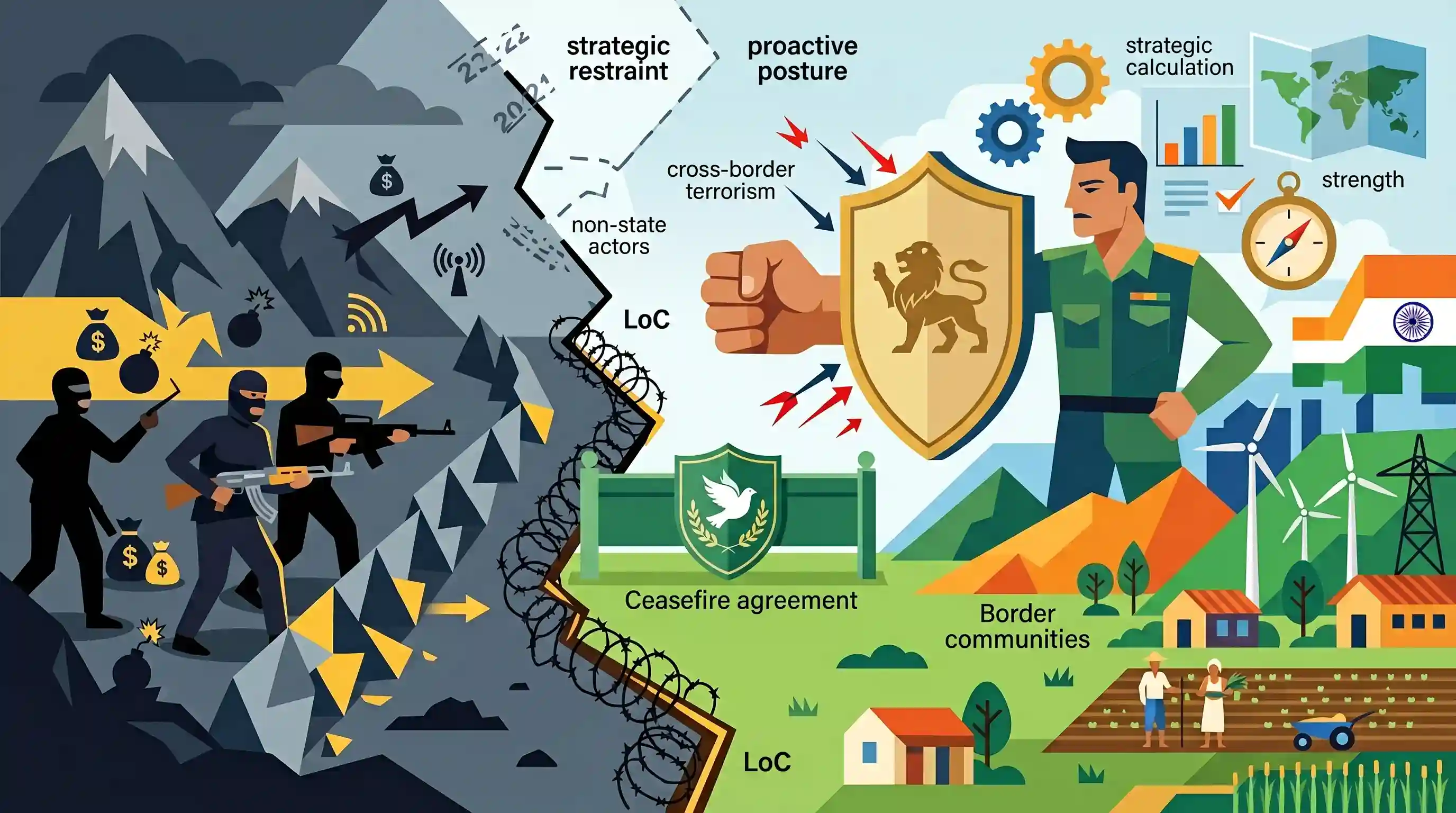
Why It Matters
Understanding the evolution of India's security doctrine—from reactive restraint to proactive deterrence—is essential for answering questions on India-Pakistan relations, LoC border management, and counter-terrorism strategies.
Summary
The article analyzes India's strategic posture regarding the ceasefire agreement with Pakistan along the Line of Control (LoC). It highlights that India's current approach is "resolute, not reactive," marking a shift from historical strategic restraint to a proactive security doctrine. By adhering to the 2003 ceasefire (reaffirmed in 2021), India seeks to maintain stability for border communities and focus on internal development. However, this commitment to border peace is coupled with a firm, zero-tolerance policy against cross-border terrorism, demonstrating that India manages its western frontier from a position of strength and strategic calculation.
Key Points
- India's adherence to the LoC ceasefire agreement reflects a strategic and resolute posture rather than a passive or reactive response to border tensions.
- Maintaining the ceasefire facilitates stability for local border populations and enables infrastructure development in border areas.
- The resolute approach signifies that upholding peace on the LoC does not equate to a softening of India's zero-tolerance policy toward cross-border terrorism.
- This stance is part of a broader shift in India's national security doctrine, prioritizing strong deterrence and calculated engagement over mere reactive measures.
Important Terms
2003 Ceasefire Agreement

A landmark bilateral commitment to halt military firing along the Line of Control and International Border, aiming to provide relief to border populations and reduce bilateral tensions.
UPSC context
GS Paper 2/International Relations. Tests knowledge of historical conflict management frameworks between India and Pakistan.
2021 Ceasefire Reaffirmation
A joint commitment by Indian and Pakistani DGMOs to strictly adhere to the 2003 ceasefire, following a record spike in border violations and civilian casualties.
UPSC context
GS Paper 2/International Relations. Examines recent diplomatic-military efforts to maintain border stability amidst broader bilateral stalemates.
Line of Control (LoC)
The 740-km de facto military boundary in Jammu and Kashmir established by the 1972 Simla Agreement; it remains a heavily militarized and sensitive frontier.
UPSC context
GS Paper 3/Security. Critical for understanding border management, infiltration challenges, and territorial disputes in J&K.
Proactive Security Doctrine
A strategic shift towards "decisive retaliation," where India responds to terror threats on its own terms, utilizing integrated military, diplomatic, and economic instruments.
UPSC context
GS Paper 3/Security. Evaluates modern national security frameworks, including zero-tolerance for terror and assertive multi-domain response strategies.
Strategic Restraint
India’s historical security posture of exercising calibrated and measured responses to provocations, prioritizing regional stability and economic growth over immediate military escalation.
UPSC context
GS Paper 3/Security. Analyzes the evolution of India’s defense policy from passive deterrence to assertive strategic posturing.
Cross-border Terrorism
State-sponsored infiltration and militant violence originating from across the border, serving as a primary security threat and the central hurdle to bilateral peace.
UPSC context
GS Paper 3/Security. Key topic for internal security challenges and India’s "Neighbourhood First" foreign policy.
Prelims Trap
The 2021 LoC ceasefire agreement is a new formal treaty signed and ratified between India and Pakistan.
The 2021 development was not a new treaty; it was merely a joint statement by the DGMOs to strictly observe the existing 2003 ceasefire understanding.
Static Concepts Connected
How did the Ceasefire Line (CFL) evolve into the Line of Control (LoC)?
- Karachi Agreement (1949): Established the original UN-monitored Ceasefire Line (CFL) in Jammu and Kashmir following the 1947-48 war.
- Simla Agreement (1972): Following the 1971 war, the CFL was converted into the LoC, rendering it a bilaterally negotiated de facto border.
- UNMOGIP irrelevance: India maintains that UNMOGIP lost its mandate after the Simla Agreement transitioned the CFL into the bilateral LoC.
What characterizes India's shift from 'Strategic Restraint' to 'Proactive Defense'?
- Strategic Restraint: Historically absorbing terror strikes (e.g., Parliament, 26/11) without overt military retaliation to prevent conventional or nuclear escalation.
- Proactive Defense: Conducting preemptive, non-military or surgical strikes (e.g., Balakot) to establish deterrence, signaling zero-tolerance for cross-border terror.
Cross-Topic Patterns
Border peace and Vibrant Villages
A stable LoC accelerates civil-military integration and programs like the Vibrant Villages Programme, shifting border security from purely military deployment to strategic population retention.
Ceasefire vs. asymmetric narco-terrorism
While conventional artillery exchanges have paused, adversaries have pivoted to asymmetric tactics like drone-dropped narcotics, tightly linking border management with organized crime and internal security.

Expect a 2026 Mains question linking LoC ceasefire stability to border infrastructure and India's shift to 'proactive deterrence'.
Linked PYQs · 3
Linked PYQs · 3
- 2020MainsGS3
Analyze internal security threats and transborder crimes along Myanmar, Bangladesh and Pakistan borders including Line of Control (LoC). Also discuss the role played by various security forces in this regard.
- 2024MainsGS3
India has a long and troubled border with China and Pakistan fraught with contentious issues. Examine the conflicting issues and security challenges along the border. Also give out the development being undertaken in these areas under the Border Area Development Programme (BADP) and Border Infrastructure and Management (BIM) Scheme.
- 2015MainsGS2
Terrorist activities and mutual distrust have clouded India-Pakistan relations. To what extent the use of soft power like sports and cultural exchanges could help generate goodwill between the two countries? Discuss with suitable examples.
