Constitutional obligation of scientific temper against superstitions
Source:The Hindu ↗
Why It Matters
The article underscores the constitutional mandate of promoting scientific temper (Article 51A) as an antidote to superstition and pseudo-science. It is highly relevant for Essays and Ethics, providing a prime real-world example of political leadership advocating for rationalism. It also offers factual fodder for GS3 on Indian achievements in science.
Summary
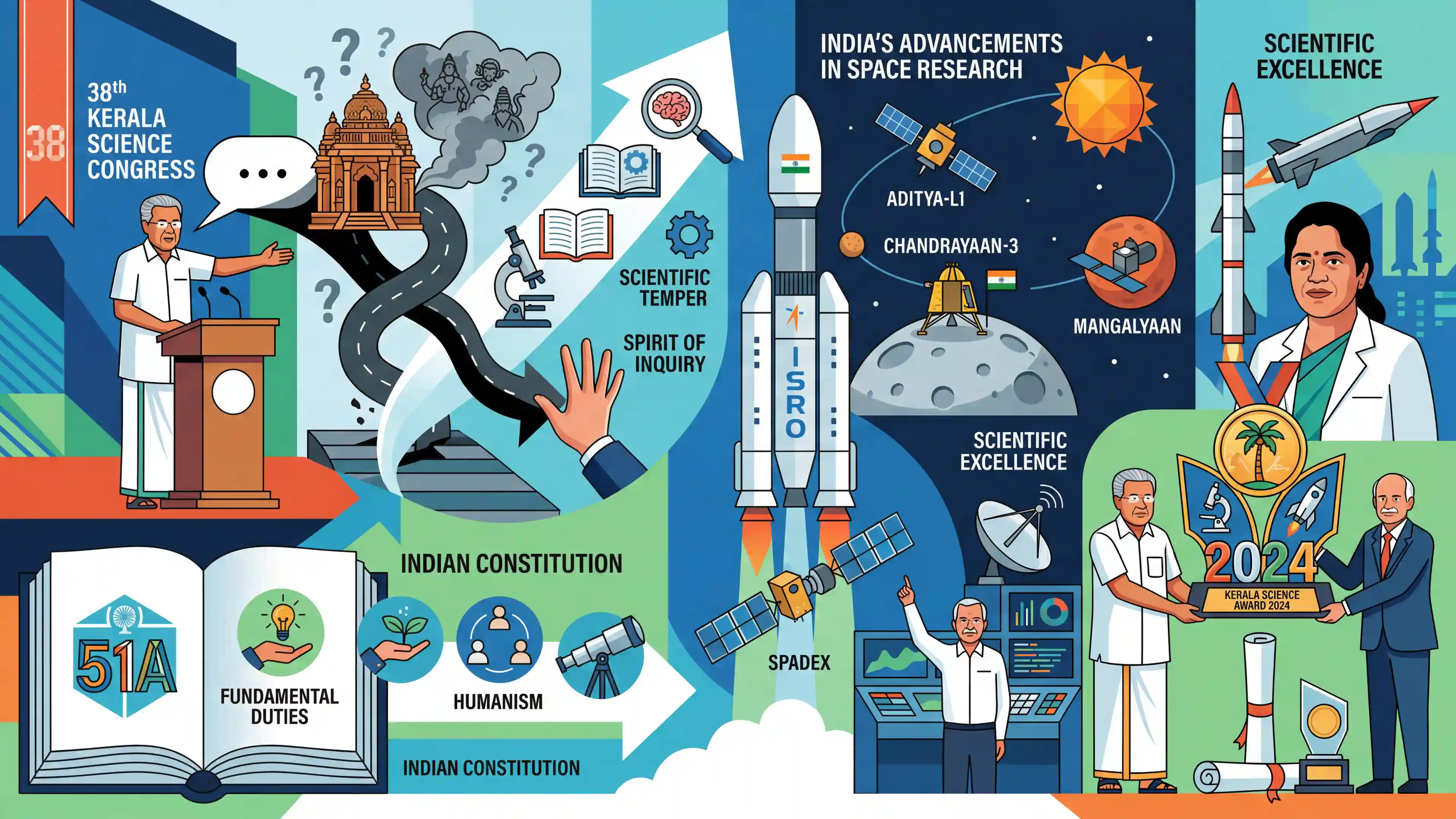
Speaking at the 38th Kerala Science Congress in Kochi, Kerala Chief Minister Pinarayi Vijayan cautioned against the revival of regressive practices and the framing of mythological tales as ancient scientific facts. He reminded citizens of their fundamental duty under Article 51A to develop a scientific temper, humanism, and a spirit of inquiry. The event also highlighted India's advancements in space research with an address by ISRO Chairman V. Narayanan, and celebrated scientific excellence by awarding the Kerala Science Award 2024 to eminent scientist Dr. Tessy Thomas.
Key Points
- Kerala Chief Minister Pinarayi Vijayan warned against attempts to normalize superstitions by projecting mythological stories as ancient scientific discoveries.
- He emphasized that cultivating a scientific temper and the spirit of inquiry is a constitutional obligation under Article 51A.
- The 38th Kerala Science Congress in Kochi featured a keynote by ISRO Chairman V. Narayanan, highlighting India's strides in space science.
- Renowned scientist Dr. Tessy Thomas was felicitated with the Kerala Science Award 2024 for her contributions to science and technology.
Important Terms
Scientific Temper

An attitude based on logic, rationality, and evidence-based inquiry rather than superstition. Coined by Jawaharlal Nehru, it emphasizes questioning and the search for truth as a civic virtue.
UPSC context
GS Paper IV (Ethics) and GS Paper II (Polity/Social Justice); tests understanding of constitutional values and societal progress.
Article 51A(h)
The specific clause within the Fundamental Duties (Part IVA) of the Indian Constitution requiring citizens to 'develop the scientific temper, humanism and the spirit of inquiry and reform.'
UPSC context
GS Paper II (Polity); tests knowledge of the 42nd Amendment and the scope of non-justiciable duties of citizens.
Dr. Tessy Thomas
An eminent Indian scientist popularly known as the 'Missile Woman of India.' She was the first woman to lead a missile project in India, serving as Project Director for Agni-IV and Agni-V.
UPSC context
GS Paper III (Science & Technology); focuses on indigenization of technology and the role of women in Indian defense research.
V. Narayanan
A distinguished rocket scientist and the 11th Chairman of the Indian Space Research Organisation (ISRO). He is a specialist in cryogenic propulsion and assumed leadership in January 2025.
UPSC context
GS Paper III (Science & Technology); relates to Indian space program leadership and advancements in launch vehicle technology.
Kerala Sasthra Puraskaram
The highest science award conferred by the Government of Kerala for lifetime achievements in research and development. The 2024 award was presented to Dr. Tessy Thomas.
UPSC context
GS Paper III (Science & Technology); pertains to awards and recognition of scientific excellence in India.
Prelims Trap
"Article 51A(h) provides direct constitutional legal sanctions to penalize unscientific practices and superstitions."
Fundamental Duties (Art 51A) are non-justiciable. They require specific parliamentary or state legislation to legally enforce or penalize citizens for failing to develop a scientific temper.
Static Concepts Connected
How is the mandate for "scientific temper" embedded in the Constitution?
- 42nd Amendment Act: Inserted Part IVA (Article 51A) into the Constitution in 1976 on the Swaran Singh Committee's recommendation, which includes Article 51A(h) regarding scientific temper.
- Non-justiciable nature: While not directly enforceable via writs, the Supreme Court uses Fundamental Duties to interpret the constitutional validity of statutes and promote civic responsibility.
- Nehruvian origin: The specific phrase 'scientific temper' was articulated by Jawaharlal Nehru in his book 'The Discovery of India' to promote rationality and critical thinking over dogma.
What is the significance of the Agni-V missile project led by Dr. Tessy Thomas?
- Agni-V ICBM capability: It is a nuclear-capable, three-stage solid-fueled intercontinental ballistic missile (ICBM) developed by DRDO, with a strike range exceeding 5,000 km.
- "Missile Woman of India": Dr. Tessy Thomas led the Agni-IV and Agni-V projects, becoming the first Indian woman to head a major strategic missile project for DRDO.
- MIRV integration: Recent upgrades include Multiple Independently Targetable Re-entry Vehicle (MIRV) technology, allowing a single missile to deploy multiple warheads at different locations.
Cross-Topic Patterns
Art 51A(h) + State Anti-Superstition Laws
Since the Constitution lacks direct penal provisions for superstitions, states like Maharashtra and Karnataka have enacted specific laws to curb black magic, practically operationalizing this Fundamental Duty.
Women in STEM + Defence Self-Reliance
Dr. Tessy Thomas's Agni-V leadership perfectly blends the social justice goal of gender parity in STEM with the strategic goal of indigenous defence manufacturing.

Expect a mixed Prelims question connecting Article 51A(h)'s origin (Nehru) with State-level anti-superstition laws or Agni missile milestones.
Linked PYQs · 2
Linked PYQs · 2
- 2024MainsEssay
The doubter is a true man of science.
- 2016MainsGS3
Discuss India's achievements in the field of Space Science and Technology. How the application of this technology has helped India in its socio-economic development?
