Uttarakhand Citizens Launch Campaign Against Noise Pollution
Source:indiatimes ↗
Why It Matters
The topic links statutory environmental rules (such as decibel thresholds across residential, commercial, and silent zones) with civil movements and judicial protection of Article 21 (right to a noise-free environment), illustrating how local community activism addresses gaps in environmental compliance in ecologically sensitive tourist states like Uttarakhand.
Summary
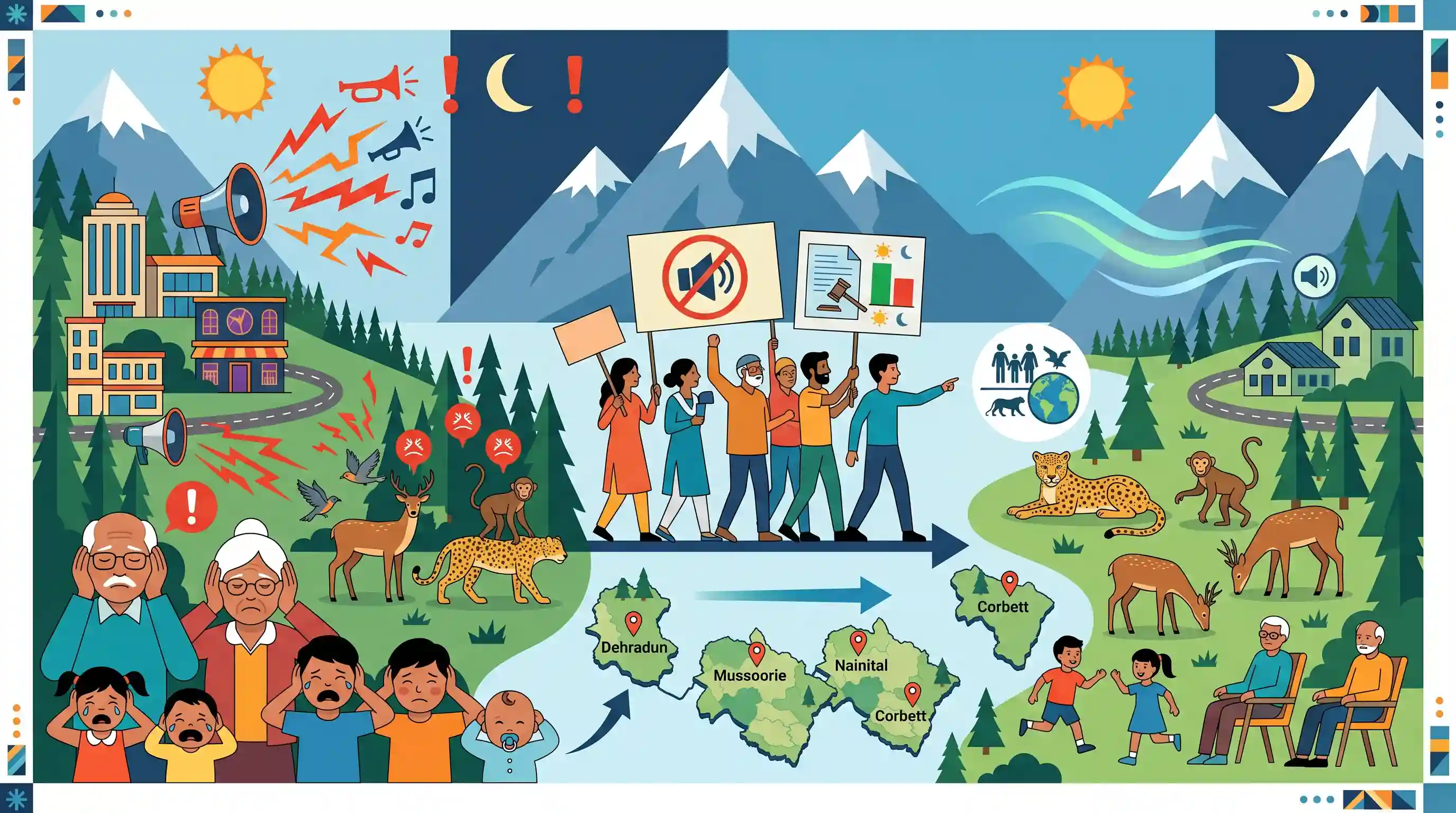
Concerned with deteriorating peace, public health, and ecological balance, citizens of Uttarakhand launched 'Uttarakhand Against Noise Pollution' (UANP), a statewide campaign demanding stricter enforcement of the Noise Pollution Rules, 2000. Under these rules, residential ambient noise limits are capped at 55 dB (day) and 45 dB (night). The movement spans Dehradun, Mussoorie, Nainital, and Corbett, drawing attention to how unregulated commercial expansion (resorts, hotels, and late-night pubs) poses significant health hazards to senior citizens and children, and disrupts wildlife in adjoining forest boundaries like the Malsi forest.
Key Points
- Civil society members in Uttarakhand have launched 'Uttarakhand Against Noise Pollution' (UANP), a statewide collective aiming to combat escalating commercial and residential noise pollution.
- Under the Noise Pollution (Regulation and Control) Rules, 2000, permissible ambient noise levels in residential areas are fixed at 55 decibels (dB) during the day (6 am to 10 pm) and 45 decibels (dB) at night (10 pm to 6 am).
- In India, noise was formally classified as an 'air pollutant' under Section 2(a) of the Air (Prevention and Control of Pollution) Act, 1981, through an amendment in 1987.
- Activists highlight severe threats to local fragile wildlife in eco-sensitive zones like Corbett and the Malsi forest, where commercial resorts and hotels operate as close as 200 meters from forest boundaries.
- The collective urges authorities—including the Police, local bodies, and the State Pollution Control Board—to strictly enforce noise limits at the boundaries of generating premises rather than treating the pre-10 pm window as a blanket exemption.
Important Terms
Noise Pollution (Regulation and Control) Rules, 2000

A set of central regulations enacted under the Environment (Protection) Act, 1986, defining permissible ambient noise limits for industrial, commercial, residential, and silence zones, alongside restrictions on loudspeaker and horn usage.
UPSC context
GS Paper III: Environmental Pollution & Degradation; tests knowledge of regulatory standards, public health linkages, and enforcement frameworks.
Environment (Protection) Act, 1986
India's "umbrella" environmental legislation enacted post-Bhopal Gas Tragedy under Article 253, empowering the Central Government to coordinate state activities, set national environmental quality standards, and regulate hazardous substances and ecological zones.
UPSC context
GS Paper III: Environment Legislation; tests understanding of the constitutional basis, key bodies, and broad powers of the central government.
Air (Prevention and Control of Pollution) Act, 1981
A statutory act enacted to combat air pollution in India, amended in 1987 to explicitly include "noise" within the definition of an air pollutant, thereby regulating industrial noise through Pollution Control Boards.
UPSC context
GS Paper III: Environmental Protection; tests knowledge of legislative histories, definitions of pollutants, and functions of state boards.
Uttarakhand Pollution Control Board
A statutory organization established in 2001 under the Water Act, 1974 and Air Act, 1981, responsible for enforcing environmental and pollution-control regulations, including noise and waste standards, within Uttarakhand.
UPSC context
GS Paper III: Environmental Bodies; tests understanding of state-level statutory bodies, their enforcement mandates, and center-state ecological powers.
Uttarakhand Against Noise Pollution
A citizens' collective and statewide campaign launched in July 2026 by civil society, environmentalists, and retired officers in Uttarakhand, demanding stricter enforcement of the Noise Pollution Rules, 2000 against commercial violations.
UPSC context
GS Paper II: Civil Society & Pressure Groups; tests the role of citizen movements in ecological governance and policy enforcement.
Prelims Trap
The Noise Pollution Rules, 2000 are framed under the Air (Prevention and Control of Pollution) Act, 1981.
Although noise was added to the Air Act in 1987, the actual Noise Rules of 2000 were notified under the Environment (Protection) Act, 1986.
Static Concepts Connected
What is the statutory framework regulating noise pollution in India?
- Air Act Amendment: The Air Act 1981 was amended in 1987 to include noise within the definition of an air pollutant under Section 2(a).
- EPA 1986 Rules: The Noise Pollution (Regulation and Control) Rules, 2000 were framed under the umbrella Environment (Protection) Act, 1986.
- Constitutional Right: The Supreme Court has interpreted the right to live in a noise-free environment as part of Article 21 (Right to Life).
What are the ambient noise standards categorized by the Central Pollution Control Board (CPCB)?
- Residential Zones: Capped at 55 dB during the day (6 AM to 10 PM) and 45 dB at night (10 PM to 6 AM).
- Silence Zones: Areas within 100 meters of hospitals, educational institutions, and courts are capped at 50 dB (day) and 40 dB (night).
- Industrial and Commercial: Industrial areas are capped at 75 dB (day) / 70 dB (night), while commercial zones allow 65 dB (day) / 55 dB (night).
Cross-Topic Patterns
Eco-tourism vs Wildlife Bio-acoustics
Unregulated commercial noise near Corbett disrupts wildlife communication and physiology, illustrating the conflict between local economic development and Wildlife Protection Act mandates.
Right to Silence and Article 21
The judiciary links freedom from noise to the Right to Life, establishing a civil liberty dimension to environmental compliance and local governance.

2026 Prelims may test the statutory roots: Noise Rules 2000 are under EPA 1986, whereas noise is defined under the Air Act 1981.
Linked PYQs · 3
Linked PYQs · 3
- 2021UKPSC_PRELIMSGS1
In which year 'The Air (Prevention and Control of Pollution) Act was enacted?
- 2024UKPSC_PRELIMSGS1
Which Constitutional Amendment Act relates to the protection and improvement of environment and safeguarding of forests and wildlife ?
- 2025UKPSC_PRELIMSGS1
Consider the following statements and select the correct answer from the options given below : Statement 1 : Uttarakhand is highly vulnerable to climate change. Statement 2 : Climate change is causing water stress and depleting biodiversity in Uttarakhand.
