AIIMS Patna Doctors Strike After Alleged Assault by Lawmaker
Source:Indian Express ↗
Why It Matters
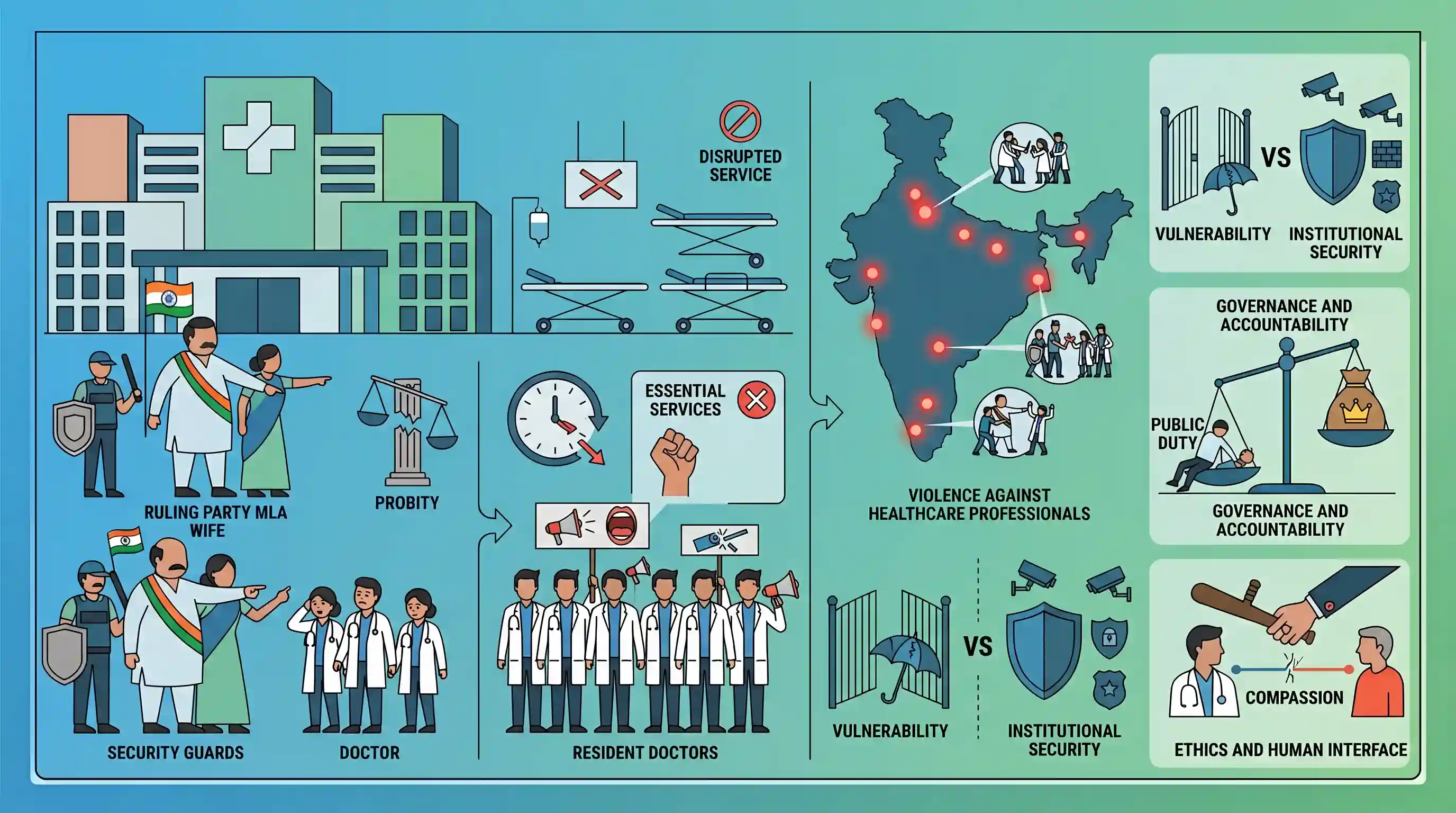
The recurring issue of violence against healthcare workers impacts public health delivery systems and highlights gaps in institutional security and legal protection for essential workers. It also provides a case study for GS4 on the abuse of power by elected representatives and the resulting disruption of public services.
Summary
Resident doctors at AIIMS Patna have gone on strike after alleging that they were threatened and assaulted by a ruling party MLA, his wife, and their security guards. The incident has disrupted essential medical services at the premier hospital, bringing to the forefront the recurring issue of violence against healthcare professionals in India. It underscores the urgent need for better institutional security measures for medical staff and highlights ethical breaches involving the misuse of political power and privilege against public duty personnel.
Key Points
- Resident doctors at AIIMS Patna initiated a strike following allegations of threats and physical assault by a JDU MLA, his wife, and their security guards.
- The incident disrupts critical public healthcare services at a major tertiary care facility, impacting patient care and emergency operations.
- The event highlights the chronic vulnerability of healthcare workers in public hospitals and the pressing need for robust workplace security protocols.
- It raises significant ethical concerns regarding the misuse of power and privilege by elected representatives against on-duty essential service professionals.
- The strike renews demands for the strict enforcement of laws protecting medical personnel from violence to ensure uninterrupted healthcare delivery.
Important Terms
Epidemic Diseases (Amendment) Act, 2020

A 2020 amendment making acts of violence against healthcare personnel during epidemics a cognizable and non-bailable offense. It provides for imprisonment up to seven years and heavy fines.
UPSC context
GS Paper 2 (Governance/Health); GS Paper 4 (Ethics). Tests knowledge of legal protections for public servants and crisis management.
Institute of National Importance (INI)
A status conferred by an Act of Parliament on premier public higher education institutions in India to develop high-standard medical education and research. AIIMS Patna holds this status.
UPSC context
GS Paper 2 (Social Justice/Health). Relates to the institutional framework for healthcare and education in India.
Janata Dal (United) (JD-U)
A major regional political party in Bihar, currently part of the ruling NDA. The MLA involved in the AIIMS Patna incident is affiliated with this party.
UPSC context
GS Paper 2 (Polity). Relates to regional parties, coalition politics, and the accountability of elected representatives.
Cognizable Offense
An offense where police can arrest without a warrant and start an investigation without court permission. Violence against doctors is classified as such under special laws.
UPSC context
GS Paper 2 (Governance/Criminal Justice). Tests understanding of legal terminology and police powers in public order maintenance.
Probity in Governance
Adherence to the highest ethical standards, honesty, and integrity in public service. It involves using political power for public good rather than personal privilege.
UPSC context
GS Paper 4 (Ethics). Central theme for case studies on misuse of power and official misconduct.
Resident Doctors’ Association (RDA)
A representative body of junior doctors in medical institutions that advocates for their rights, safety, and working conditions. The AIIMS Patna RDA led the strike.
UPSC context
GS Paper 2 (Health Governance). Relevant for topics concerning professional unions and grievances in the health sector.
Prelims Trap
"The Epidemic Diseases (Amendment) Act 2020 makes violence against healthcare workers a cognizable offence across all situations."
The 2020 amendment provides protection ONLY during a declared epidemic. Standard hospital violence requires state-specific laws, as public health is a State subject.
Static Concepts Connected
Where does 'Public Health' figure in the Constitutional distribution of powers?
- State List: Public health, sanitation, hospitals, and dispensaries fall exclusively under Entry 6 of the State List.
- Concurrent List: Medical professions, medical education, and population control fall under the Concurrent List, enabling joint regulation.
- Union Role: The Centre regulates institutions of national importance like AIIMS and manages international quarantine.
How does the Essential Services Maintenance Act (ESMA) regulate strikes?
- Core Objective: Ensures the uninterrupted delivery of critical public services like healthcare, public transport, and sanitation.
- Strike Prohibition: State governments can invoke ESMA to legally ban strikes in notified essential services for a temporary period (usually up to six months).
- Strict Enforcement: Participating in an ESMA-banned strike is illegal, empowering police to arrest violators without a warrant.
Cross-Topic Patterns
Right to Strike vs. Duty to Care
Doctor strikes present a classic GS4 ethical dilemma—balancing a professional's right to workplace safety against the Hippocratic oath and the potential loss of patient lives during emergencies.
Nolan Principles and VIP Culture
An elected representative assaulting public servants violates core principles of public life (Integrity, Leadership, Accountability), transforming political mandate into unethical intimidation and VIP culture.

Expect a GS4 case study balancing medical strikes and patient care, or a prelims statement on ESMA and 7th Schedule entries for health.
Linked PYQs · 3
Linked PYQs · 3
- 2024MainsGS2
In a crucial domain like the public healthcare system the Indian State should play a vital role to contain the adverse impact of marketisation of the system. Suggest some measures through which the State can enhance the reach of public healthcare at the grassroots level.
- 2014MainsGS4
There is a heavy ethical responsibility on the public servants because they occupy positions of power, handle huge amounts of public funds, and their decisions have wide-ranging impact on society and environment. What steps have you taken to improve your ethical competence to handle such responsibility?
- 2025MainsGS4
It is said that for an ethical work culture, there must be code of ethics in place in every organisation. To ensure value-based and compliance-based work culture, what suitable measures would you adopt in your work place?
