Foreign Exchange Reserves Management and Rupee Defense Operations
Source:Indian Express ↗
Why It Matters
Currency depreciation and the RBI's forex interventions are foundational concepts in UPSC Economics. Understanding how selling dollars defends the rupee and impacts domestic liquidity is crucial for both Prelims (conceptual questions on RBI's market operations) and Mains (evaluating macroeconomic stability and monetary policy).
Summary
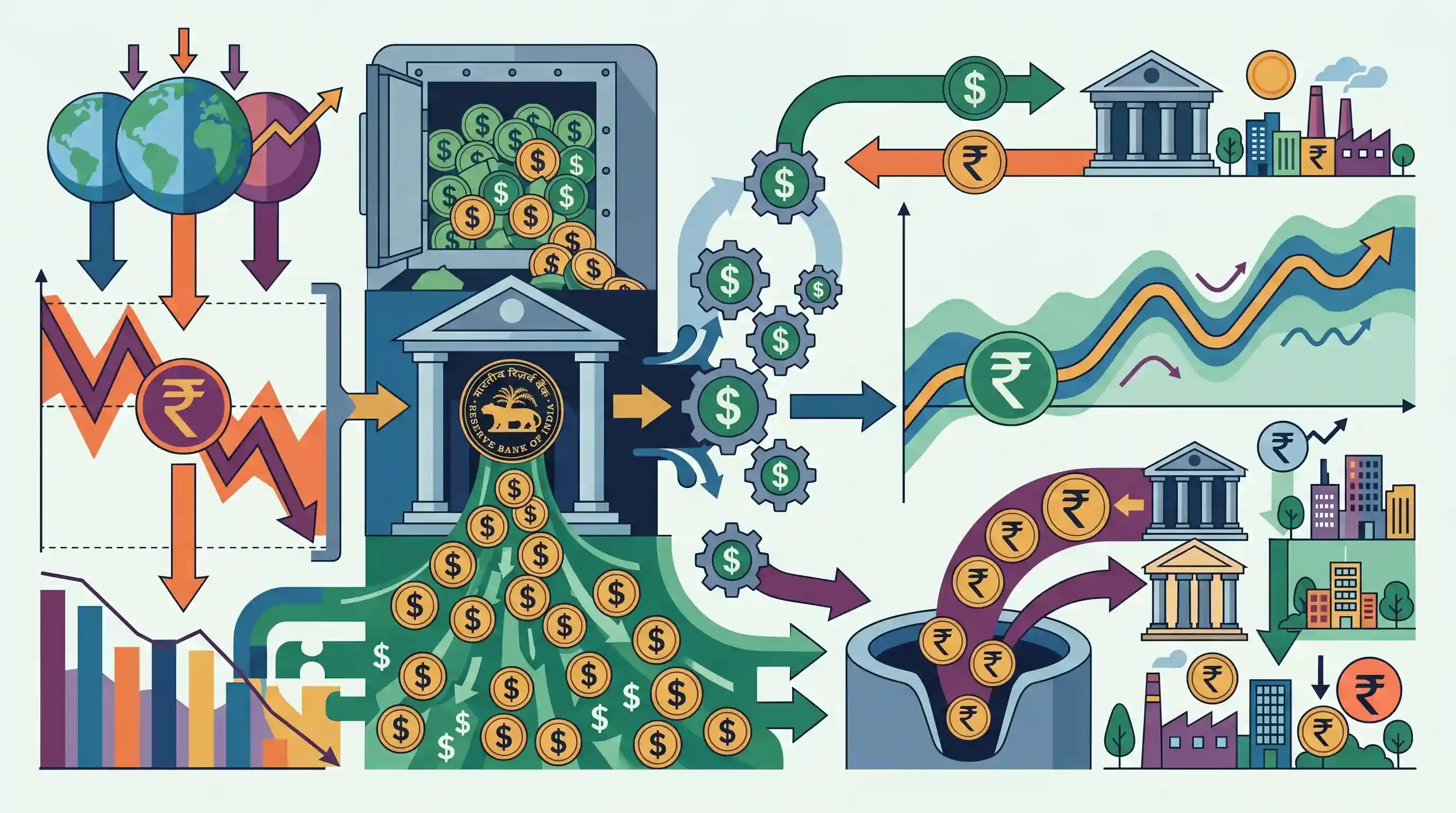
Between January and October 2025, the Reserve Bank of India (RBI) net sold $31.98 billion from its foreign exchange reserves to defend the Indian rupee against steep depreciation. This large-scale intervention underscores the RBI's commitment to a 'managed float' exchange rate system, where it actively manages excessive market volatility without fixing the currency's value. While selling dollars helps stabilize the rupee by increasing the supply of foreign currency, it simultaneously sucks out rupee liquidity from the domestic banking system, which can influence domestic monetary policy and inflation management.
Key Points
- The RBI net sold $31.98 billion from its foreign exchange reserves between January and October 2025 to curb rapid depreciation of the Indian rupee.
- Under India's 'managed float' exchange rate regime, the RBI intervenes in the forex market to prevent excessive currency volatility rather than targeting a specific exchange rate.
- Selling US dollars in the domestic market absorbs an equivalent amount of rupee liquidity, which can tighten domestic monetary conditions and impact interest rates.
- Forex interventions are critical for maintaining macroeconomic stability, as a steeply depreciating rupee would inflate India's import bill (especially for crude oil) and exacerbate imported inflation.
Important Terms
Managed Float Exchange Rate System

A hybrid regime where the exchange rate is primarily market-determined, but the central bank intervenes to curb excessive volatility without fixing the currency's value to a specific level.
UPSC context
GS Paper III: Indian Economy. Relevant for understanding India's exchange rate policy and how the RBI balances market forces with stability.
Foreign Exchange Management Act (FEMA)
Legislation enacted in 1999 to facilitate external trade and payments while promoting an orderly foreign exchange market. It replaced the more restrictive Foreign Exchange Regulation Act (FERA).
UPSC context
GS Paper III: Economy. A core legislative framework for external sector transactions, often tested in Prelims and Mains.
Reserve Bank of India (RBI)
India's central bank and regulatory body responsible for maintaining monetary stability, managing foreign exchange reserves, and overseeing the banking system to ensure economic growth.
UPSC context
GS Paper III: Banking and Monetary Policy. Central to almost all macroeconomic questions in the UPSC syllabus.
Foreign Exchange Reserves
External assets (usually USD, Gold, SDRs) held by the central bank to support the currency, pay off international debt, and maintain confidence in the economy.
UPSC context
GS Paper III: Economic Development. Crucial for stability topics and India's ability to handle external shocks like the Taper Tantrum.
Liquidity Management
The process by which the central bank controls the supply of money in the banking system to influence interest rates and inflation, often using tools like OMOs.
UPSC context
GS Paper III: Monetary Policy. Tests understanding of how forex interventions (selling dollars) can unintentionally shrink domestic money supply.
Currency Depreciation
The decrease in the value of a currency (like the Rupee) relative to others (like the Dollar) due to market forces such as trade imbalances or capital outflows.
UPSC context
GS Paper III: Indian Economy. Tests knowledge of external sector dynamics and its impact on imports (inflation) and exports.
Prelims Trap
"RBI selling dollars to defend the rupee increases domestic banking liquidity."
Selling dollars absorbs rupees from the market, shrinking domestic liquidity. Aspirants often reverse this, confusing a dollar supply increase with a rupee liquidity injection.
Static Concepts Connected
What is RBI's 'Sterilization' of forex intervention?
- Forex Impact: Buying or selling foreign exchange inherently alters the domestic money supply by injecting or absorbing rupees.
- Neutralization: RBI uses Open Market Operations (OMOs) to neutralize this impact, preventing unintended inflation or liquidity crunches.
- Example: When RBI sells dollars (absorbing rupees), it simultaneously buys government securities to inject those rupees back into the system.
What are the components of India's Foreign Exchange Reserves?
- FCA: Foreign Currency Assets (FCA) form the largest chunk, held in major global currencies like USD, Euro, and GBP.
- Gold: Held physically and abroad by the RBI as a traditional, stable store of value against fiat volatility.
- SDR & RTP: Special Drawing Rights (SDRs) and the Reserve Tranche Position (RTP) held with the International Monetary Fund.
Cross-Topic Patterns
Forex operations + Monetary Policy
RBI's dollar sales absorb domestic liquidity, unintentionally tightening monetary conditions. This forces coordination between external exchange rate management and internal inflation targeting mandates.
Rupee drop + Imported Inflation
Because India's crude and edible oil demand is highly inelastic, a depreciating rupee directly inflates the import bill, passing external price shocks straight into domestic CPI.

Expect a 2026 Prelims multi-statement question linking RBI’s dollar sales, domestic liquidity contraction, and the concept of sterilization.
Linked PYQs · 3
Linked PYQs · 3
- 2022PrelimsGS1
With reference to the Indian economy, consider the following statements: 1. If the inflation is too high, Reserve Bank of India (RBI) is likely to buy government securities. 2. If the rupee is rapidly depreciating, RBI is likely to sell dollars in the market. 3. If interest rates in the USA or European Union were to fall, that is likely to induce RBI to buy dollars. Which of the statements given above are correct?
- 2025PrelimsGS1
Which of the following are the sources of income for the Reserve Bank of India? I. Buying and selling Government bonds II. Buying and selling foreign currency III. Pension fund management IV. Lending to private companies V. Printing and distributing currency notes Select the correct answer using the code given below.
- 2018MainsGS3
How would the recent phenomena of protectionism and currency manipulations in world trade affect macroeconomic stability of India?
