RBI Cuts Repo Rate and CRR to Boost Liquidity and Growth
Source:The Hindu ↗
Why It Matters
Monetary policy is a foundational topic in the UPSC GS3 (Indian Economy) and Prelims syllabus. The article provides a textbook real-world example of how the RBI uses quantitative tools (repo rate and CRR) to inject liquidity and spur growth while balancing inflation targets. Understanding the MPC's stance shifts (from accommodative to neutral) is critical for answering questions on macroeconomic management.
Summary
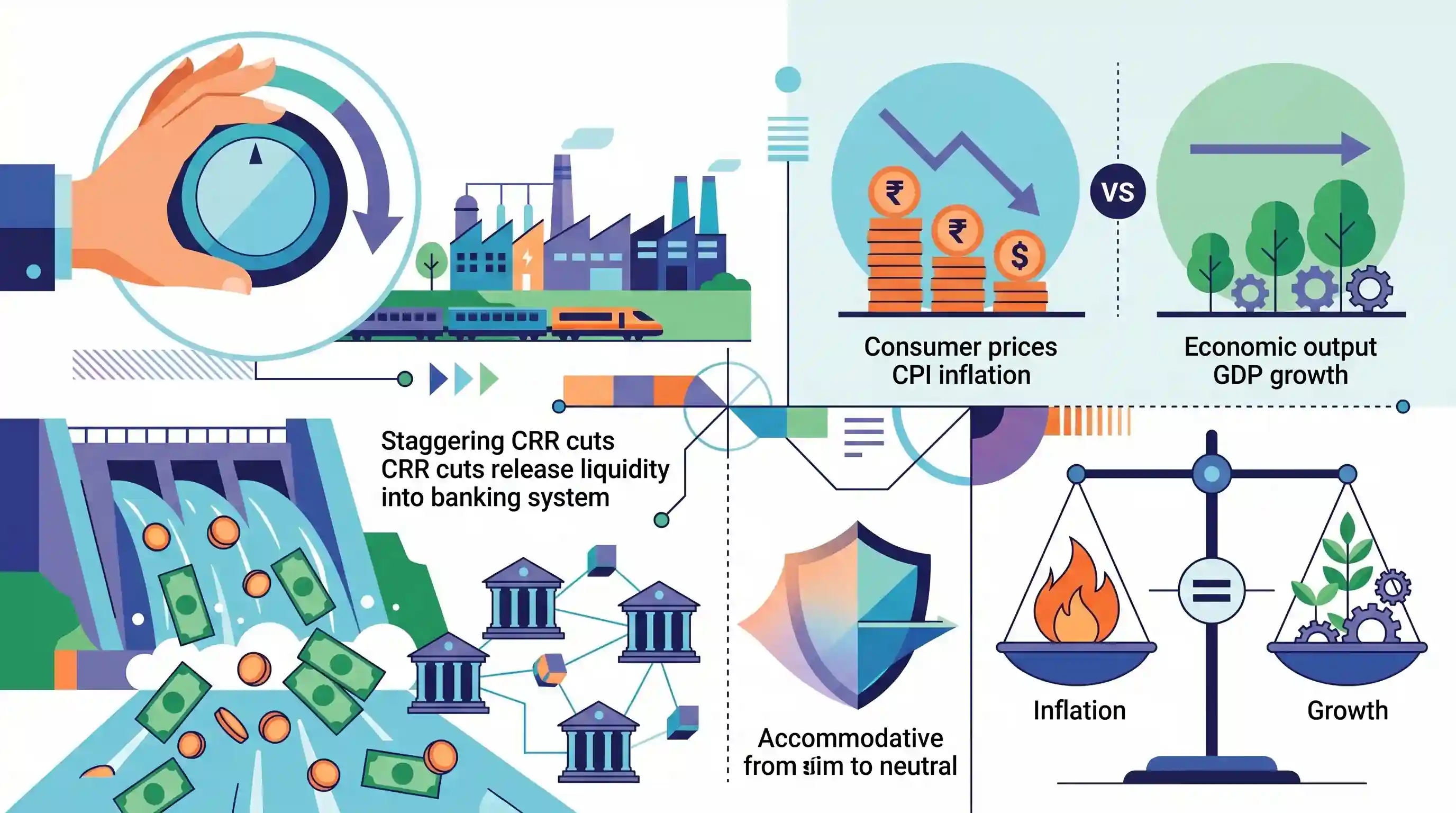
The Reserve Bank of India's Monetary Policy Committee (MPC) announced a 50 basis points reduction in the repo rate, lowering it to 5.50%, aiming to stimulate economic growth. The central bank also outlined staggered cuts to the Cash Reserve Ratio (CRR) by a total of 100 basis points over the financial year, a move expected to release ₹2.5 lakh crore of primary liquidity into the banking system. The decision was supported by a downward revision of the CPI inflation forecast for 2025-26 to 3.7%, while the GDP growth projection was maintained at 6.5%. Concurrently, the MPC shifted its policy stance from 'accommodative' to 'neutral', reflecting a balanced focus on inflation targeting and growth support.
Key Points
- The RBI's Monetary Policy Committee (MPC) slashed the repo rate by 50 basis points to 5.50% to boost economic growth.
- The central bank announced staggered 100-basis-point cuts in the Cash Reserve Ratio (CRR) to inject ₹2.5 lakh crore of primary liquidity into the banking system.
- CPI inflation forecast for the 2025-26 fiscal year was revised downward to 3.7%, providing the RBI with room to ease monetary policy.
- The real GDP growth projection for 2025-26 was maintained at 6.5%.
- The MPC altered its monetary policy stance from 'accommodative' to 'neutral', indicating a balanced approach between supporting growth and keeping inflation within the target band.
Important Terms
Repo Rate

The interest rate at which the RBI lends short-term money to commercial banks against government securities. It is the primary tool for controlling inflation and managing liquidity.
UPSC context
GS Paper III (Economy); core tool for monetary policy transmission and inflation control.
Monetary Policy Committee (MPC)
A statutory six-member committee (3 from RBI, 3 external) mandated to determine the benchmark policy rate (Repo Rate) required to achieve the inflation target.
UPSC context
GS Paper III (Economy); tests institutional framework, composition, and decision-making for price stability.
Cash Reserve Ratio (CRR)
A specified minimum percentage of a bank's total deposits (NDTL) that it must maintain as cash with the RBI, used to regulate liquidity without earning interest.
UPSC context
GS Paper III (Economy); quantitative credit control tool used to manage banking system liquidity.
Flexible Inflation Targeting (FIT)
A policy framework where the RBI targets a 4% retail inflation (CPI) rate with a tolerance band of 2%–6%, balancing price stability and economic growth.
UPSC context
GS Paper III (Economy); legal mandate under Section 45ZA of the RBI Act.
Monetary Policy Stance
The directional outlook of the central bank; 'accommodative' implies readiness to cut rates for growth, while 'neutral' allows flexibility for either cuts or hikes.
UPSC context
GS Paper III (Economy); reflects the central bank's shifting priorities between inflation and growth.
Consumer Price Index (CPI) Inflation
The primary index used by the RBI to measure retail inflation, reflecting changes in the price level of a basket of consumer goods and services.
UPSC context
GS Paper III (Economy); the 'nominal anchor' for India's monetary policy decisions.
Prelims Trap
"A shift to a 'neutral' stance means the RBI will pause interest rate changes."
A neutral stance means the RBI retains full flexibility to either hike or cut rates based on incoming data, removing the explicit bias of an 'accommodative' stance.
Static Concepts Connected
What is the difference between primary liquidity and the money multiplier?
- Primary Liquidity: The base money (M0) created by the RBI. It increases directly when the Cash Reserve Ratio (CRR) is cut, releasing trapped funds back to banks.
- Money Multiplier: The process by which commercial banks create broad money (M3) through subsequent cycles of lending. Increased primary liquidity enhances this multiplier effect.
What is the statutory framework of the Monetary Policy Committee (MPC)?
- Statutory Basis: Constituted under the amended RBI Act, 1934, it is a 6-member body comprising 3 RBI officials and 3 government appointees.
- Mandate: Mandated to determine the policy interest rate (repo rate) required to achieve the statutory inflation target of 4% (with a +/- 2% tolerance band).
- Decision Making: Decisions are binding and made by a majority vote, with the RBI Governor possessing a casting vote in the event of a tie.
Cross-Topic Patterns
Interest Rates & Exchange Rate Dynamics
Repo rate cuts reduce the interest rate differential with advanced economies like the US, potentially triggering Foreign Portfolio Investment (FPI) outflows and leading to rupee depreciation.
Monetary-Fiscal Synergy
Lower policy rates reduce sovereign bond yields, which significantly lowers the government's borrowing costs and eases fiscal deficit pressures during budget execution.

Expect a 2026 Prelims question testing how CRR cuts inject primary liquidity (M0) while Repo rate cuts merely alter the cost of funds.
Linked PYQs · 5
Linked PYQs · 5
- 2017PrelimsGS1
Which of the following statements is/are correct regarding the Monetary Policy Committee (MPC)? 1. It decides the RBI's benchmark interest rates. 2. It is a 12-member body including the Governor of RBI and is reconstituted every year. 3. It functions under the chairmanship of the Union Finance Minister. Select the correct answer using the code given below:
- 2022PrelimsGS1
In India, which one of the following is responsible for maintaining price stability by controlling inflation?
- 2021PrelimsGS1
The money multiplier in an economy increases with which one of the following?
- 2020PrelimsGS1
If the RBI decides to adopt an expansionist monetary policy, which of the following would it not do ? 1. Cut and optimize the Statutory Liquidity Ratio 2. Increase the Marginal Standing Facility Rate 3. Cut the Bank Rate and Repo Rate Select the correct answer using the code given below:
- 2023PrelimsGS1
Consider the following statements: Statement-I: In the post-pandemic recent past, many Central Banks worldwide had carried out interest rate hikes. Statement-II: Central Banks generally assume that they have the ability to counteract the rising consumer prices via monetary policy means. Which one of the following is correct in respect of the above statements?
