Constitutional Delimitation and Federal Equity Pressures
Source:The Hindu ↗
Why It Matters
The impending delimitation of constituencies is one of the most critical constitutional debates in contemporary India, directly impacting the balance of power between the Centre and States. Linking this fraught federal issue with women's political empowerment adds immense complexity to discussions on democratic representation, demographic dividends, and federal equity.
Summary
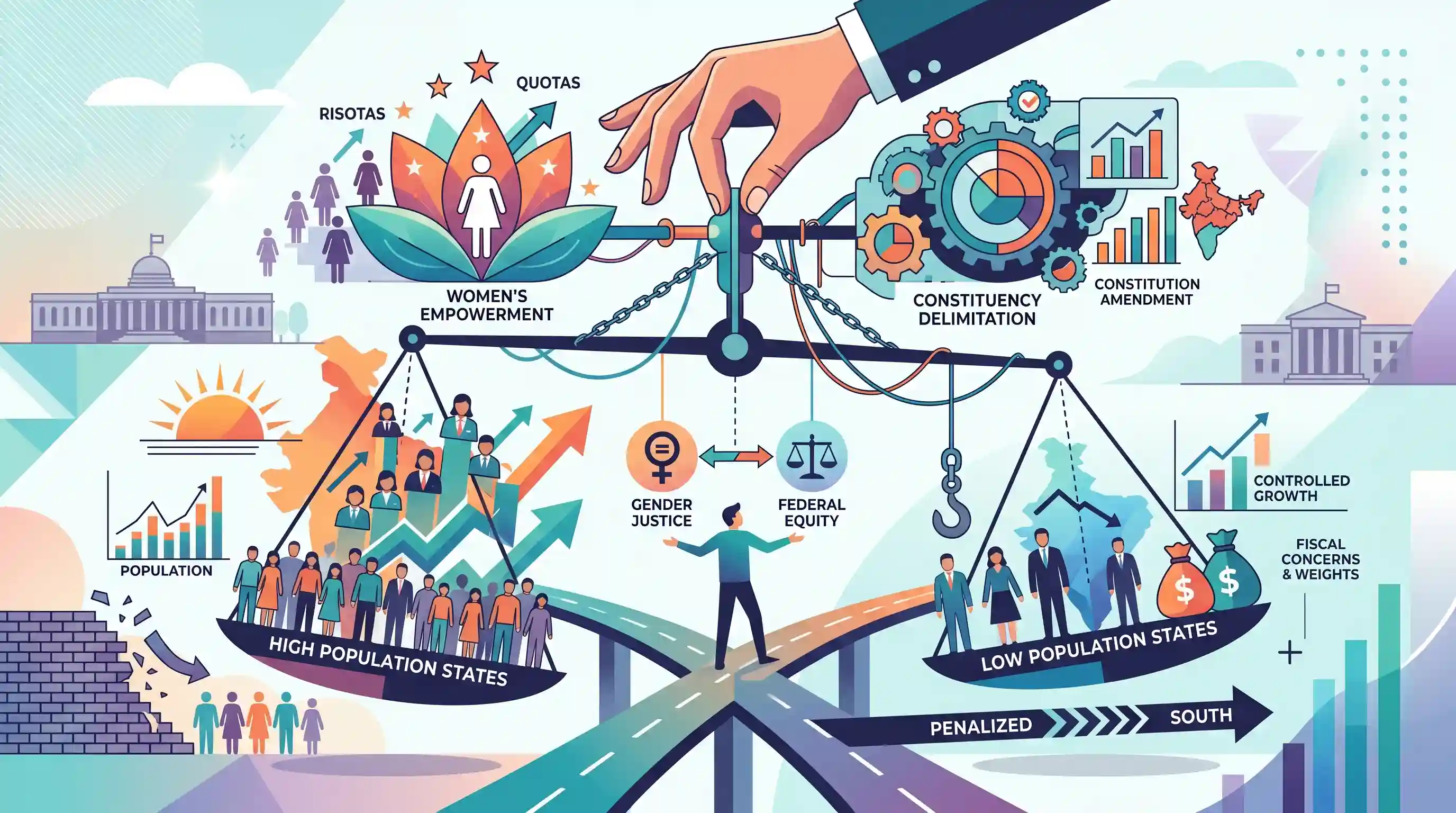
The editorial critiques the Union government’s strategy of coupling the implementation of the women's reservation quota (Nari Shakti Vandan Adhiniyam) with the contentious process of constituency delimitation. It argues that leveraging women’s political empowerment to push through the Constitution (131st Amendment) Bill is a "ruse" that threatens India's federal structure. By lifting the 1971 population freeze, the proposed delimitation will base Lok Sabha seat allocation on recent population data. This disproportionately benefits states that failed to control population growth, while penalizing Southern states that successfully achieved national demographic goals. This impending shift in parliamentary composition risks compounding existing concerns over weakened fiscal federalism with diminished political representation for the South, forcing an unfair choice between supporting gender justice and protecting federal equity.
Key Points
- The Union government's push for the 131st Constitution Amendment and Delimitation Bill links the implementation of the women's reservation quota to the post-Census constituency delimitation.
- The Nari Shakti Vandan Adhiniyam (106th Amendment, 2023), which reserves one-third of Lok Sabha and State Assembly seats for women, cannot be operationalized until this delimitation process is complete.
- The proposed changes remove the 1971 population freeze, changing the basis of parliamentary seat allocation to current population figures.
- This shift poses a severe threat to federal equity, as Southern states that successfully stabilized their populations risk losing significant political representation compared to Hindi heartland states.
- The editorial argues that coupling the long-overdue political empowerment of women with a divisive delimitation exercise is a 'ruse' that forces Southern states into an unfair dilemma between federalism and gender justice.
Important Terms
Nari Shakti Vandan Adhiniyam

The 106th Constitutional Amendment Act (2023) providing 33% reservation for women in the Lok Sabha, State Legislative Assemblies, and the Delhi Assembly, implemented post-delimitation.
UPSC context
Relevant for GS Paper II (Polity and Governance) regarding women's political empowerment and constitutional amendments.
Constitution (131st Amendment) Bill, 2026
A 2026 legislative proposal aiming to expand Lok Sabha seats and accelerate women's reservation using 2011 Census data; notably defeated in Parliament for lacking a two-thirds majority.
UPSC context
Important for GS Paper II (Parliament and State Legislatures) concerning legislative processes and contemporary constitutional challenges.
Delimitation Commission
A high-powered statutory body appointed by the President to redraw constituency boundaries to ensure equal representation based on population; its orders cannot be challenged in court.
UPSC context
Key for GS Paper II (Elections) regarding the mechanism for redrawing electoral maps and maintaining democratic parity.
1971 Population Freeze
A constitutional freeze (via the 42nd and 84th Amendments) on seat allocation in Lok Sabha based on 1971 data to incentivize and protect states implementing population control.
UPSC context
Relevant for GS Paper I (Population Issues) and GS Paper II (Federalism) concerning the impact of demography on political representation.
Federal Equity
The principle ensuring that states are not penalized in political representation or fiscal transfers for achieving national development goals, such as population control.
UPSC context
Central to GS Paper II (Federal Structure) regarding the balance of power between the Union and diverse States.
Prelims Trap
The 106th Amendment providing 33% women's reservation comes into effect immediately upon presidential assent.
The Act explicitly links its operationalization to the publication of the first Census conducted after the Act's enactment and the subsequent delimitation exercise.
Static Concepts Connected
What are the unique powers of the Delimitation Commission?
- Statutory Body: It is a high-power body appointed by the President, working in collaboration with the Election Commission of India.
- Absolute Finality: Its orders have the force of law and are strictly immune from being challenged in any court.
- No Legislative Modification: When its orders are tabled before the Lok Sabha or State Legislative Assemblies, they cannot effect any modifications to them.
How did past constitutional amendments freeze parliamentary seat allocation?
- 42nd Amendment (1976): Froze the state-wise allocation of Lok Sabha seats based on the 1971 Census to ensure states controlling their population were not politically penalized.
- 84th Amendment (2001): Extended this freeze on the total number of state seats until the first Census published after the year 2026.
Cross-Topic Patterns
Delimitation vs. Finance Commission criteria
The 15th and 16th Finance Commissions used a 'Demographic Performance' criterion to reward Southern states for population control, contrasting sharply with the impending political penalty of delimitation.
Panchayat vs. Parliamentary quotas
Unlike the 73rd/74th Amendments which mandated immediate local-body women's reservation, the 106th Amendment legally subordinates gender empowerment to the complex, delayed delimitation process.

Expect a 2026 Mains question linking the 106th CAA and post-2026 Delimitation to the growing North-South divide in political federalism.
Linked PYQs · 4
Linked PYQs · 4
- 2024PrelimsGS1
How many Delimitation Commissions have been constituted by the Government of India till December 2023?
- 2023MainsGS2
Discuss the contribution of civil society groups for women's effective and meaningful participation and representation in state legislatures in India.
- 2019MainsGS2
“The reservation of seats for women in the institutions of local self-government has had a limited impact on the patriarchal character of the Indian Political Process.” Comment.
- 2025MainsGS2
Examine the evolving pattern of Centre-State financial relations in the context of planned development in India. How far have the recent reforms impacted the fiscal federalism in India?
