Affirmative action necessary until social inequality ends
Source:The Hindu ↗
Why It Matters
Provides a critical judicial perspective on the rationale and constitutional nuances of India's reservation policy, making it relevant for GS2 questions on social justice and affirmative action. It also highlights structural governance issues like judicial delays and the commercialization of education.
Summary
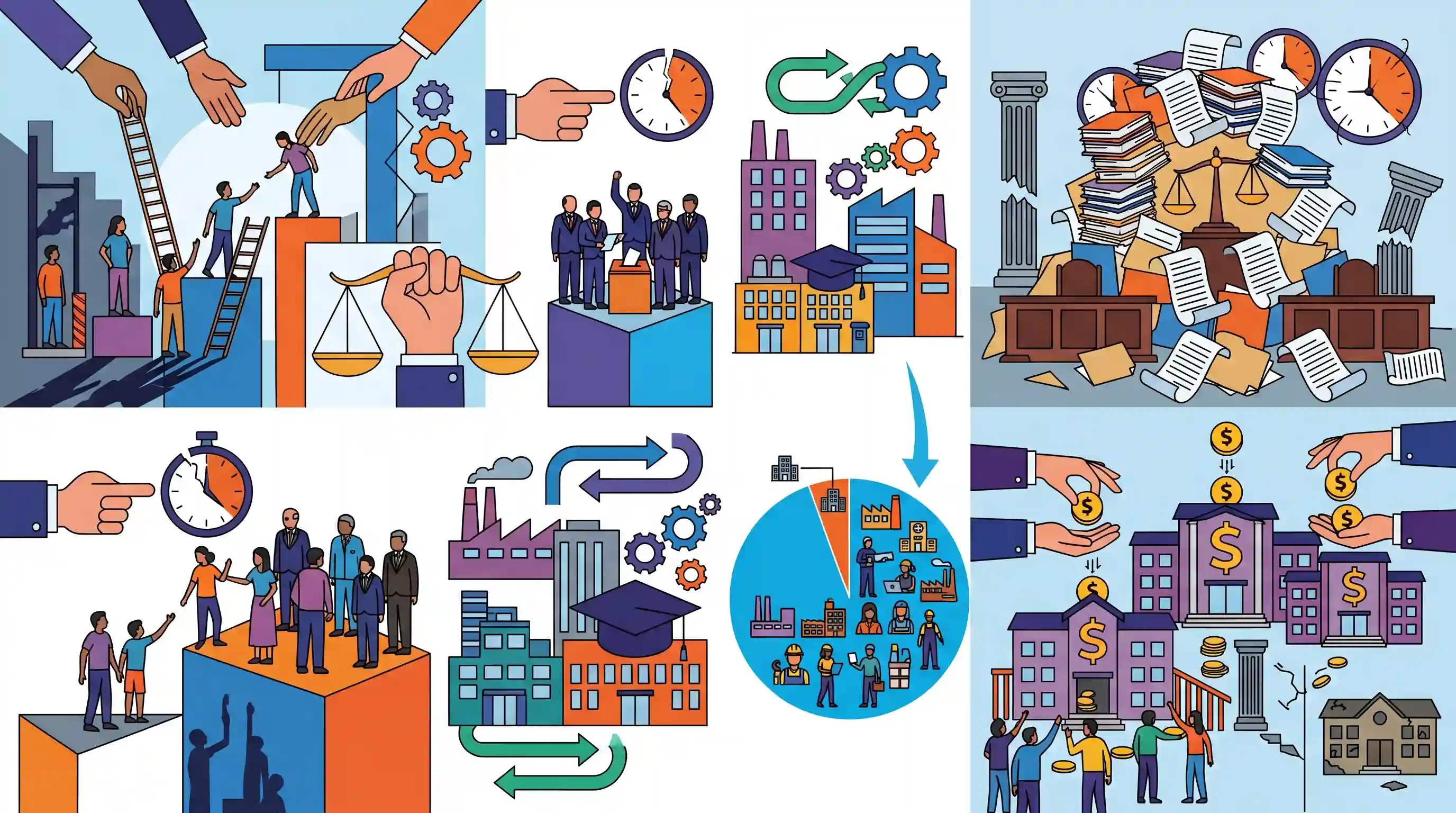
Retired High Court Judge H.N. Nagamohan Das emphasized that India's reservation policy must continue as long as caste-based inequality persists. He clarified a common misconception, noting that the constitutional framers' 10-year limit on reservations was intended solely for political representation, not for public employment or education. Highlighting that government jobs account for only 2% of the workforce, he advocated for extending reservations to the private sector to achieve true social justice for SC, ST, and OBC communities. Additionally, he raised concerns over the severe judicial backlog of over five crore cases caused by critical infrastructure and staff shortages, and criticized the state's withdrawal from public education amidst growing commercialization driven by politicians' vested interests.
Key Points
- Reservation remains an essential mechanism for social justice and must continue as long as the caste system and systemic inequalities exist.
- The Constitution's initial 10-year limitation on reservations applied strictly to political representation (legislatures) and not to reservations in education or employment.
- With government jobs constituting merely 2% of the workforce, extending affirmative action to the private sector is necessary to ensure adequate representation for marginalized communities (SC/ST/OBCs).
- The Indian judiciary is burdened with a backlog of over five crore cases, primarily due to severe shortages of judges, courtrooms, advocates, and administrative staff.
- The state's progressive withdrawal from the public education sector and the conflicting interests of politicians owning private institutions threaten accessible education.
Important Terms
Article 334

Constitutional provision originally mandating a 10-year limit for SC/ST seat reservations in Lok Sabha and State Assemblies. It has been periodically extended, currently valid until 2030.
UPSC context
GS Paper-II (Polity); essential for understanding the temporal nature of political reservation versus permanent nature of social-educational reservation.
Judicial Pendency
The accumulation of unresolved legal cases in the court system. India's backlog currently exceeds five crore cases due to judge shortages and infrastructure gaps.
UPSC context
GS Paper-II (Judiciary); tests knowledge of justice delivery challenges, judge-to-population ratios, and the e-Courts mission.
Private Sector Reservation
Policies requiring private companies to reserve a percentage of jobs for specific social groups. Currently, India lacks a national mandate for private-sector reservation.
UPSC context
GS Paper-II (Social Justice); involves debates on Article 19(1)(g) (freedom of profession) versus affirmative action goals.
Internal Reservation
The sub-classification of Scheduled Castes (SC) to ensure equitable distribution of quota benefits among more marginalized sub-castes, recently upheld by the Supreme Court.
UPSC context
GS Paper-II (Welfare Schemes); critical for questions on social inclusion and the H.N. Nagamohan Das Committee recommendations.
Social Justice
A foundational constitutional principle (Preamble, Article 38) aimed at removing social, economic, and political inequalities through proactive state measures like reservation.
UPSC context
GS Paper-I (Social Issues) & Paper-II; the primary objective driving affirmative action and welfare legislation in India.
Commercialization of Education
The process of treating education as a profit-making business, often criticized for reducing accessibility for marginalized groups as the state withdraws from public funding.
UPSC context
GS Paper-II (Issues relating to Education); relevant for discussions on the Right to Education (RTE) and social equity.
Affirmative Action
Public policies, such as reservation, designed to provide preferential treatment to historically disadvantaged groups to achieve substantive equality.
UPSC context
GS Paper-II (Governance); the broad theoretical framework for India's reservation policy and its evolution.
Prelims Trap
The Constitution originally imposed a 10-year time limit on all reservations, including public employment and education.
Article 334's original 10-year limit applied exclusively to political reservations in the Lok Sabha and State Assemblies, not to education or employment.
Static Concepts Connected
How does the Constitution differentiate types of reservations?
- Articles 15 & 16: Provide affirmative action in education and public employment for marginalized classes. These were enacted without an original constitutional expiration date.
- Articles 330 & 332: Mandate political reservation for SC/STs in the Lok Sabha and State Legislative Assemblies to ensure adequate legislative representation.
- Article 334: Originally set a 10-year expiration for political reservations under Arts 330/332, which has been continuously extended (currently till 2030 via the 104th Amendment).
What are the legal barriers to private sector reservations?
- Constitutional Limits: While Article 16 governs public employment, there is currently no constitutional backing that mandates affirmative action in private sector employment.
- Fundamental Rights: State laws mandating private quotas are frequently challenged in courts for violating Article 19(1)(g) (right to carry on trade/business) and Article 14 (equality).
- Domicile Quotas: Recent attempts by states like Haryana to mandate 75% private sector quotas for locals were struck down by the High Court for violating constitutional structures.
Cross-Topic Patterns
Shrinking State & Private Quotas
As government footprint shrinks (formal govt jobs are only 2% of the workforce), PSU privatization accelerates demands for private sector affirmative action to offset lost representation opportunities.
Marketisation of Public Goods
The state's withdrawal from public education parallels public healthcare privatization, framing a classic Mains debate on whether marketisation undermines equitable human capital formation for marginalized groups.

Expect a 2026 prelims statement testing the distinction between Article 334's political quota timeline and Articles 15/16's open mandate.
Linked PYQs · 3
Linked PYQs · 3
- 2022MainsGS2
Discuss the role of the National Commission for Backward Classes in the wake of its transformation from a statutory body to a constitutional body.
- 2023MainsGS2
Skill development programmes have succeeded in increasing human resources supply to various sectors. In the context of the statement analyse the linkages between education, skill and employment.
- 2017MainsEssay
Destiny of a nation is shaped in its classrooms.
