Calicut University researchers develop sustainable nanoclusters
Source:The Hindu ↗
Why It Matters
The development highlights India's growing research capabilities in nanoscience and sustainable technology. Utilizing non-toxic, cost-effective nanoclusters for highly efficient LEDs aligns with global trends toward environmentally friendly electronics, reducing e-waste toxicity and material costs, making it highly relevant to GS3 (Science and Technology) topics like nanotechnology applications and energy conservation.
Summary
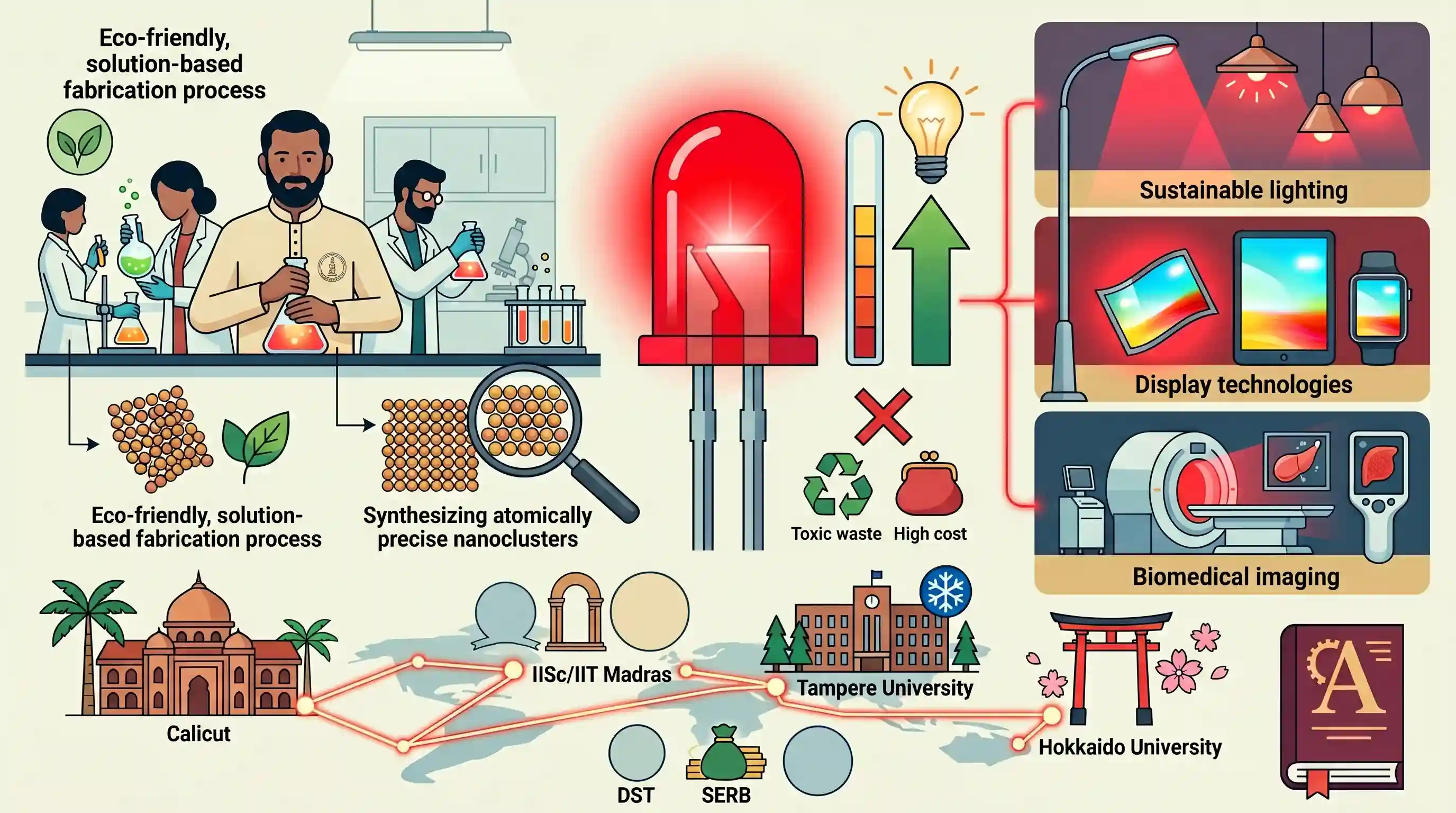
Researchers from the University of Calicut have developed a breakthrough in next-generation light-emitting diode (LED) technology using atomically precise gold-copper alloy nanoclusters. The novel, solution-based fabrication process is environmentally friendly, eliminating the need for toxic or costly host materials. Emitting a pure red light with an external quantum efficiency of 12.6%, the innovation holds promise for sustainable lighting, display technologies, and biomedical imaging. The project, published in the high-impact journal Advanced Materials, was realised through funding from DST and SERB and collaborations with premier institutions like IISc, IIT Madras, Tampere University (Finland), and Hokkaido University (Japan).
Key Points
- Researchers from the University of Calicut have developed a sustainable, cost-effective LED device based on gold-copper alloy nanoclusters.
- The fabrication method is environmentally friendly, avoiding toxic or expensive host materials typically used in conventional LEDs.
- The device features atomically precise nanoclusters, emits pure red light, and records a high external quantum efficiency of 12.6%.
- The research was published in Advanced Materials and supported through international collaborations with institutions in Finland and Japan, alongside IISc and IIT Madras.
Important Terms
Promotion of University Research and Scientific Excellence (PURSE)

A flagship scheme by the Department of Science and Technology (DST) to strengthen research capacity and infrastructure in performing Indian universities based on their scientific output.
UPSC context
GS Paper III: S&T; Institutional capacity building and government funding for research in higher education.
Science and Engineering Research Board (SERB)
A statutory body under the Department of Science and Technology (DST) established in 2009 to promote and fund basic research in emerging areas of science and engineering.
UPSC context
GS Paper III: S&T; Nodal agency for R&D funding and its successor, the Anusandhan National Research Foundation (ANRF).
Department of Science and Technology (DST)
The nodal ministry department in India for promoting new areas of science and technology and acting as a nodal agency for organizing and coordinating S&T activities.
UPSC context
GS Paper III: S&T; Role of government departments in fostering innovation and indigenous technological development.
Startup Research Grant
A two-year grant provided by SERB to help early-career researchers and first-time faculty members establish independent research careers in frontier areas of science.
UPSC context
GS Paper III: S&T; Government schemes supporting young scientists and fostering an innovation-led ecosystem.
Indian Institute of Science (IISc)
A premier public research university for higher education and research in science, engineering, and management, consistently ranked as India's top university in various global rankings.
UPSC context
GS Paper III: S&T; Role of premier national institutions in collaborative high-impact scientific breakthroughs.
Indian Institute of Technology (IIT) Madras
A public technical and research university located in Chennai, recognized as an Institute of Eminence and known for its contributions to industrial research and engineering innovation.
UPSC context
GS Paper III: S&T; Institutional contributions to indigenous technology and industry-academia collaboration.
Prelims Trap
Nanoscale gold particles retain the same optical properties and yellow color as bulk gold.
Bulk gold is yellow, but at the nanoscale, gold exhibits size-dependent optical properties (like emitting red or blue hues) due to surface plasmon resonance and quantum confinement.
Static Concepts Connected
How do the optical properties of metals change at the nanoscale?
- Surface Plasmon Resonance: The collective oscillation of surface electrons in metal nanoparticles absorbs specific light wavelengths, fundamentally changing their visible color compared to bulk metals.
- Quantum Confinement: As particle size shrinks below certain limits, electron energy levels become discrete, allowing nano-materials to emit highly specific colors, such as pure red.
What are the key features of the Anusandhan National Research Foundation (ANRF)?
- Replaces SERB: The ANRF Act 2023 subsumed the Science and Engineering Research Board (SERB), making ANRF the new apex body to provide strategic direction for India's R&D.
- Private Sector Funding: It aims to raise approximately 70% of its massive ₹50,000 crore budget (over 5 years) from non-government and private-sector sources.
- Apex Leadership: The Prime Minister of India serves as the ex-officio President of the ANRF Governing Board.
Cross-Topic Patterns
Eco-friendly electronics & E-Waste Rules
Conventional advanced LEDs rely on toxic lead. This non-toxic nanocluster innovation directly supports the Reduction of Hazardous Substances (RoHS) mandate under India's E-Waste (Management) Rules, 2022.
Biomedical imaging via nanoclusters
Beyond lighting, the unique luminescence and molecular sensitivity of gold nanoclusters make them highly effective for non-invasive disease diagnostics, linking nanotechnology to health-tech syllabus areas.

Properties of bulk vs. nano-materials (e.g., gold's color shift) and the mandate of the newly formed ANRF are prime 2026 Prelims targets.
Linked PYQs · 5
Linked PYQs · 5
- 2025MainsGS3
How does nanotechnology offer significant advancements in the field of agriculture? How can this technology help to uplift the socio-economic status of farmers?
- 2020MainsGS3
What do you understand by nanotechnology and how is it helping in health sector?
- 2017PrelimsGS1
Organic Light Emitting Diodes (OLEDs) are used to create digital display in many devices. What are the advantages of OLED displays over Liquid Crystal displays? 1. OLED displays can be fabricated on flexible plastic substrates. 2. Roll-up displays embedded in clothing can be made using OLEDs. 3. Transparent displays are possible using OLEDs. Select the correct answer using the code given below:
- 2021PrelimsGS1
With reference to street-lighting, how do sodium lamps differ from LED lamps? 1. Sodium lamps produce light in 360 degrees but it is not so in the case of LED lamps. 2. As street-lights, sodium lamps have longer life span than LED lamps. 3. The spectrum of visible light from sodium lamps is almost monochromatic while LED lamps offer significant colour advantages in street-lighting. Select the correct answer using the code given below.
- 2022PrelimsGS1
Consider the following statements: 1. Other than those made by humans, nanoparticles do not exist in nature. 2. Nanoparticles of some metallic oxides are used in the manufacture of some cosmetics. 3. Nanoparticles of some commercial products which enter the environment are unsafe for humans. Which of the statements given above is/are correct?
