IISER Pune Researchers Boost RNA Based Biosensor Sensitivity
Source:Indian Express ↗
Why It Matters
It highlights practical applications of synthetic biology and molecular diagnostics, crucial for UPSC GS3 Science & Technology and Healthcare. It offers solutions for pandemic preparedness and accessible healthcare in low-resource settings, aligning with India's public health priorities.
Summary
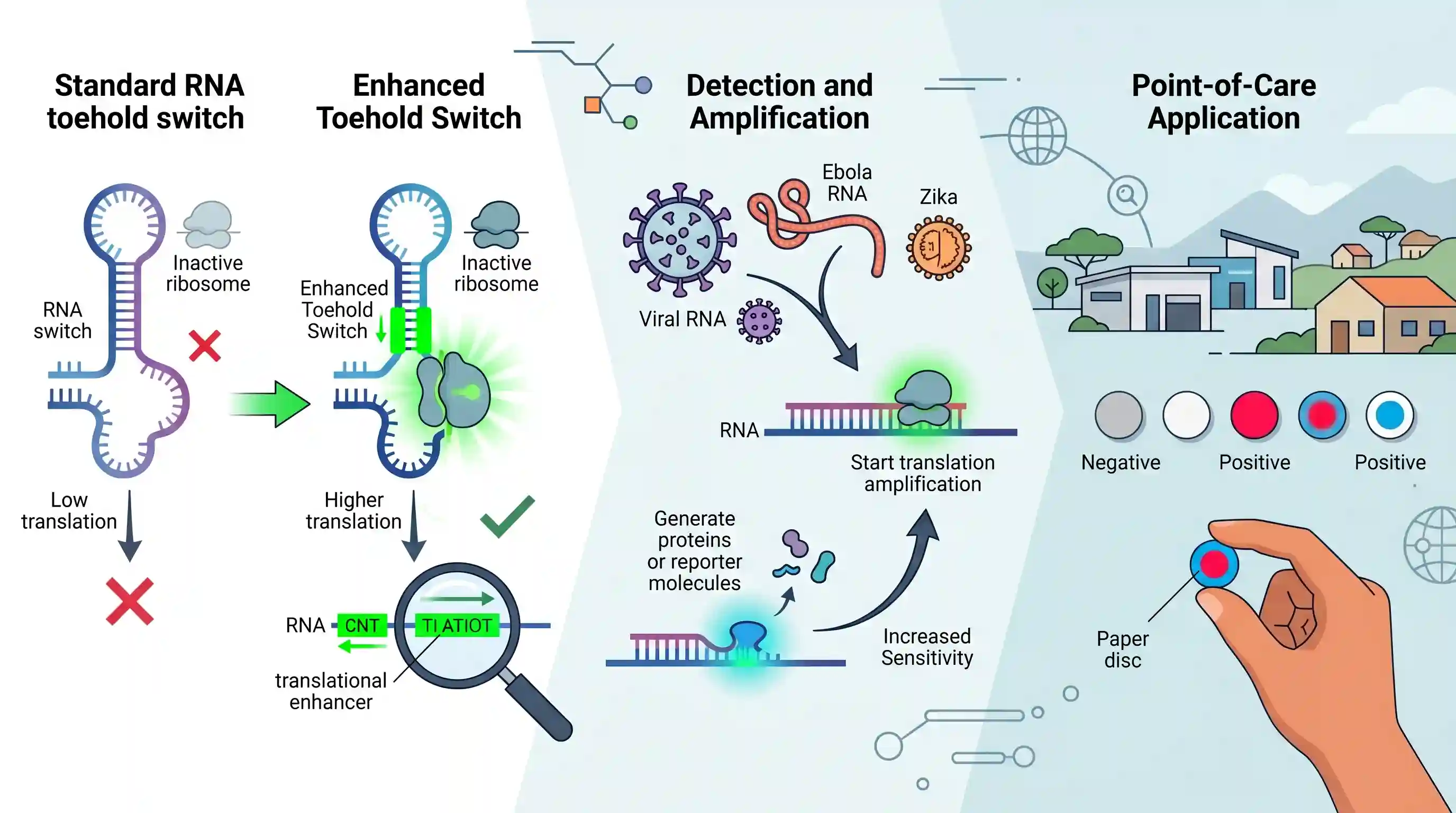
Researchers at the Indian Institute of Science Education and Research (IISER) Pune have developed a novel synthetic biology strategy to enhance the sensitivity of RNA-based biosensors known as 'toehold switches'. By incorporating translational enhancers into the genetic sequence, the biosensors can more rapidly and accurately detect viral RNA from diseases such as Covid-19, Zika, and Ebola. The system operates as a genetic device that outputs a distinct color signal in the presence of the target pathogen. This breakthrough paves the way for highly sensitive, paper-disc molecular diagnostic tests that are field-ready and accessible, offering a significant boost to point-of-care disease detection in low-resource and remote environments.
Key Points
- Researchers at IISER Pune have enhanced the sensitivity of RNA-based biosensors, specifically 'toehold switches', using synthetic biology.
- The strategy involves inserting translational enhancers upstream of the toehold region to accelerate protein production and signal generation.
- The biosensors act as genetic devices that produce a visual color signal upon detecting target viral RNA from pathogens like Covid-19, Zika, and Ebola.
- This advancement enables the development of accessible, paper-disc based molecular point-of-care diagnostics.
- The technology is highly suited for field deployment and rapid disease detection in low-resource settings without needing complex lab equipment.
Important Terms
Synthetic Biology

An interdisciplinary field that applies engineering principles to biology to design and construct new biological parts, devices, and systems, or to redesign existing natural systems for useful purposes.
UPSC context
GS Paper III (Science & Technology/Biotechnology); tests understanding of emerging disruptive technologies and their multi-sectoral applications.
Toehold Switches
Synthetic RNA-based riboregulators that act as genetic switches, activating protein production only in the presence of a specific target "trigger" RNA, such as a viral sequence.
UPSC context
GS Paper III (Biotechnology); relevant for questions on molecular diagnostics, gene regulation, and low-cost disease detection tools.
Biosensors
Analytical devices combining a biological recognition element (like enzymes or nucleic acids) with a transducer to convert a biological response into a measurable signal for detecting specific substances.
UPSC context
GS Paper III (Science & Technology); focuses on the application of biological tools in healthcare, agriculture, and environmental monitoring.
Point-of-Care (POC) Diagnostics
Medical diagnostic testing performed at or near the site of patient care, providing rapid results to facilitate immediate clinical decisions without requiring centralized laboratory infrastructure.
UPSC context
GS Paper II (Health) & GS Paper III (S&T); tests knowledge of improving healthcare accessibility in rural or resource-limited settings.
IISER Pune
A premier autonomous research and education institution established in 2006 by the Ministry of Education; it is designated as an 'Institute of National Importance' focusing on basic sciences.
UPSC context
Prelims/GS Paper III; identifies key Indian institutions leading indigenous R&D and scientific innovation in basic and applied sciences.
Prelims Trap
RNA-based diagnostic tests mandate complex cold-chain infrastructure and sophisticated laboratory equipment to function.
Aspirants often confuse standard RNA tests (like RT-PCR) with these biosensors. These novel 'toehold switches' are specifically engineered as paper-disc, field-ready diagnostics needing no complex labs.
Static Concepts Connected
What are the three core functional components of a typical biosensor?
- Bioreceptor: A biological element (like enzymes, antibodies, or engineered RNA) that recognizes and binds specifically to the target analyte.
- Transducer: A component that converts the biological interaction into a measurable signal (e.g., optical color change, electrical current).
- Amplifier/Processor: The system that enhances and interprets the transducer's signal, outputting it to a readable display for the user.
How does Synthetic Biology differ from traditional genetic engineering?
- Engineering Approach: It applies engineering principles to design biological systems from scratch, rather than merely transferring existing genes between organisms.
- Standardized Parts: It uses well-characterized, modular biological parts (like 'BioBricks') to assemble programmable genetic circuits and devices (like toehold switches).
- Broader Applications: Beyond agriculture, it is heavily focused on biomanufacturing, programmable therapeutics, and advanced environmental or medical biosensors.
Cross-Topic Patterns
Biosensors and Zoonotic Disease Surveillance
Rapid, field-deployable tools for detecting Ebola and Zika connect to India's One Health framework, enabling early detection of zoonotic disease spillovers in remote forest fringes.
Point-of-care diagnostics in rural health
Accessible paper-disc molecular tests align perfectly with the mandate of Ayushman Arogya Mandirs (Health & Wellness Centres) to provide decentralized, low-cost diagnostics at the grassroots level.

"Toehold switches" or "synthetic biology biosensors" are highly likely to appear in a 2026 Prelims application-based pairing question.
Linked PYQs · 2
Linked PYQs · 2
- 2021MainsGS3
What are the research and developmental achievements in applied biotechnology? How will these achievements help to uplift the poorer sections of the society?
- 2019PrelimsGS1
With reference to the recent developments in science, which one of the following statements is not correct?
