Adaptive Synthetic Materials and Nanotechnology Applications
Source:The Hindu ↗
Why It Matters
The development of adaptive synthetic materials represents a critical intersection of nanotechnology, artificial intelligence (neuromorphic principles), and material science. Its wide-ranging applications in healthcare, robotics, and aerospace make it highly relevant for GS-3 questions concerning technological advancements and their practical applications.
Summary
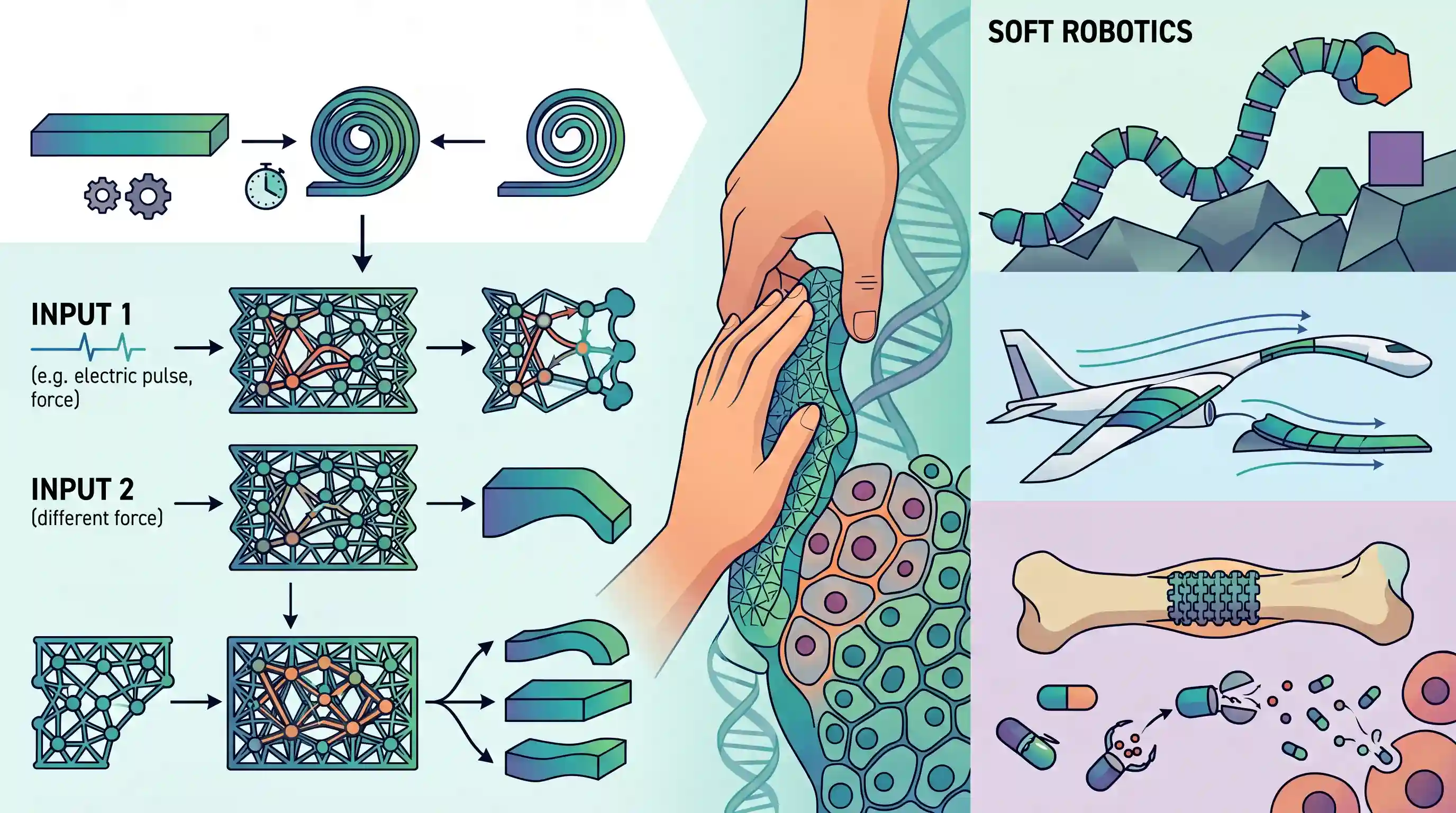
Researchers have developed advanced synthetic materials capable of "learning" to change their shape, marking a significant evolution in the field of smart materials. Unlike traditional shape-memory materials that have a fixed response to external stimuli (such as heat or light), these new materials integrate principles akin to artificial neural networks and metamaterials. This allows them to adapt their physical responses based on previous interactions and environmental inputs. This breakthrough bridges the gap between static artificial materials and adaptive biological systems, offering transformative potential across various sectors. Key applications include soft robotics for unpredictable environments, aerospace for adaptive structural components, and biomedicine for creating smart, responsive implants and dynamic drug-delivery mechanisms.
Key Points
- Conventional smart materials (like shape-memory alloys) react to stimuli in a fixed manner, whereas the newly developed synthetic materials can adapt their responses based on past inputs, mimicking biological learning.
- These materials utilize concepts from mechanical neural networks and metamaterials, engineered to process physical inputs and mechanically adapt.
- Biomedical applications include adaptive medical implants, targeted drug-delivery nanosystems, and smart stents that adjust dynamically to a patient's healing process.
- The technology offers significant advancements for soft robotics (enabling machines to navigate unpredictable terrains) and aerospace engineering (facilitating adaptive structures like morphing wings).
Prelims Trap
"Metamaterials derive their unique shape-shifting and optical properties from their rare chemical composition."
Metamaterials derive their unique properties (like negative refraction) from their engineered geometric microscopic structures, not their base chemical makeup.
Static Concepts Connected
What are the defining characteristics of Metamaterials?
- Structural origin: Properties emerge from artificially engineered microscopic geometric structures rather than the raw chemical composition of the material.
- Negative refraction: They can bend electromagnetic waves (like light) in unnatural ways, forming the theoretical basis for "invisibility cloaks".
- Wave manipulation: Their engineered structure allows them to selectively absorb, block, or redirect sound, vibration, and seismic waves.
How do traditional Shape Memory Alloys (SMAs) work?
- Phase transformation: SMAs (like Nitinol) undergo fixed thermo-elastic phase changes between martensite and austenite phases to return to a pre-programmed shape.
- Fixed response: Unlike the new synthetic metamaterials, SMAs have a hardcoded response to heat or stress and cannot "learn" or adapt to new stimuli.
Cross-Topic Patterns
AI escaping the software domain
UPSC typically frames AI around software and algorithms. This development introduces "mechanical neural networks"—AI principles embedded directly into physical structures, blending material science with machine learning.
Defense tech and morphing wings
Shape-learning materials in aerospace link directly to advanced stealth UAV development. Morphing wings optimize aerodynamic efficiency and radar evasion by eliminating conventional rigid moving parts.

Expect a 2026 Prelims question distinguishing between Shape Memory Alloys (fixed chemical response) and Metamaterials (structural/adaptive).
Linked PYQs · 4
Linked PYQs · 4
- 2020MainsGS3
What do you understand by nanotechnology and how is it helping in health sector?
- 2015MainsGS3
What are the areas of prohibitive labour that can be sustainably managed by robots ? Discuss the initiatives that can propel research in premier research institutes for substantive and gainful innovation.
- 2025PrelimsGS1
Consider the following statements: I. It is expected that Majorana 1 chip will enable quantum computing. II. Majorana 1 chip has been introduced by Amazon Web Services (AWS). III. Deep learning is a subset of machine learning. Which of the statements given above are correct?
- 2025MainsGS3
How does nanotechnology offer significant advancements in the field of agriculture? How can this technology help to uplift the socio-economic status of farmers?
