IIT Bombay Needle-Free Shock Syringes for Healthcare
Source:Indian Express ↗
Why It Matters
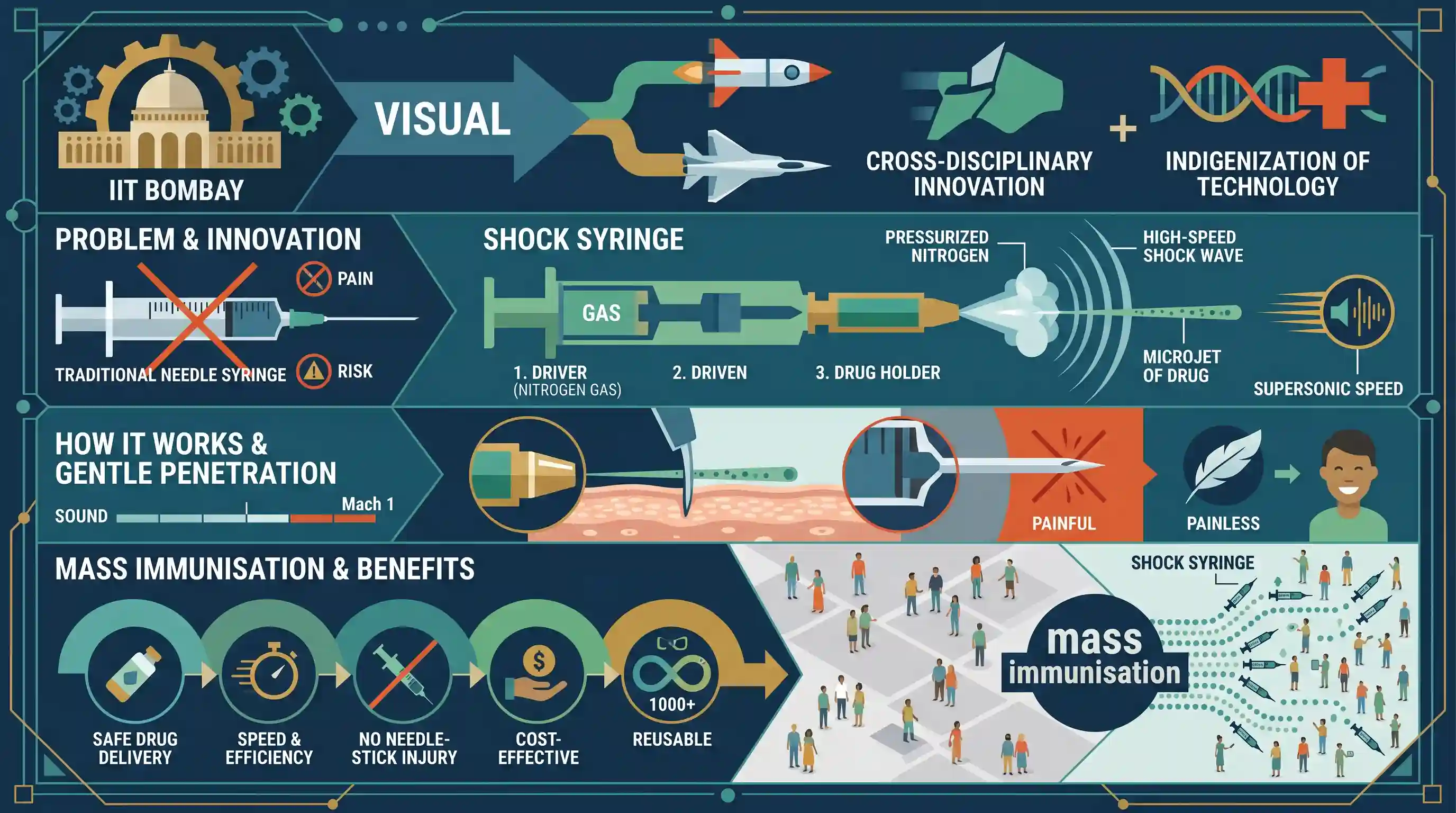
Demonstrates the successful application of aerospace engineering principles (shock waves) to solve critical healthcare challenges, reflecting the growing importance of indigenous innovation and interdisciplinary research in improving India's public health infrastructure and immunisation efficiency.
Summary
Researchers at IIT Bombay have engineered a needle-free "shock syringe" that utilizes high-speed shock waves to administer medication painlessly. Driven by pressurized nitrogen gas, the device creates a microjet of the drug that travels faster than the speed of sound to penetrate the skin gently. This cross-disciplinary innovation—merging aerospace principles with biomedicine—promises to enhance the speed and safety of mass immunisation drives, eliminate needle-stick injury risks, and offer cost-effective, reusable drug delivery solutions.
Key Points
- Researchers at IIT Bombay have developed a needle-free "shock syringe" that uses high-energy pressure waves (shock waves) to administer drugs without piercing the skin.
- The device features a micro shock tube where pressurized nitrogen gas generates a microjet of liquid drug that travels nearly twice as fast as a commercial airplane at takeoff.
- The jet stream gently penetrates the skin, providing a rapid, painless injection while avoiding tissue trauma associated with regular syringes.
- This technology promises to make large-scale immunisation drives more efficient and prevents the spread of bloodborne diseases caused by accidental needle-stick injuries or improper disposal.
- The shock syringes are reusable and can deliver over 1,000 shots (with nozzle replacement), offering long-term reliability and cost-effectiveness.
Important Terms
Indigenization of Technology

The development, adaptation, and manufacturing of technological products within a country using local resources and skills to reduce foreign dependency and achieve self-reliance.
UPSC context
GS Paper 3 syllabus keyword; tests understanding of India's technological sovereignty and the 'Atmanirbhar Bharat' initiative in strategic sectors.
Needle-free Injection System (NFIS)
Medical devices that deliver vaccines or drugs into the body without piercing the skin with a needle, using mechanisms like high-pressure gas, springs, or shock waves.
UPSC context
GS Paper 3 (Science & Tech) and GS Paper 2 (Health); tests knowledge of healthcare innovations that improve safety and patient compliance.
Shock Waves
Rapidly propagating pressure waves that travel through a medium faster than the speed of sound, causing sudden changes in pressure, temperature, and density.
UPSC context
GS Paper 3 (General Science); tests the practical application of physical principles in advanced medical engineering and drug delivery.
Mass Immunization
Large-scale, systematic vaccination of a population to prevent the spread of infectious diseases, exemplified by programs like India's Universal Immunization Programme (UIP).
UPSC context
GS Paper 2 (Social Justice/Health); tests awareness of public health strategies, government schemes (Mission Indradhanush), and global health security.
Microjets
Ultra-fine, high-velocity liquid streams capable of penetrating human skin to deliver therapeutic doses without the mechanical trauma of a traditional hypodermic needle.
UPSC context
GS Paper 3 (Science & Tech); tests knowledge of emerging biotechnology mechanisms for precise and minimally invasive medical treatments.
IIT Bombay
A premier public technical university in Mumbai, designated as an Institute of Eminence, playing a critical role in India's R&D, innovation, and indigenization.
UPSC context
GS Paper 3; tests understanding of the role of premier educational and research institutes in national technological development.
Prelims Trap
"The shock syringe utilizes high-frequency electromagnetic pulses to administer drugs without piercing the skin."
The term "shock" refers to aerodynamic pressure waves (created by pressurized nitrogen gas moving faster than sound), not electrical or electromagnetic shocks.
Static Concepts Connected
What is a 'shock wave' in the context of physics and aerodynamics?
- Supersonic speed: A propagating disturbance that moves faster than the local speed of sound in the medium.
- Abrupt change: It carries energy and causes an abrupt, nearly discontinuous change in pressure, temperature, and density of the medium.
- Examples: Sonic booms, explosions, and supersonic aircraft wakes are common examples of shock waves in a gaseous medium.
What are Needle Stick Injuries (NSIs) and their associated public health risks?
- Definition: Accidental skin-penetrating wounds caused by hollow-bore needles or other sharp medical instruments used in healthcare.
- Disease Transmission: They are the primary occupational vector for transmitting blood-borne pathogens like Hepatitis B, Hepatitis C, and HIV among healthcare workers.
- Mitigation: Proper bio-medical waste disposal, auto-disable syringes, and emerging needle-free delivery systems are key mitigating strategies.
Cross-Topic Patterns
Aerospace principles in biomedical tech
UPSC frequently tests cross-domain tech applications, similar to ISRO's polyurethane used for artificial limbs or space-grade telemetry applied to remote medical monitoring.
Mission Indradhanush logistics & waste
Needle-free delivery and reusable syringes directly mitigate the bio-medical waste management and occupational hazard challenges of massive drives like the Universal Immunisation Programme.

Expect a Prelims S&T question testing the mechanism of 'shock syringes', specifically contrasting acoustic/pressure waves with electrical shocks.
Linked PYQs · 3
Linked PYQs · 3
- 2015PrelimsGS1
With reference to the use of nano-technology in health sector, which of the following statements is/are correct? 1. Targeted drug delivery is made possible by nanotechnology. 2. Nanotechnology can largely contribute to gene therapy. Select the correct answer using the code given below.
- 2020MainsGS3
What do you understand by nanotechnology and how is it helping in health sector?
- 2024MainsGS2
In a crucial domain like the public healthcare system the Indian State should play a vital role to contain the adverse impact of marketisation of the system. Suggest some measures through which the State can enhance the reach of public healthcare at the grassroots level.
