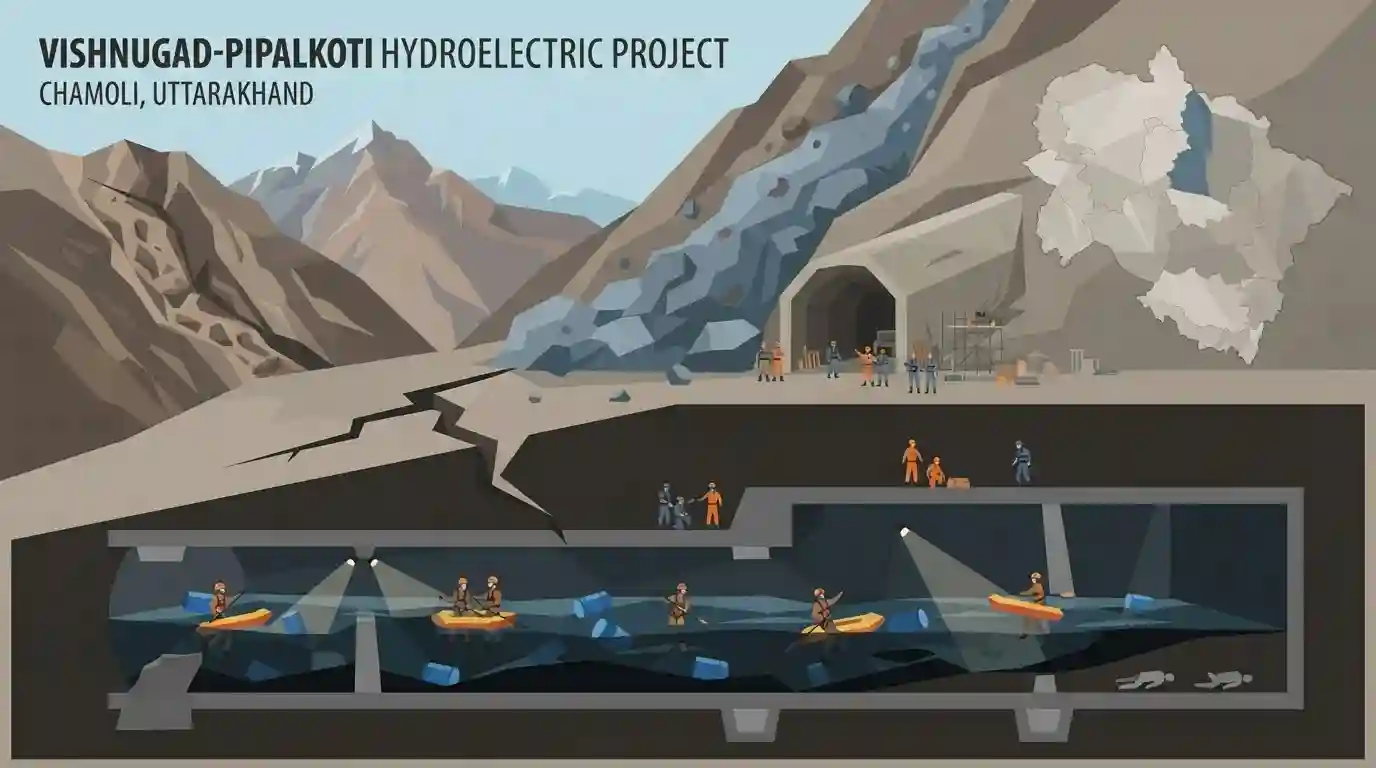
Chamoli Hydropower Site Tunnel Flooding Search Operations
Source:we-news ↗
Why It Matters
The incident underscores the geographical and ecological fragility of the Himalayan region, which makes large-scale infrastructure projects like hydropower dams highly susceptible to natural disasters like landslides and flash floods. It is highly relevant for UKPSC Prelims regarding state geography, major hydroelectric projects (like Vishnugad-Pipalkoti), and disaster management operations (NDRF/SDRF).
Summary
Rescue teams comprising the NDRF, SDRF, ITBP, and other state agencies are conducting search operations using blue drums at the Vishnugad-Pipalkoti Hydroelectric Project in Chamoli, Uttarakhand. The operation follows a devastating deluge caused by a landslide that flooded the project's Tail Race Tunnel (TRT). The incident has resulted in the deaths of eight workers, with two still missing. The hydropower project is managed by THDCIL and the construction was being executed by Hindustan Construction Company (HCC). This disaster highlights the extreme vulnerability of infrastructure projects in the fragile Himalayan ecosystem.
Key Points
- Rescue operations using blue drums and life jackets are ongoing to find missing workers at the Vishnugad-Pipalkoti Hydroelectric Project in Chamoli.
- A landslide caused a massive deluge, flooding the Tail Race Tunnel (TRT) and trapping workers inside.
- The hydroelectric project is managed by THDCIL and executed by Hindustan Construction Company (HCC).
- Multi-agency search efforts involve NDRF, SDRF, ITBP, Army, and local police, following the death of 8 workers in the incident.
Important Terms
THDCIL (THDC India Limited)

A public sector enterprise under the Ministry of Power that develops and operates hydroelectric projects. It manages the Vishnugad-Pipalkoti Hydroelectric Project in Uttarakhand where the recent tunnel deluge occurred.
UPSC context
Relevant for GS Paper 3 (Energy/Infrastructure) and state exams, testing knowledge of Uttarakhand's hydropower potential, development projects, and ecological risks.
HCC (Hindustan Construction Company)
A major Indian engineering and construction firm responsible for executing large-scale infrastructure projects. They were carrying out the construction work at the flooded Vishnugad-Pipalkoti Tail Race Tunnel in Chamoli.
UPSC context
Tests GS Paper 3 (Infrastructure/Disaster Management) awareness regarding the role and accountability of private contractors in vulnerable Himalayan development projects.
NDRF (National Disaster Response Force)
India's specialized, multi-skilled force established under the Disaster Management Act of 2005. It conducts rescue and relief operations during major natural and man-made emergencies, including complex tunnel collapses.
UPSC context
Crucial for GS Paper 3 (Disaster Management). It evaluates understanding of India's statutory emergency response framework and central-level intervention capabilities.
SDRF (State Disaster Response Force)
A specialized wing of the Uttarakhand Police trained for immediate local search and rescue operations during regional disasters, such as floods, landslides, and infrastructure failures in difficult Himalayan terrain.
UPSC context
Vital for UKPSC specific papers (Geography/Disaster Management), testing knowledge of state-level emergency preparedness, local agency coordination, and rapid crisis response.
ITBP (Indo-Tibetan Border Police)
A Central Armed Police Force primarily guarding the India-China border. Given its high-altitude deployment, it frequently assists in complex mountain rescue operations and disaster management in the Himalayan region.
UPSC context
Important for GS Paper 3 (Security Forces). Tests knowledge of border forces' secondary mandates, specifically their crucial humanitarian role in regional disasters.
Prelims Trap
The Vishnugad-Pipalkoti HEP is located on the Bhagirathi River and funded by the ADB.
The project is actually a run-of-the-river facility on the Alaknanda River in Chamoli, backed financially by the World Bank, not the Asian Development Bank.
Static Concepts Connected
What are the key geographical features and confluences of the Alaknanda River?
- Glacial Origin: It originates from the confluence of the Satopanth and Bhagirath Kharak glaciers above Badrinath in the Garhwal Himalayas.
- Panch Prayag: Merges with major tributaries to form the Panch Prayag, ultimately joining the Bhagirathi at Devprayag to form the Ganga.
What characterizes Run-of-the-River (RoR) hydroelectric projects?
- Natural Flow Mechanism: Generates electricity using the natural river flow and elevation drop, avoiding the need for massive, large-scale reservoirs.
- Tail Race Tunnel: A critical underground conduit (TRT) that discharges water back into the river basin after power generation, vulnerable to mudslides.
Cross-Topic Patterns
Hydropower & Himalayan Fragility
Recurrent incidents like this and the Tapovan disaster link infrastructure push with EIA norms, making 'carrying capacity of the Himalayas' a highly probable Mains topic.
ITBP in Disaster Management
Beyond Indo-China border guarding duties, ITBP's specialized high-altitude training makes them crucial first responders for Uttarakhand's glacial, riverine, and tunnel disasters.

Expect a match-the-following prelims question pairing recent Uttarakhand HEPs (Vishnugad, Tapovan) with their rivers and host districts.
Linked PYQs · 4
Linked PYQs · 4
- 2024UKPSC_PRELIMSGS1
Match the hydroelectric projects with the river on which they are constructed : | Name of Project | River | |---|---| | A. Koteshwar | 1. Asan | | B. Kulhal | 2. Alaknanda | | C. Tapoban Vishnugad | 3. Bhagirathi | | D. Vishnuprayag | 4. Dhalui | A B C D
- 2016UKPSC_PRELIMSGS1
The biggest Hydro-Electric Project of Uttarakhand State is:
- 2021UKPSC_PRELIMSGS1
At which place in Uttarakhand did the Indian, Meteorological Department install a Doppler Weather Radar?
- 2024UKPSC_PRELIMSGS1
Durmital is located in which of the following district of Uttarakhand ?
