Tiger Reintroduction and Habitat Restoration in Protected Reserves
Source:The Hindu ↗
ఇది ఎందుకు ముఖ్యం
This article is vital for understanding wildlife conservation strategies, challenges in tiger reintroduction, habitat management, and human-wildlife conflict mitigation in Indian protected areas like Buxa Tiger Reserve.
సారాంశం
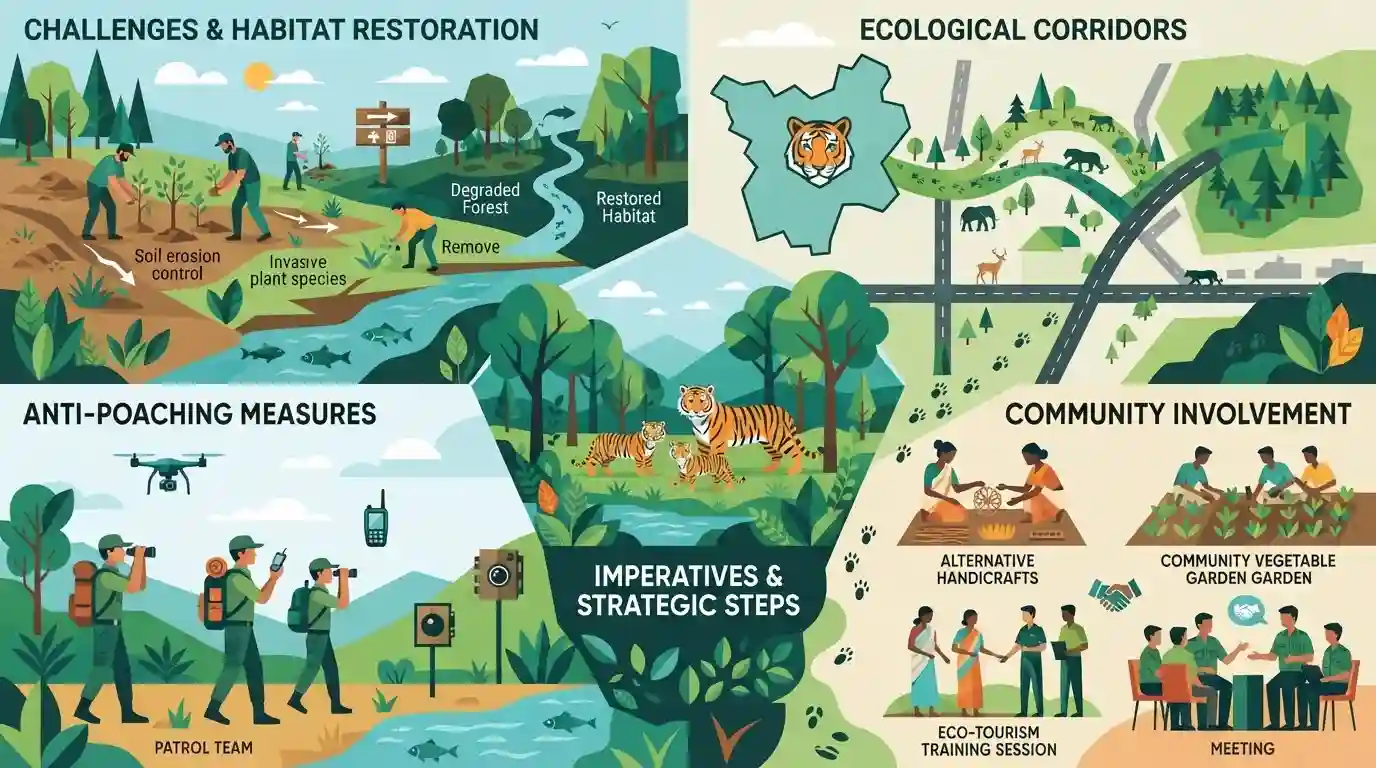
The editorial discusses the challenges, imperatives, and strategic steps involved in the tiger reintroduction and habitat restoration program at the Buxa Tiger Reserve in West Bengal, emphasizing ecological corridors, anti-poaching measures, and community involvement.
ముఖ్య అంశాలు
- Buxa Tiger Reserve in West Bengal is witnessing renewed efforts towards tiger reintroduction and habitat restoration.
- Successful tiger reintroduction requires not just translocation of animals, but rigorous habitat improvement, mitigation of human-wildlife conflict, and secure wildlife corridors.
- Historical depletion of tigers in Buxa underscores challenges related to fragmentation, poaching, and anthropogenic pressures.
- Community participation and local support are vital components for the long-term sustainability of conservation and rewilding initiatives.
ముఖ్యమైన పదాలు
Project Tiger

A centrally sponsored flagship conservation program launched in 1973 by the Government of India to ensure a viable population of Bengal tigers in their natural habitats.
UPSC context
UPSC Prelims/Mains (Environment & Ecology): Tests knowledge of wildlife conservation schemes, protected areas, and species recovery programs.
National Tiger Conservation Authority (NTCA)
A statutory body under the Ministry of Environment, Forest and Climate Change established in 2005, providing statutory authority to Project Tiger for conservation oversight.
UPSC context
UPSC Prelims/Mains (Environment): Tests functions of environmental statutory bodies, wildlife governance, and tiger reserve management.
West Bengal Forest Department
The nodal state government agency responsible for the administration, protection, and scientific management of forests, wildlife, and protected areas within West Bengal.
UPSC context
UPSC Mains (Environment & Governance): Tests federal coordination and implementation of wildlife reintroduction and anti-poaching policies at the state level.
ప్రిలిమ్స్ ఉచ్చు
Buxa Tiger Reserve shares its international boundary with Bangladesh in the eastern foothills of the Himalayas.
Buxa shares its northern boundary with Bhutan and acts as a trans-boundary corridor, not with Bangladesh or Nepal. UPSC frequently tests exact border alignments.
అనుసంధానమైన స్థిర భావనలు
What are the key statutory powers and mandates of the National Tiger Conservation Authority (NTCA) under the Wildlife Protection Act?
- Statutory Origin:: Statutory body established in 2006 under the Wildlife (Protection) Act, 1972, following the recommendations of the Tiger Task Force.
- Core Mandate:: Approves tiger conservation plans, lays down normative standards for tourism and tiger reserves, and oversees Project Tiger implementation.
- Monitoring & Standards:: Provides statutory backing to the Tiger Task Force and ensures quarterly monitoring of tiger status and habitat conditions using M-STREAMS.
అంతర-అంశ నమూనాలు
Buxa Tiger Reserve & Trans-boundary Ecological Diplomacy
Trans-boundary conservation frameworks linking Bhutan and India test bilateral ecological diplomacy alongside strategic security along the Siliguri Corridor.
Wildlife Rewilding vs. Forest Rights Act Implementation
Tiger reintroduction programs like Buxa require balancing strict NTCA conservation protocols with the Forest Rights Act implementation for fringe communities.

NTCA protocols for tiger translocation and trans-boundary ecological corridors (Bhutan-India) are high-yield prelims focus areas.
అనుసంధాన PYQలు · 3
అనుసంధాన PYQలు · 3
- 2019PrelimsGS1
Which of the following are in Agasthyamala Biosphere Reserve?
- 2017PrelimsGS1
From the ecological point of view, which one of the following assumes importance in being a good link between the Eastern Ghats and the Western Ghats?
- 2020PrelimsGS1
Which one of the following protected areas is well-known for the conservation of a sub-species of the Indian swamp deer (Barasingha) that thrives well on hard ground and is exclusively graminivorous?
