Unilateral Sanctions and Strategic Autonomy in Energy Security
Source:Indian Express ↗
Why It Matters
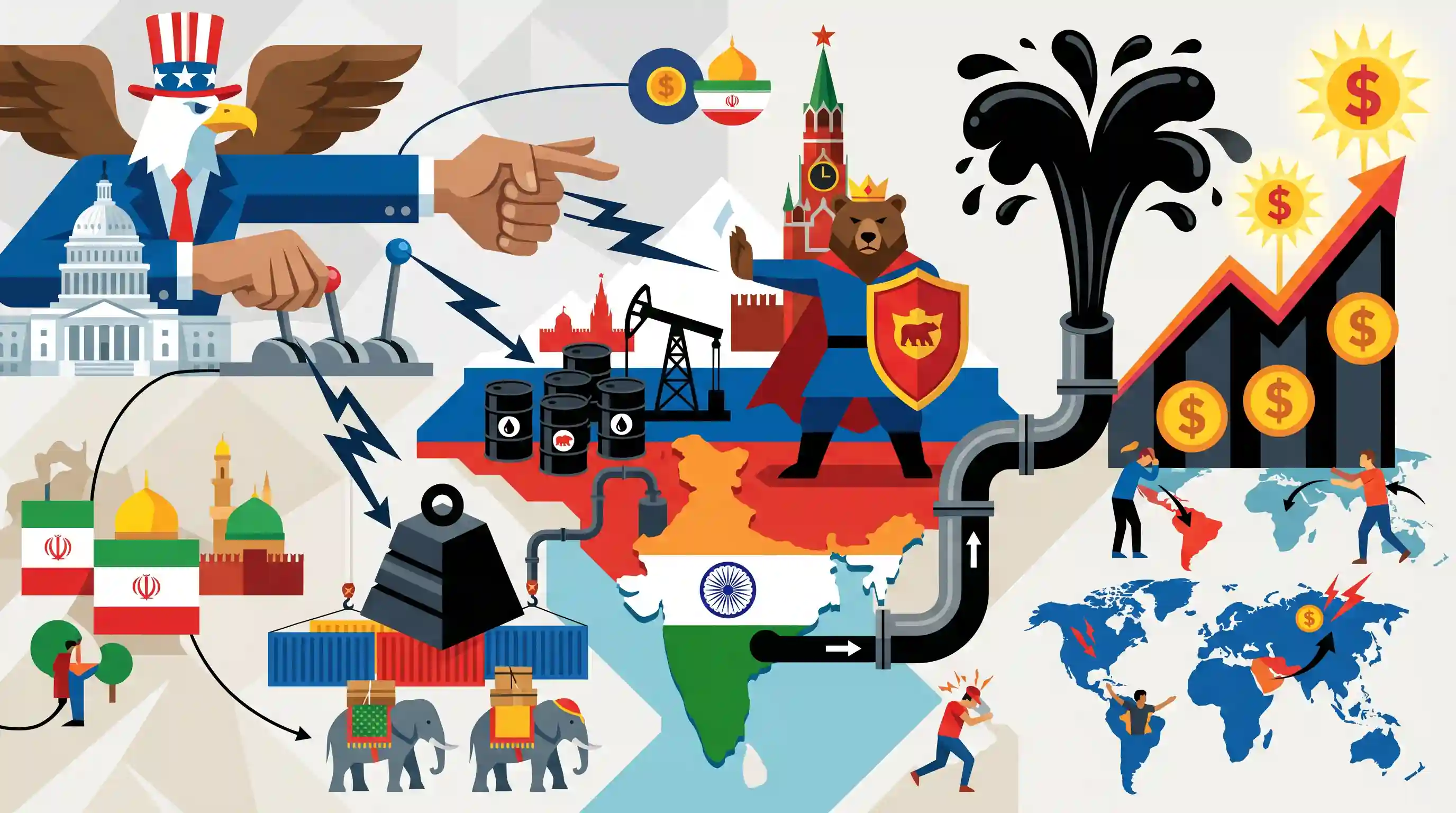
The imposition of a 50% cumulative tariff on Indian goods by the US as a penalty for buying Russian oil highlights the growing friction in India-US ties. It forces India to navigate a complex geopolitical challenge, balancing its critical energy security needs against the economic impact of punitive American trade barriers.
Summary
US President Donald Trump announced that Republican lawmakers are drafting legislation to impose severe sanctions on any country conducting business with Russia, with Iran potentially being added to the list. The move follows recent US sanctions against Russian oil companies Lukoil and Rosneft. Furthermore, the Trump administration has already penalized India for its continued purchase of Russian oil by imposing an additional 25% tariff on Indian goods, bringing the cumulative total to 50%. Russian President Vladimir Putin dismissed the pressure, warning that any artificial restriction in supply could sharply inflate global oil prices and disrupt international energy markets.
Key Points
- US Republican lawmakers are drafting a bill to impose severe sanctions on countries doing business with Russia, with Iran potentially being added to the target list.
- The Trump administration has penalized India for purchasing Russian oil by levying an additional 25% tariff on Indian goods, bringing the cumulative tariff to 50%.
- The US Treasury Department recently sanctioned Russian oil giants Lukoil and Rosneft over Moscow's refusal to negotiate an end to the Ukraine war.
- Russian President Vladimir Putin warned that while the sanctions will not significantly hurt Russia, a sharp plunge in oil supply could inflate global prices.
Important Terms
Secondary Sanctions

Economic penalties imposed by a country on third-party nations or companies that maintain trade or financial ties with a primary sanctioned target.
UPSC context
GS Paper II: International Relations. Tests understanding of unilateralism and its impact on India's energy security and sovereign trade.
Strategic Autonomy
A nation's ability to make independent foreign policy and defense decisions based on national interest, without being constrained by external pressures or formal alliances.
UPSC context
GS Paper II: Indian Foreign Policy. Core principle reflecting India's balancing act between major power blocs (US-Russia-China).
CAATSA
A 2017 US federal law authorizing sanctions on countries that engage in 'significant transactions' with the defense, intelligence, or energy sectors of Russia, Iran, and North Korea.
UPSC context
GS Paper II: International Relations. Crucial for analyzing friction in Indo-US defense deals (S-400) and energy imports.
Extraterritoriality
The application of a nation's domestic laws and legal authority to entities or activities occurring outside its own sovereign borders.
UPSC context
GS Paper II: International Relations. Examines the legal legitimacy and sovereign challenges posed by foreign-imposed economic regimes.
Rosneft
Russia's state-controlled oil giant and its largest exporter, central to the Russian federal budget and a primary target of Western energy sanctions.
UPSC context
GS Paper II & III: Energy Security. Relevant for understanding global oil geopolitics and India's dependency on Russian energy.
Lukoil
Russia's largest non-state oil and gas company; its targeting by US sanctions signals an expansion of pressure beyond Russian state entities.
UPSC context
GS Paper II. Illustrates the widening of global sanction scopes from government ministries to private-sector industrial giants.
Prelims Trap
US secondary sanctions on Russia are legally binding on India under international law and WTO frameworks.
India only recognizes multilateral sanctions imposed by the UN Security Council. US secondary sanctions are unilateral domestic laws relying on dollar dominance, not international law.
Static Concepts Connected
What is the difference between primary and secondary unilateral sanctions?
- Primary sanctions: Prohibit a sanctioning country's own citizens, banks, and companies from doing business with a targeted nation or entity.
- Secondary sanctions: Threaten third-party countries and foreign entities with economic penalties if they engage with the sanctioned target, effectively applying domestic laws extraterritorially.
- Enforcement mechanism: Leveraging the dominance of the US dollar to block non-compliant foreign entities from accessing the global financial system.
How do global oil supply disruptions impact India's macroeconomic indicators?
- Widening CAD: Because India imports ~85% of its crude oil, an artificial price spike drastically inflates the national import bill, worsening the trade balance and Current Account Deficit.
- Imported inflation: Elevated fuel costs cascade through the economy, raising transportation and production costs, which directly pushes up both WPI and CPI inflation.
- Currency depreciation: Expanding trade deficits and increased demand for US dollars to finance expensive oil imports exert severe downward pressure on the Indian Rupee.
Cross-Topic Patterns
Strategic Autonomy vs Secondary Sanctions
India's continued procurement of Russian oil despite US tariffs perfectly illustrates 'strategic autonomy'—prioritizing domestic energy security over Western geopolitical pressures and unilateral extraterritorial laws.
Tariff Weaponization & WTO Decline
The US unilaterally slapping a 50% tariff on Indian goods over political disagreements sidesteps the WTO's dispute settlement mechanisms, highlighting the growing trend of geoeconomic fragmentation.

Expect a 2026 mains question on how US tariff weaponization and extraterritorial sanctions challenge India's strategic autonomy doctrine.
Linked PYQs · 3
Linked PYQs · 3
- 2012MainsGS2
How have the US sanctions against Iran affected India's bilateral relations with Iran?
- 2019MainsGS2
‘What introduces friction into the ties between India and the United States is that Washington is still unable to find for India a position in its global strategy, which would satisfy India's national self-esteem and ambitions.’ Explain with suitable examples.
- 2025MainsGS2
"The reform process in the United Nations remains unresolved, because of the delicate imbalance of East and West and entanglement of the USA vs. Russo-Chinese alliance.” Examine and critically evaluate the East-West policy confrontations in this regard.
