Constitutional Morality and Democratic Public Deliberation in India
Source:Indian Express ↗
Why It Matters
The distinction between the formal celebration of the Republic and the substantive realization of its democratic ideals is a critical analytical framework for GS2 Polity and philosophical Essays. It highlights issues of constitutional morality, freedom of expression, and the essential role of public deliberation in a healthy democracy.
Summary
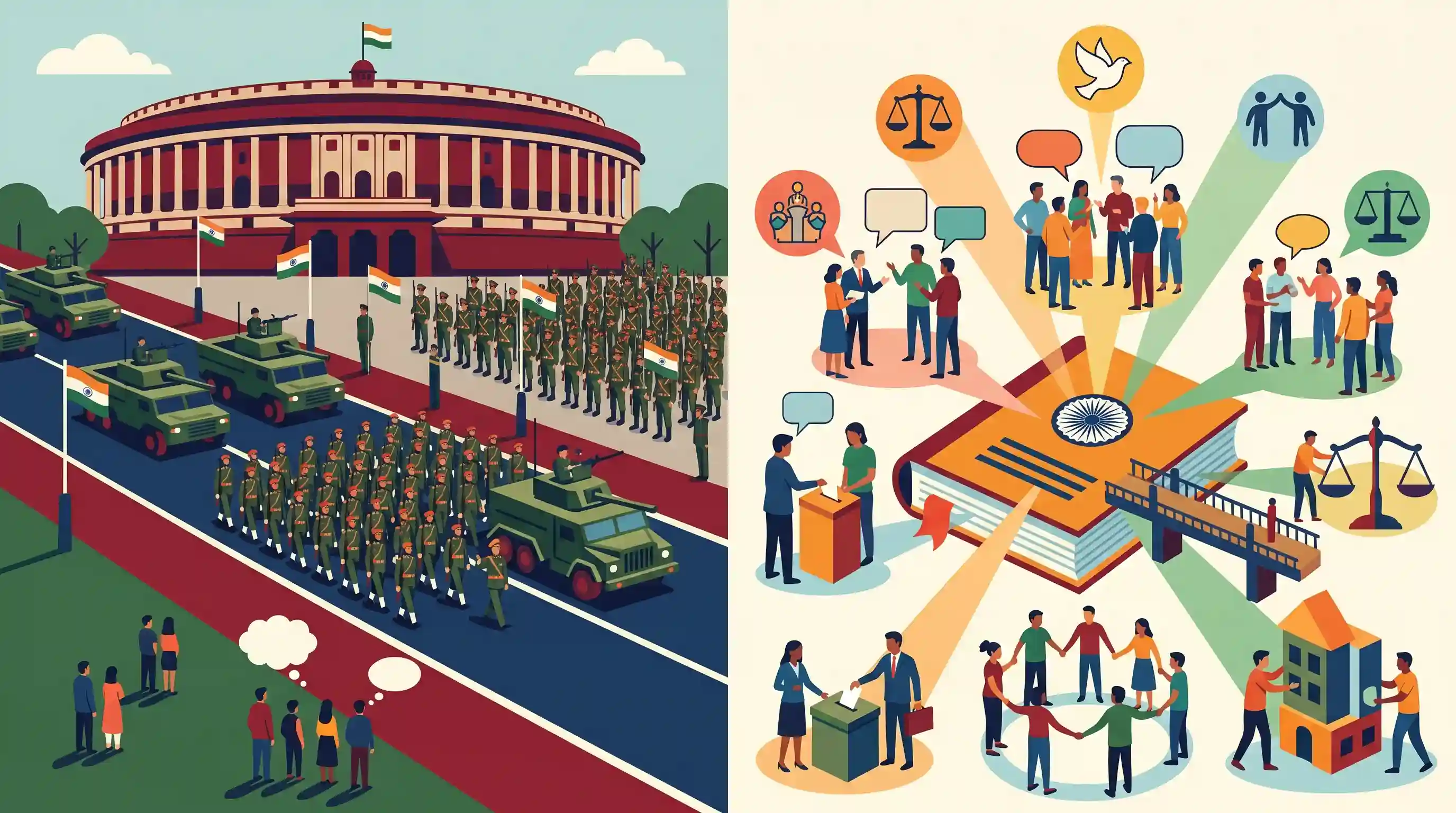
The article reflects critically on the aftermath of Republic Day celebrations, drawing a contrast between the grand spectacle of state power and the "lingering silence" of the public. It explores the substantive state of India's republic, emphasizing that true democratic governance relies on the active engagement and voice of its citizens, rather than mere performative nationalism. The piece underscores the importance of reviving constitutional morality and civic discourse to address democratic deficits, ensuring that the foundational ideals of the Constitution are lived out by an empowered public rather than being overshadowed by state pageantry.
Key Points
- The essence of a republic lies in the active and vocal participation of its citizens, not just in the passive observation of state spectacles.
- While Republic Day celebrations project state power, military might, and cultural heritage, they must not overshadow the substantive role of the ordinary citizen.
- A "lingering silence" among the public indicates a shrinking space for civic discourse, dissent, and democratic deliberation.
- Reinvigorating constitutional morality is essential to ensure that the "public" remains the central focus of the "republic."
Important Terms
Constitutional Morality

Adherence to the core values and spirit of the Constitution, such as justice and equality, rather than just its literal text.
UPSC context
GS II - Indian Constitution/Polity. Tests understanding of judicial doctrines and democratic ethics beyond procedural laws.
Substantive Democracy
A democratic system where outcomes like social justice and true equality are achieved, moving beyond mere procedural rituals like periodic elections.
UPSC context
GS II - Governance/Polity. Tests the ability to analyze the quality of democratic institutions and civic empowerment.
Republic
A form of government where the head of state is elected, not hereditary, and the nation is treated as a 'public matter.'
UPSC context
GS II - Polity/Preamble. Fundamental concept regarding the nature of the Indian state and accountability of the executive.
Constitutionalism
The principle that the authority of government is derived from and limited by a body of fundamental law or constitution.
UPSC context
GS II - Polity. Tests the understanding of 'limited government' and the prevention of arbitrary state power.
Civil Society
The space of collective action by citizens independent of the state and market, including NGOs and community groups, to safeguard democracy.
UPSC context
GS II - Governance. Vital for discussing the role of non-state actors in policy-making and accountability.
Performative Governance
Governance prioritizing public optics, nationalist symbols, and grand spectacles over addressing core structural issues or policy effectiveness.
UPSC context
GS II - Governance. Analyzes the gap between political rhetoric and actual socio-economic outcomes.
Prelims Trap
The term 'Republic' in the Preamble legally guarantees active civic participation and freedom of dissent.
In constitutional law, a 'Republic' strictly means the head of state is elected (not a monarch). While editorials expand this to mean 'civic participation', Prelims requires the strict legal definition.
Static Concepts Connected
What is 'Constitutional Morality' in the Indian context?
- Core meaning: Adherence to the foundational principles of the Constitution, acting as a check against majoritarian impulses and state excesses.
- Ambedkar's view: He cautioned it is not a natural sentiment in India and must be actively cultivated to prevent the Constitution from failing.
- Judicial application: Invoked by the Supreme Court (e.g., Sabarimala, Navtej Johar) to uphold fundamental individual rights against societal orthodoxies or popular morality.
How does Substantive Democracy differ from Procedural Democracy?
- Procedural Democracy: Focuses merely on the formal machinery of democracy, such as regular elections, voting rights, and established constitutional institutions.
- Substantive Democracy: Focuses on actual outcomes—ensuring socio-economic justice, equality, empowerment of the marginalized, and continuous active civic participation.
Cross-Topic Patterns
Fundamental Duties and Civic Engagement
The article's call for an engaged public mirrors the spirit of Article 51A, emphasizing that citizens must actively participate in upholding constitutional ideals rather than remaining passive spectators.
Dissent as a democratic safety valve
Shrinking civic discourse (a 'lingering silence') restricts Article 19(1)(a). Constructive dissent is frequently cited by the Supreme Court as a necessary safety valve preventing civil unrest.

Expect a 2026 Mains GS2 or Essay question contrasting procedural state pageantry with the need for substantive democratic civic engagement.
Linked PYQs · 3
Linked PYQs · 3
- 2021MainsGS2
‘Constitutional Morality’ is rooted in the Constitution itself and is founded on its essential facets. Explain the doctrine of ‘Constitutional Morality’ with the help of relevant judicial decisions.
- 2025MainsGS2
"Constitutional morality is the fulcrum which acts as an essential check upon the high functionaries and citizens alike...." In view of the above observation of the Supreme Court, explain the concept of constitutional morality and its application to ensure balance between judicial independence and judicial accountability in India.
- 2024MainsGS2
The Doctrine of Democratic Governance makes it necessary that the public perception of the integrity and commitment of civil servants becomes absolutely positive. Discuss.
