Constitutional Amendments and Basic Structure Doctrine Analysis
Source:The Hindu ↗
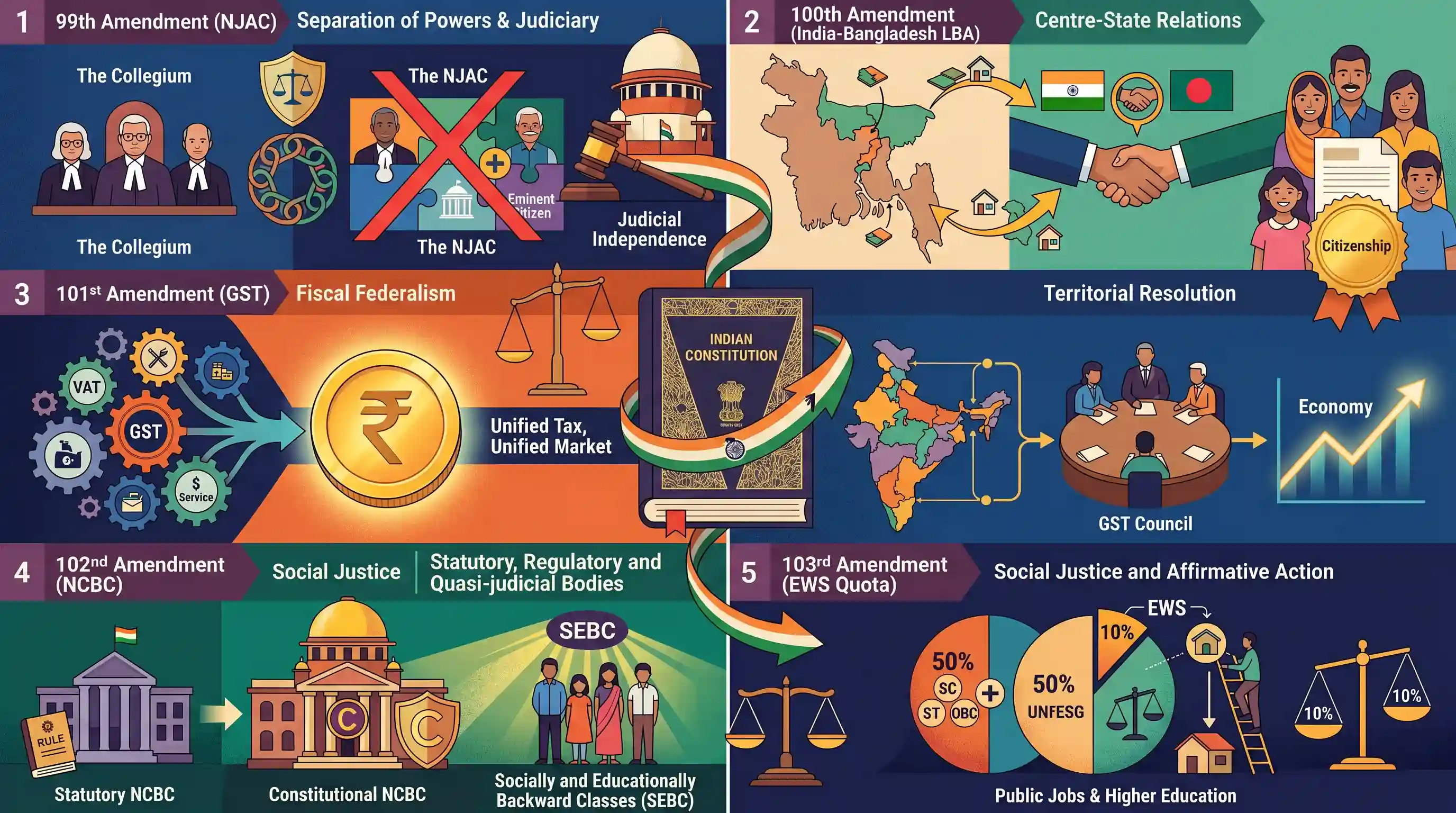
Why It Matters
This article serves as a critical revision tool for GS2, mapping the substantive changes to the Constitution from 2014 to 2019. It links core syllabus topics like judicial independence (NJAC), fiscal federalism (GST), constitutional bodies (NCBC), and affirmative action (EWS) to actual constitutional amendments, which is highly relevant for both Prelims (Article 368 procedures, specific amendment details) and Mains (evaluating the impact of these amendments).
Summary
An overview of the five major Constitutional Amendment Acts passed during Prime Minister Narendra Modi's first term (2014-2019). The piece examines how these legislative shifts influenced various facets of Indian democracy, economy, and social justice. Highlights include the failed attempt to replace the collegium system via the 99th Amendment (NJAC), the resolution of territorial disputes with Bangladesh (100th Amendment), the landmark indirect tax reform through GST (101st Amendment), the empowerment of the NCBC with constitutional status (102nd Amendment), and the introduction of the 10% EWS quota (103rd Amendment).
Key Points
- The 99th Amendment Act (2014) established the National Judicial Appointments Commission (NJAC) but was struck down by the Supreme Court in 2015 for violating the basic structure doctrine (independence of the judiciary).
- The 100th Amendment Act (2015) operationalized the Land Boundary Agreement with Bangladesh, resolving historic border disputes through the exchange of enclaves.
- The 101st Amendment Act (2016) introduced the Goods and Services Tax (GST), overhauling India's indirect tax system and altering Centre-State fiscal relations.
- The 102nd Amendment Act (2018) granted constitutional status to the National Commission for Backward Classes (NCBC), giving it greater powers to safeguard marginalized communities.
- The 103rd Amendment Act (2019) introduced a 10% reservation for Economically Weaker Sections (EWS), fundamentally altering affirmative action by basing it on economic criteria.
Important Terms
99th Constitutional Amendment Act

Enacted in 2014 to establish the National Judicial Appointments Commission (NJAC) for appointing judges. It was struck down by the Supreme Court in 2015 for violating the "basic structure" of judicial independence.
UPSC context
GS II (Judiciary). Tests separation of powers, judicial independence, and the Basic Structure Doctrine via the Fourth Judges Case.
100th Constitutional Amendment Act
Passed in 2015, it ratified the 1974 Land Boundary Agreement with Bangladesh. It enabled the exchange of enclaves and demarcated undemarcated border stretches, altering the Constitution's First Schedule.
UPSC context
GS II (International Relations). Relevant for India-Bangladesh ties and constitutional procedures for territorial exchange.
101st Constitutional Amendment Act
Introduced the Goods and Services Tax (GST) in 2016. It granted concurrent powers to the Centre and States to levy indirect taxes, significantly reshaping Indian fiscal federalism.
UPSC context
GS III (Economy/Federalism). Critical for indirect tax reforms, Centre-State fiscal relations, and the GST Council's role.
102nd Constitutional Amendment Act
Granted constitutional status to the National Commission for Backward Classes (NCBC) in 2018. It inserted Articles 338B and 342A, empowering the President to notify socially and educationally backward classes.
UPSC context
GS II (Social Justice). Tests knowledge of constitutional bodies and the federal power to identify backward classes.
103rd Constitutional Amendment Act
Introduced 10% reservation for Economically Weaker Sections (EWS) in 2019. It amended Articles 15 and 16 to provide quotas in education and employment based solely on economic criteria.
UPSC context
GS II (Social Justice). Relevant for affirmative action debates, economic justice, and the 50% reservation cap.
National Judicial Appointments Commission (NJAC)
A proposed six-member constitutional body designed to replace the collegium system for judicial appointments. It aimed to include executive and civil society representatives before being declared unconstitutional.
UPSC context
GS II (Judiciary). Key for debates on transparency, accountability, and executive vs. judicial primacy in appointments.
National Commission for Backward Classes (NCBC)
A constitutional body under Article 338B responsible for safeguarding the interests of backward classes. It investigates welfare safeguards and advises on socio-economic development policies.
UPSC context
GS II (Vulnerable Sections). Important for understanding institutional mechanisms for social justice and administrative oversight.
Goods and Services Tax (GST)
A comprehensive, destination-based indirect tax that replaced multiple central and state levies. It seeks to create a unified national market and eliminate the cascading effect of taxes.
UPSC context
GS III (Indian Economy). Central to fiscal policy, ease of doing business, and cooperative federalism.
Prelims Trap
Ceding Indian territory to Bangladesh under the 100th Amendment was done via an ordinary law under Article 3.
Under Article 3, Parliament alters state boundaries via ordinary law. However, ceding Indian territory to a foreign state requires a formal Constitutional Amendment under Article 368 (Berubari Union Case, 1960).
Static Concepts Connected
How does the Constitution handle the cession of territory to a foreign state?
- Article 3 limits: Under Article 3, Parliament can alter domestic boundaries, but cannot cede territory to foreign nations using an ordinary legislative process.
- Article 368 mandate: Ceding Indian territory to a foreign nation strictly requires a Constitutional Amendment under Article 368, as established in the 1960 Berubari Union Case.
- First Schedule impact: The 100th Amendment operationalized the Land Boundary Agreement by formally amending the First Schedule of the Constitution.
What key constitutional insertions were made to enable the GST regime?
- Article 246A: Inserted to grant concurrent, overriding powers to the Centre and States to levy and collect Goods and Services Tax.
- Article 279A: Established the GST Council as a joint forum of the Centre and States, heavily altering fiscal federalism dynamics.
- Article 268A repeal: Repealed to remove the explicit power of the Union to levy taxes on the sale or purchase of goods in the course of inter-state trade.
Cross-Topic Patterns
EWS & Indra Sawhney 50% ceiling
The 103rd Amendment challenged the 1992 Indra Sawhney ruling, which previously established that economic backwardness cannot be the sole criterion for reservation and capped overall quotas at 50%.
Evolution of NCBC to Constitutional status
Originally a statutory body formed in 1993, the NCBC was elevated via the 102nd Amendment (Article 338B), granting it civil court powers akin to the NCSC and NCST.

Expect a chronological matching question on recent CAAs (99-106) or a statement linking the 102nd CAA (Art 338B) to state backward lists.
Linked PYQs · 5
Linked PYQs · 5
- 2017MainsGS2
Critically examine the Supreme Court's judgement on 'National Judicial Appointments Commission Act, 2014' with reference to appointment of judges of higher judiciary in India.
- 2019MainsGS2
“Parliament's power to amend the Constitution is a limited power and it cannot be enlarged into absolute power." In the light of this statement explain whether Parliament under Article 368 of the Constitution can destroy the Basic Structure of the Constitution by expanding its amending power?
- 2019MainsGS3
Enumerate the indirect taxes which have been subsumed in the Goods and Services Tax (GST) in India. Also, comment on the revenue implications of the GST introduced in India since July 2017.
- 2020MainsGS3
Explain the rationale behind the Goods and Services Tax (Compensation to States) Act of 2017. How has COVID-19 impacted the GST compensation fund and created new federal tensions?
- 2022MainsGS2
Discuss the role of the National Commission for Backward Classes in the wake of its transformation from a statutory body to a constitutional body.
