Structural Hurdles Slow India Renewable Energy Transition
Source:Indian Express ↗
Why It Matters
Directly relevant to GS3 (Infrastructure: Energy, Environmental Conservation). It bridges the gap between India's international climate commitments (like Panchamrit at COP26) and the domestic, ground-level structural challenges hindering the transition, which is a frequent theme in Mains.
Summary
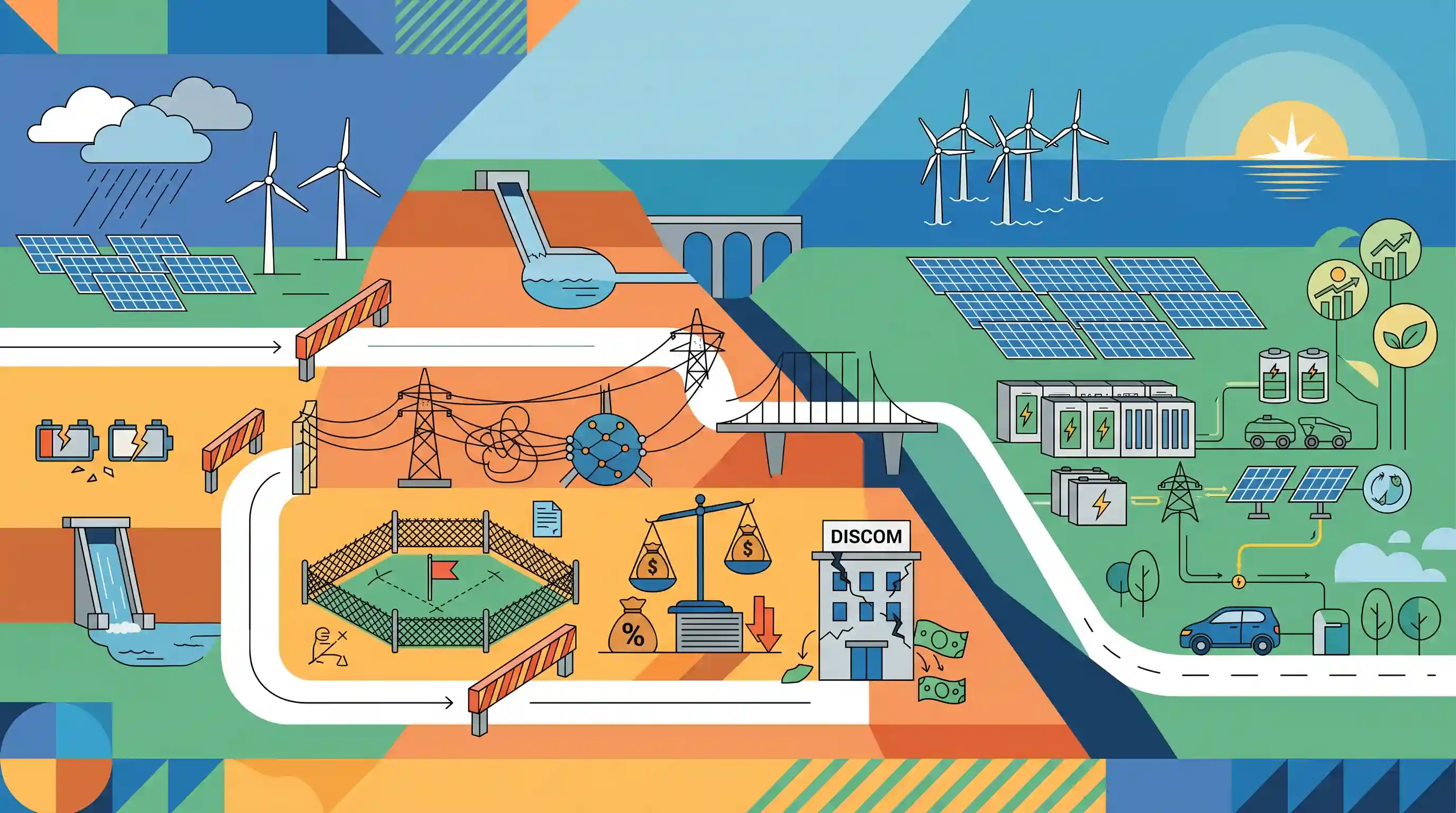
The article analyzes India's energy transition trajectory, highlighting the long-term projection that renewable energy will dominate the national grid by 2070, aligning with the country's net-zero emission commitments. However, the current pace of this green transition is significantly constrained by systemic and structural challenges. Key bottlenecks include the intermittent generation of solar and wind power, inadequate energy storage infrastructure (like battery and pumped hydro storage), and grid integration difficulties. Furthermore, complex land acquisition processes, high financing costs, and the persistent financial distress of power distribution companies (DISCOMs) hamper capacity addition. Addressing these structural hurdles is imperative for India to achieve its 2030 renewable capacity targets and ensure a sustainable, reliable, and secure energy future.
Key Points
- India aims to achieve net-zero emissions by 2070, requiring a massive shift towards renewable energy to dominate its power grid.
- Despite the long-term vision, the pace of India's renewable energy transition is being slowed down by structural and infrastructural bottlenecks.
- The intermittent nature of solar and wind energy poses significant grid integration and load-balancing challenges.
- A severe lack of scalable and cost-effective energy storage solutions, such as battery energy storage systems (BESS) and pumped hydro storage, limits steady power supply.
- Other systemic challenges include land acquisition difficulties, high capital financing costs, and the poor financial health of state-owned power distribution companies (DISCOMs).
- Accelerating infrastructural upgrades and resolving these structural issues is crucial to meet the intermediate target of 500 GW non-fossil fuel capacity by 2030.
Important Terms
Panchamrit

India's five-point climate action plan announced at COP26 (2021). Key goals include 500 GW non-fossil capacity, 50% renewable energy share, 45% carbon intensity reduction by 2030, and achieving Net Zero by 2070.
UPSC context
GS Paper 3 (Environment); essential for analyzing India's climate leadership, domestic energy policy shifts, and sectoral decarbonization targets.
Paris Agreement
A legally binding 2015 international treaty under the UNFCCC aiming to limit global warming to well below 2°C. It requires countries to submit and update climate action plans known as Nationally Determined Contributions (NDCs).
UPSC context
GS Paper 3 (Environment/International Relations); tests understanding of global climate governance, legal frameworks, and India’s adherence to international environmental treaties.
Net Zero 2070
India's commitment to achieve carbon neutrality by 2070, balancing greenhouse gas emissions with removals. This long-term target aligns with the principle of "Common but Differentiated Responsibilities" while addressing development needs.
UPSC context
GS Paper 3 (Economy/Environment); critical for discussing energy transition timelines, carbon sequestration technologies, and trade-offs between growth and sustainability.
Central Electricity Authority (CEA)
A statutory body under the Ministry of Power that provides technical advice on national electricity policy, formulates national plans, and sets standards for grid connectivity, safety, and infrastructure development.
UPSC context
GS Paper 3 (Infrastructure/Energy); relevant for understanding technical governance, grid management, and planning required to integrate large-scale variable renewable energy.
Ministry of New and Renewable Energy (MNRE)
The nodal agency for research, development, and deployment of renewable energy sources in India. It spearheads major initiatives like the National Solar Mission and National Green Hydrogen Mission.
UPSC context
GS Paper 3 (Energy/Government Schemes); tests knowledge of the institutional setup and policy execution for achieving India’s ambitious 2030 renewable targets.
UNFCCC
The primary international framework for climate action, facilitating global negotiations to stabilize greenhouse gas levels. It provides the platform for annual COP summits where major agreements like the Paris Accord are reached.
UPSC context
GS Paper 2 (International Institutions) and GS 3 (Environment); fundamental for evaluating global diplomacy, climate justice, and the evolution of international climate mandates.
Prelims Trap
Surplus solar energy is fully absorbed by the grid by completely shutting down coal plants during peak sunshine.
Thermal plants operate at a Minimum Technical Load (e.g., 55%) and cannot be instantly shut down, frequently forcing grid operators to curtail (waste) renewable energy instead.
Static Concepts Connected
What is the 'Duck Curve' phenomenon in the power sector?
- Timing imbalance: It represents the timing imbalance between peak renewable energy production (midday solar) and peak energy demand (evening).
- Grid stress: It necessitates steep and rapid power generation ramp-ups from conventional sources at sunset when solar drops off but evening demand spikes.
- Mitigation strategies: Mitigating the duck curve requires robust energy storage (BESS, pumped hydro) and demand-side load shifting.
How does the Minimum Technical Load (MTL) of thermal plants impact renewable energy integration?
- Operational threshold: MTL is the lowest capacity at which a coal plant can safely and continuously operate without shutting down (often around 55% in India).
- Intermittency clash: Because coal plants cannot be switched off instantly, high daytime solar generation often exceeds the remaining grid space above the thermal MTL.
- Renewable curtailment: This inflexibility forces grid operators to periodically "curtail" (waste) surplus renewable power to maintain grid frequency and stability.
Cross-Topic Patterns
Renewable storage + Critical Mineral Security
Expanding Battery Energy Storage Systems (BESS) to solve grid intermittency directly links to India's import dependency for lithium and cobalt, tying climate goals to critical mineral diplomacy (e.g., MSP).
Grid transition + DISCOM financial distress
The physical transition to a green grid is financially gated by the structural health of DISCOMs. Reforms like the Revamped Distribution Sector Scheme (RDSS) are prerequisites for sustainable RE expansion.

Expect a multi-statement Prelims question linking the 'Duck Curve', Minimum Technical Load of coal plants, and BESS VGF schemes in 2026.
Linked PYQs · 4
Linked PYQs · 4
- 2022MainsGS3
Do you think India will meet 50 percent of its energy needs from renewable energy by 2030 ? Justify your answer. How will the shift of subsidies from fossil fuels to renewables help achieve the above objective ? Explain.
- 2025MainsGS3
Write a review on India's climate commitments under the Paris Agreement (2015) and mention how these have been further strengthened in COP26 (2021). In this direction, how has the first Nationally Determined Contribution intended by India been updated in 2022?
- 2021MainsGS3
Describe the major outcomes of the 26th session of the Conference of the Parties (COP) to the United Nations Framework Convention on Climate Change (UNFCCC). What are the commitments made by India in this conference?
- 2016MainsGS3
Give an account of the current status and the targets to be achieved pertaining to renewable energy sources in the country. Discuss in brief the importance of National Programme on Light Emitting Diodes (LEDs).
