Renewable Energy Projects and Land Livelihood Conflicts
Source:The Hindu ↗
Why It Matters
Highlights a critical conflict between India's climate goals (renewable energy targets) and local ecological/livelihood security. Understanding the adverse impacts of green energy transitions, regulatory loopholes like the "white category" classification, and the misclassification of common lands is essential for the GS3 Environment and GS2 Governance syllabus.
Summary
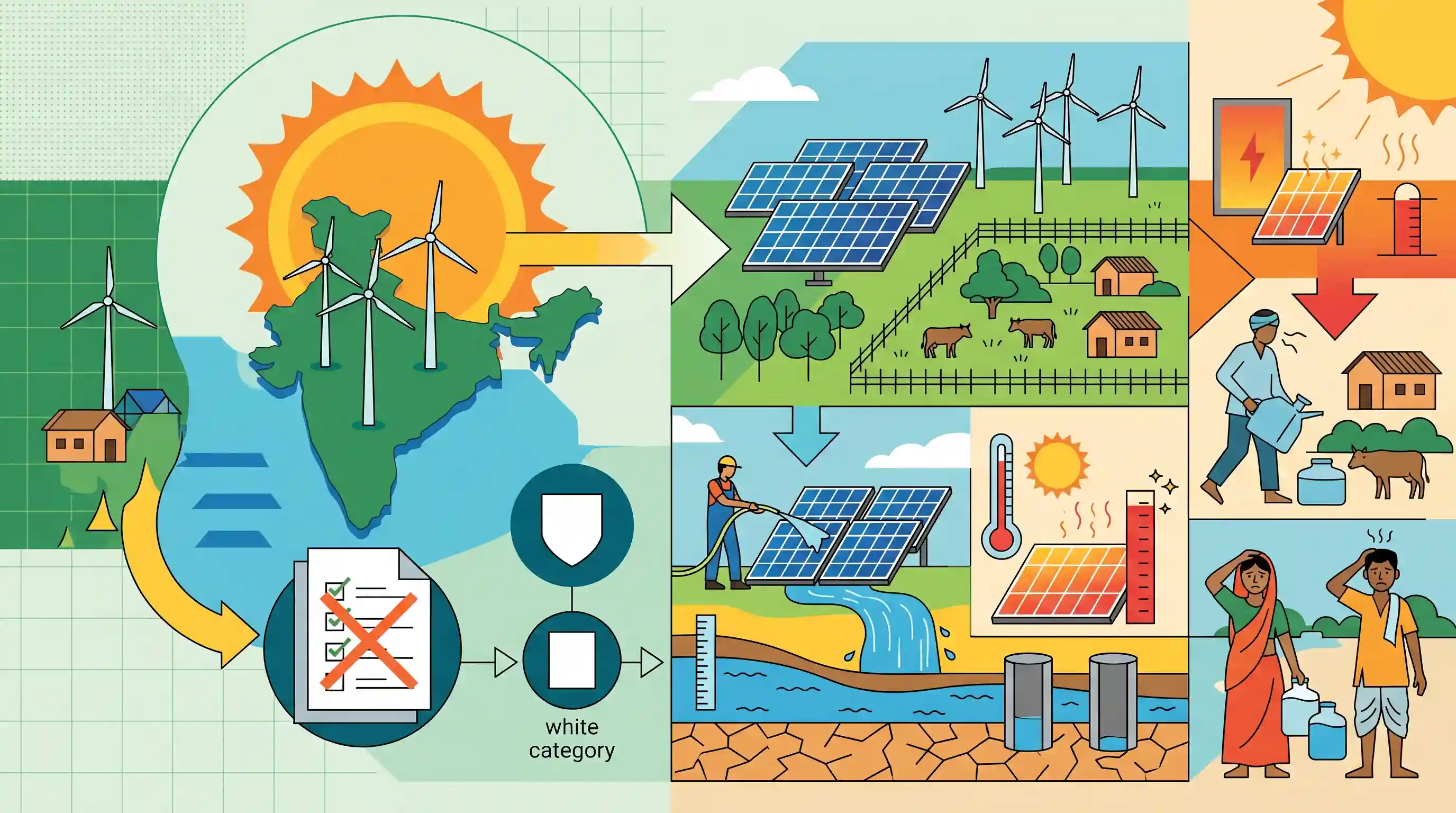
India's ambitious renewable energy drive is raising significant concerns over land rights, environmental degradation, and livelihoods, according to experts at an Asian College of Journalism webinar. Large-scale solar and wind projects, often situated on common lands mislabeled as 'wastelands', are causing local communities to lose grazing spaces and groundwater. The situation is exacerbated by regulatory gaps, as these projects are categorized as "white category" industries, exempting them from Environmental Impact Assessments (EIA). This lack of oversight has resulted in undocumented environmental impacts, such as increased local temperatures and high water consumption for cleaning solar panels, intensifying water scarcity and livelihood conflicts.
Key Points
- India's aggressive push for renewable energy is inadvertently sparking land conflicts, as massive solar and wind parks encroach on common lands often misclassified as "wastelands."
- The Kamuthi solar park in Tamil Nadu exemplifies the adverse socio-economic impacts, where farmers face loss of groundwater and livelihood autonomy, forcing them into low-paying work or migration.
- Environmental concerns are exacerbating, with large-scale projects contributing to rising local temperatures and depleting critical water sources due to panel cleaning requirements.
- A significant regulatory loophole exists as solar and wind projects are classified under "white category" industries, exempting them from mandatory Environmental Impact Assessments (EIA) and removing a formal platform for community grievances.
Important Terms
Environment Impact Assessment (EIA)

A regulatory process to evaluate the environmental, social, and economic impacts of a proposed project before approval to ensure sustainable development.
UPSC context
GS Paper III: Environment & Ecology. Crucial for understanding industrial clearances and environmental governance.
White Category Industries
A classification by the Central Pollution Control Board (CPCB) for non-polluting industries (Pollution Index score 0-20) that are exempt from certain environmental consents.
UPSC context
GS Paper III: Industrial Policy & Environment. Tests knowledge of regulatory reforms and pollution control norms.
Common Property Resources (CPR)
Community-managed natural resources, such as grazing lands and village ponds, where every member has access and usage rights without individual ownership.
UPSC context
GS Paper III: Agriculture & Livelihoods. Relevant for questions on rural economy and land resource management.
Land Conflict Watch
An independent data-research project that maps and analyzes ongoing land and natural resource disputes across India to inform policy and governance.
UPSC context
GS Paper III: Internal Security & Environment. Useful for data on Forest Rights Act (FRA) violations and land-tenure issues.
Sustainable Development
A development approach that meets current needs without compromising future generations' ability to meet theirs, balancing economic, social, and environmental goals.
UPSC context
GS Paper III: Environment & Economy. A foundational theme for ethics, essay, and environmental policy questions.
Climate Change Media Hub
A specialized initiative launched by the Asian College of Journalism to strengthen the quality and depth of environmental reporting and climate journalism in India.
UPSC context
GS Paper III: Environment. Relevant for the role of media in climate awareness and adaptation discourse.
Prelims Trap
"Large-scale utility solar parks (>50 MW) require mandatory Environmental Impact Assessment (EIA) clearance."
Solar and wind power projects are classified as 'White Category' by the CPCB, making them entirely exempt from mandatory EIA, CTE, and CTO.
Static Concepts Connected
How does CPCB categorize industries for environmental clearance?
- Red Category: Pollution Index score of 60 and above. Highly polluting industries like thermal power and mining.
- Orange Category: Pollution Index between 41 and 59. Moderately polluting industries.
- Green Category: Pollution Index between 21 and 40. Low polluting industries.
- White Category: Pollution Index up to 20. Non-polluting (e.g., solar/wind power); exempt from EIA and Consent to Operate/Establish.
What is the ecological debate surrounding the 'Wasteland Atlas'?
- Wasteland classification: It maps lands perceived as degraded/unproductive, inadvertently encouraging their diversion for industrial or renewable energy projects.
- Ecological reality: Many classified "wastelands" are actually ecologically vital Open Natural Ecosystems (ONEs) like grasslands, supporting pastoral livelihoods and unique biodiversity.
Cross-Topic Patterns
Green vs. Green Conflict (SDG clashes)
The 'Solar-Agriculture-Water nexus' pits SDG 7 (Clean Energy) against SDG 2 (Zero Hunger) and SDG 15 (Life on Land), highlighting the emerging 'Green vs. Green' conflict in environmental governance.
Great Indian Bustard & Power Lines
The exemption of solar parks from EIAs in arid regions directly links to the Supreme Court's recent interventions on undergrounding transmission lines to save the critically endangered Great Indian Bustard.

Expect a Prelims question on CPCB's "White Category" exemption for solar parks, or a Mains question on the "Green vs Green" RE conflict.
Linked PYQs · 5
Linked PYQs · 5
- 2024MainsGS3
What role do environmental NGOs and activists play in influencing Environmental Impact Assessment (EIA) outcomes for major projects in India? Cite four examples with all important details.
- 2020MainsGS3
How does the draft Environment Impact Assessment (EIA) Notification, 2020 differ from the existing EIA Notification, 2006?
- 2022MainsGS3
Do you think India will meet 50 percent of its energy needs from renewable energy by 2030 ? Justify your answer. How will the shift of subsidies from fossil fuels to renewables help achieve the above objective ? Explain.
- 2014MainsGS3
Environmental Impact Assessment studies are increasingly undertaken before a project is cleared by the Government. Discuss the environmental impacts of coal-fired thermal plants located at coal pitheads.
- 2018MainsGS2
“Policy contradictions among various competing sectors and stakeholders have resulted in inadequate 'protection and prevention of degradation' to environment.” Comment with relevant illustrations.
