BCG Vaccine Immunity Remodelling and Alzheimer Risk Reduction
Source:The Hindu ↗
Why It Matters
This article connects biotechnology (vaccine mechanisms and trained immunity) with a critical public health challenge (Alzheimer's and neurodegenerative diseases driven by demographic aging). In the context of India's Universal Immunisation Programme (UIP) and its rapid demographic transition, low-cost preventative interventions using repurposed therapeutics like the BCG vaccine are of significant policy and clinical importance.
Summary
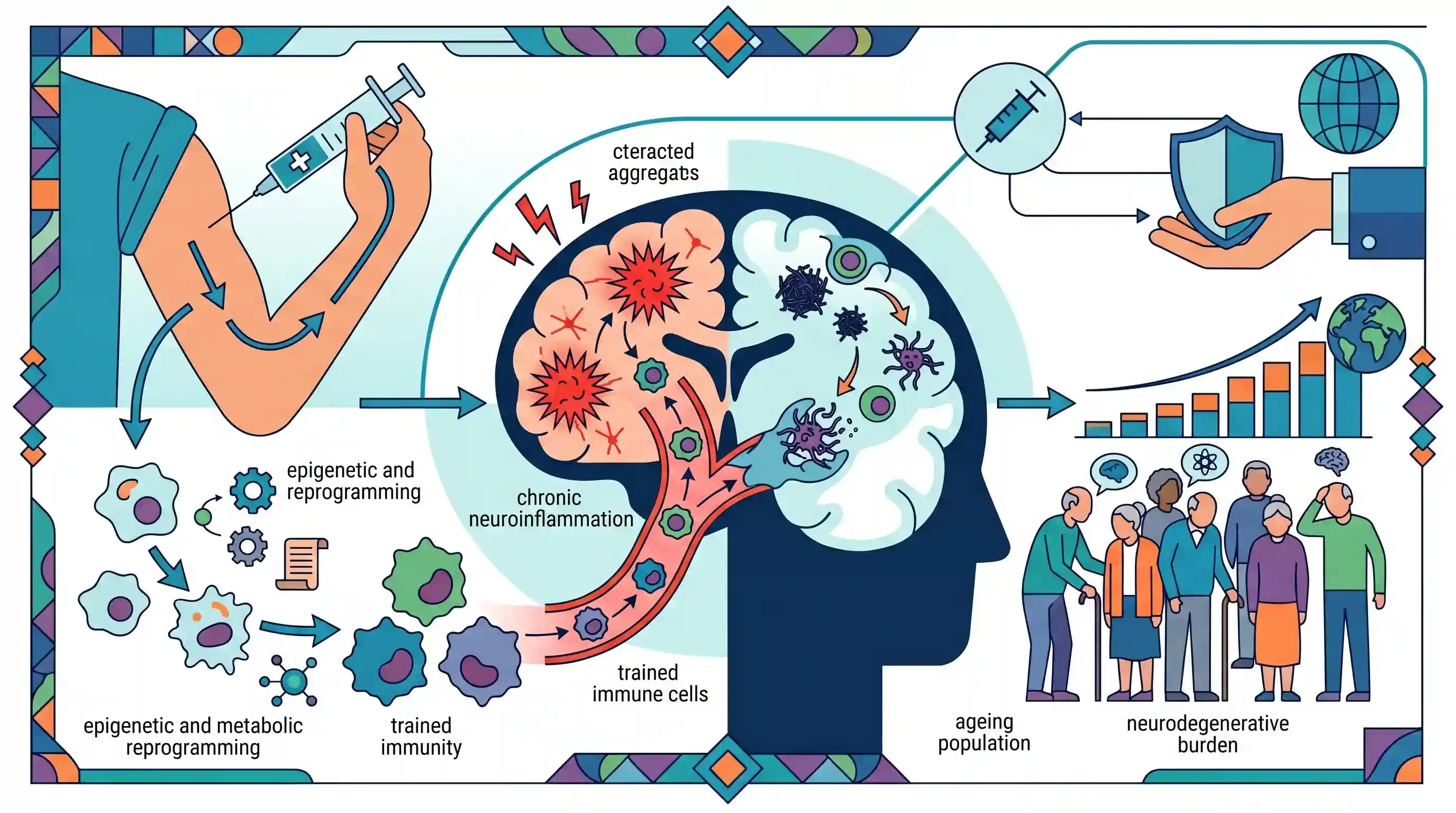
A scientific study has revealed the biological mechanism behind why the Bacillus Calmette-Guérin (BCG) vaccine is associated with a lower risk of Alzheimer's disease. The vaccine remodels the immune system by inducing 'trained immunity'—the epigenetic and metabolic reprogramming of innate immune cells. This remodelling curbs chronic neuroinflammation and enhances the brain's ability to clear toxic protein aggregates (amyloid-beta and tau). Given the rising global burden of neurodegenerative diseases, repurposing the cheap and widely accessible BCG vaccine presents a promising preventative healthcare solution.
Key Points
- A recent study highlights that the Bacillus Calmette-Guérin (BCG) vaccine, traditionally used for tuberculosis and bladder cancer immunotherapy, is linked to a significantly lower risk of Alzheimer's disease.
- The protective effect is driven by 'trained immunity,' where the BCG vaccine epigenetically and metabolically reprograms innate immune cells (such as monocytes and macrophages) to respond more effectively to non-specific challenges.
- This immune remodelling dampens chronic systemic and neuro-inflammation, a primary driver of cognitive decline and neurodegeneration in Alzheimer's.
- The reprogrammed immune response also enhances the phagocytic activity of microglia (the brain's resident immune cells), assisting in the clearance of toxic amyloid-beta plaques and tau protein tangles.
- Since BCG is a highly accessible, safe, and inexpensive vaccine, these findings hold immense potential for clinical repurposing as a low-cost preventative strategy against dementia globally, particularly in aging and developing nations like India.
Important Terms
BCG Vaccine

A live-attenuated vaccine primarily used to prevent tuberculosis, administered at birth, which also demonstrates off-target benefits like inducing trained immunity against non-specific infections.
UPSC context
GS Paper III (Science and Technology); tests understanding of vaccine development, communicable diseases, and medical biotechnology.
Trained Immunity
The functional reprogramming of innate immune cells (like monocytes and macrophages) through epigenetic and metabolic shifts, allowing them to mount a stronger response to secondary, unrelated challenges.
UPSC context
GS Paper III (Science & Technology - Biotechnology); tests comprehension of advanced immunology, genetic regulation, and therapeutic innovations.
Alzheimer's Disease
A progressive neurodegenerative disorder characterised by the accumulation of amyloid-beta plaques and tau tangles in the brain, leading to cognitive decline, memory loss, and dementia.
UPSC context
GS Paper III (Science & Technology - Health/Diseases); tests knowledge of non-communicable diseases, public health challenges, and neurological health.
Universal Immunisation Programme
A flagship public health initiative launched by the Government of India in 1985 to provide free-of-cost vaccines to infants and pregnant women against major vaccine-preventable diseases.
UPSC context
GS Paper II (Government Policies & Interventions - Health); tests understanding of national healthcare delivery schemes and maternal-child health metrics.
World Health Organization
A specialized agency of the United Nations responsible for international public health, coordinating global disease response, setting health standards, and supporting universal healthcare access.
UPSC context
GS Paper II (International Relations / Agencies); tests awareness of global multilateral bodies, health governance, and international disease eradication efforts.
Prelims Trap
BCG is derived from inactivated Mycobacterium tuberculosis and its long-term efficacy relies solely on developing T-cell-mediated adaptive immunological memory.
BCG is derived from Mycobacterium bovis, not tuberculosis. Additionally, 'trained immunity' demonstrates that immunological memory is not exclusive to adaptive immunity, but can also be developed by innate immune cells.
Static Concepts Connected
What are the distinctions between innate and adaptive immunity, and how does 'trained immunity' alter this?
- Innate Immunity: First-line, rapid, non-specific defense consisting of physical barriers and cells (macrophages, neutrophils) that do not historically retain antigen-specific memory.
- Adaptive Immunity: Delayed, highly specific defense mediated by B-cells and T-cells, characterized by the creation of antigen-specific memory cells.
- Trained Immunity: The epigenetic and metabolic reprogramming of innate immune cells (like monocytes), allowing them to exhibit a form of non-specific immunological memory.
What is the biological composition of the BCG vaccine and its major clinical applications?
- Composition: A live attenuated vaccine derived from Mycobacterium bovis, a bacterium closely related to the causative agent of human tuberculosis.
- TB Protection: Provides primary protection against severe forms of childhood tuberculosis, such as tubercular meningitis and disseminated TB.
- Other Uses: Standard intravesical immunotherapy for superficial bladder cancer, and offers cross-protection against other mycobacterial diseases like leprosy.
Cross-Topic Patterns
Dementia demographics & health economics
Leveraging affordable, existing vaccines like BCG for dementia prevention addresses the double burden of an aging population and high out-of-pocket healthcare costs in developing economies.
Drug repurposing vs pharma monopolies
Utilizing off-patent vaccines bypasses expensive, monopolized monoclonal antibody therapies, presenting a democratic and highly accessible route to managing global neurodegenerative crises.

The concept of 'trained immunity' challenging classical dogmas of innate vs adaptive memory is a high-probability target for S&T 2026.
Linked PYQs · 3
Linked PYQs · 3
- 2022PrelimsGS1
Which one of the following statements best describes the role of B cells and T cells in the human body?
- 2022MainsGS3
The increase in life expectancy in the country has led to newer health challenges in the community. What are those challenges and what steps need to be taken to meet them?
- 2021MainsGS3
What are the research and developmental achievements in applied biotechnology? How will these achievements help to uplift the poorer sections of the society?
