ISRO Spaceport Infrastructure and Operational Launch Pad Bottlenecks
Source:The Hindu ↗
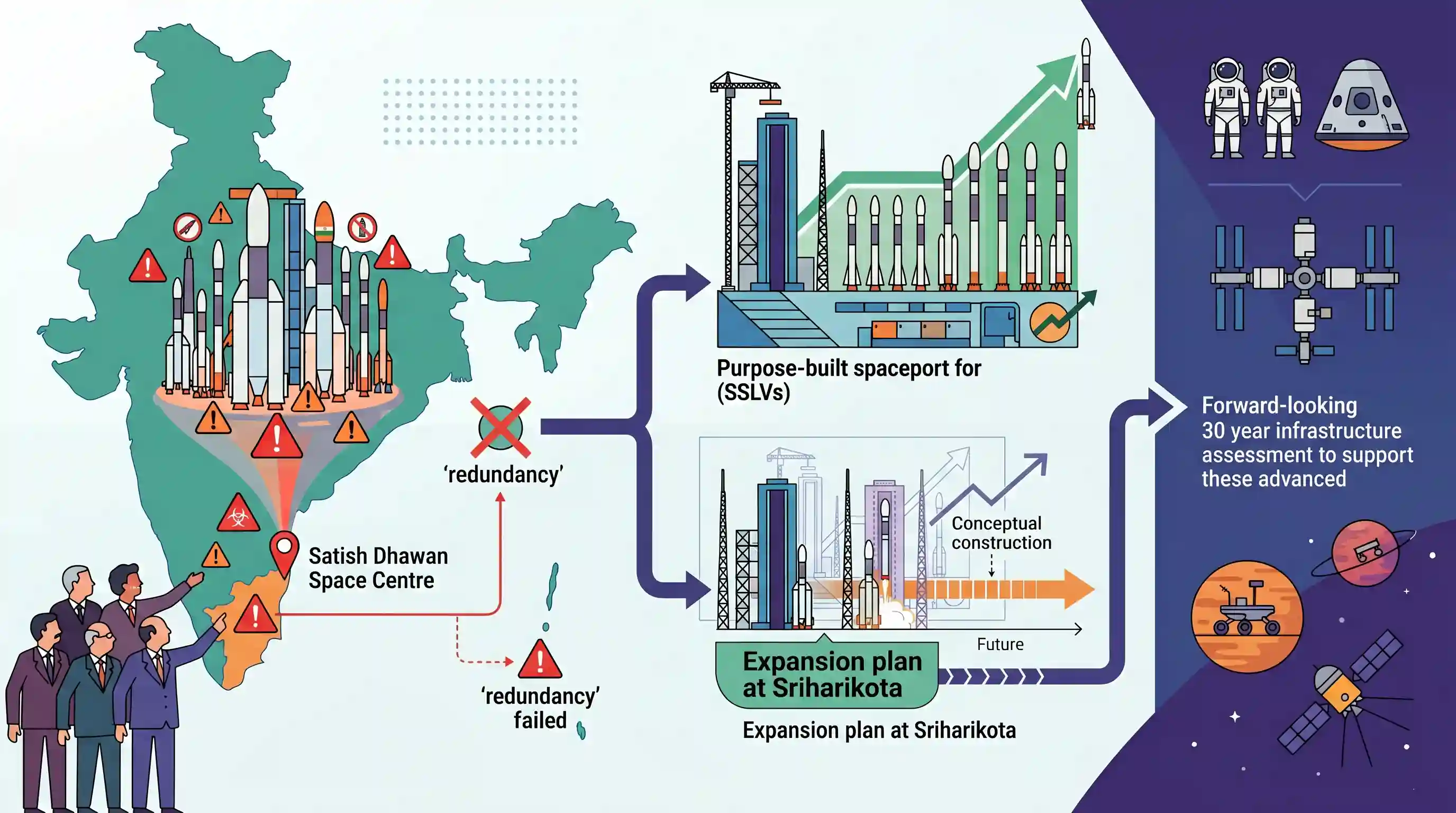
Why It Matters
Highlights the infrastructural bottlenecks in India's space program and introduces the strategic importance of the upcoming Kulasekarapattinam spaceport. Important for Prelims (locations of spaceports, SSLV) and Mains (evaluating ISRO's capabilities and infrastructure preparedness for future missions).
Summary
A Parliamentary panel has raised concerns over India's reliance on a single spaceport—the Satish Dhawan Space Centre at Sriharikota—warning that a lack of redundant launch facilities poses operational risks to the country's space program. To address these vulnerabilities and accommodate a growing frequency of missions, the Department of Space is constructing a new spaceport for Small Satellite Launch Vehicles (SSLV) at Kulasekarapattinam in Tamil Nadu and planning a third launch pad at Sriharikota by 2029-30. The committee urged ISRO to conduct a 30-year assessment of its infrastructure needs to support future human spaceflight and planetary exploration.
Key Points
- India currently relies heavily on a single spaceport—the Satish Dhawan Space Centre (SDSC) in Sriharikota—which operates with only two launch pads.
- A Parliamentary Standing Committee warned that this limited infrastructure poses severe operational risks, citing the disruption of Russian space operations following an incident at the Baikonur cosmodrome.
- To mitigate risks and handle increased launch frequencies, ISRO is developing a new spaceport at Kulasekarapattinam in Tamil Nadu, dedicated primarily to Small Satellite Launch Vehicles (SSLV).
- A third launch pad at Sriharikota is proposed to be operational by 2029-30, and the panel has recommended a 30-year comprehensive assessment of space infrastructure needs to support upcoming missions like human spaceflight.
Important Terms
Small Satellite Launch Vehicle (SSLV)

A three-stage, all-solid propellant rocket designed by ISRO for rapid, low-cost "launch-on-demand" of small satellites (10-500kg) into Low Earth Orbit, primarily catering to commercial and research needs.
UPSC context
GS Paper III (Science & Tech); focuses on indigenous technology, space commercialization, and diversifying India’s launch fleet.
Satish Dhawan Space Centre (SDSC)
India’s primary spaceport located in Sriharikota, Andhra Pradesh. It utilizes a strategic east-coast location for an orbital velocity boost from Earth’s rotation and safe flight paths over the Bay of Bengal.
UPSC context
GS Paper III (Infrastructure) & Geography; tests knowledge of site selection criteria and risks of launch facility centralization.
Department of Space (DoS)
An administrative department under the Prime Minister's Office (PMO) that formulates space policy, manages budgets, and oversees technical agencies like ISRO and commercial arms like NewSpace India Limited (NSIL).
UPSC context
GS Paper II (Governance) & III (Science & Tech); examines the institutional framework and executive control over scientific research.
Kulasekarapattinam Spaceport
India’s second spaceport being constructed in Tamil Nadu to support SSLVs. Its location allows direct southward trajectories for polar launches, eliminating the fuel-consuming "dogleg" maneuver required from Sriharikota.
UPSC context
GS Paper III (Science & Tech); evaluates understanding of infrastructure expansion for operational efficiency and the growing space economy.
Indian Space Research Organisation (ISRO)
India's premier space agency under the Department of Space, responsible for the indigenous design and execution of satellite launches, planetary exploration, and human spaceflight missions like Gaganyaan.
UPSC context
GS Paper III (Science & Tech); core body for technological breakthroughs and international space cooperation.
Parliamentary Standing Committee on Science and Technology
A permanent committee of Members of Parliament that ensures executive accountability by scrutinizing the policies, annual reports, and "Demands for Grants" of the Department of Space and ISRO.
UPSC context
GS Paper II (Polity); tests knowledge of parliamentary oversight mechanisms and the role of committees in policy evaluation.
Prelims Trap
"Kulasekarapattinam spaceport is being built to launch heavy payloads into Geosynchronous orbits due to its equatorial proximity."
Kulasekarapattinam is explicitly meant for Small Satellite Launch Vehicles (SSLVs) flying to Polar/Low Earth Orbits to avoid the fuel-wasting 'dogleg manoeuvre' over Sri Lanka.
Static Concepts Connected
Why are major spaceports typically located on eastern coasts near the equator?
- Earth's Rotation: Rockets launch eastward to leverage Earth's west-to-east rotational velocity, effectively giving the rocket a free speed boost.
- Equatorial Advantage: Rotational speed is maximum at the equator, saving significant fuel, especially for launches targeting Geostationary orbits.
- Debris Management: Eastern coastlines (like Sriharikota) ensure that spent rocket stages and fairings fall safely into the open ocean.
What is the 'Dogleg Manoeuvre' in Indian space launches?
- Trajectory Deviation: A sharp trajectory deviation required for rockets launching southward from Sriharikota to avoid dropping debris over the landmass of Sri Lanka.
- Fuel Penalty: This mid-flight steering consumes substantial extra propellant, which correspondingly reduces the maximum payload the rocket can carry into orbit.
- Kulasekarapattinam Advantage: Kulasekarapattinam's location further south allows SSLVs to fly a direct southward path to polar orbits without any deviation, maximizing payload efficiency.
Cross-Topic Patterns
Space Privatisation + Commercial SSLVs
The Kulasekarapattinam spaceport directly supports India's space privatization push (IN-SPACe/NSIL). By providing a dedicated hub for SSLVs, it targets the lucrative, high-frequency global market for commercial micro-satellite constellations.
Critical Infrastructure & Single-Point Failures
The panel's comparison to Russia's Baikonur incident shifts the framing of spaceports from mere scientific facilities to 'Critical Information and Space Infrastructure', requiring strict redundancy and disaster-recovery planning.

A multi-statement question combining SSLV payload specs, the 'dogleg manoeuvre', and Kulasekarapattinam's geography is highly likely in 2026.
Linked PYQs · 3
Linked PYQs · 3
- 2023MainsGS3
What is the main task of India's third moon mission which could not be achieved in its earlier mission? List the countries that have achieved this task. Introduce the subsystems in the spacecraft launched and explain the role of the Virtual Launch Control Centre' at the Vikram Sarabhai Space Centre which contributed to the successful launch from Sriharikota.
- 2016MainsGS3
Discuss India's achievements in the field of Space Science and Technology. How the application of this technology has helped India in its socio-economic development?
- 2018PrelimsGS1
With reference to India's satellite launch vehicles, consider the following statements: 1. PSLVs launch the satellites useful for Earth resources monitoring whereas GSLVs are designed mainly to launch communication satellites. 2. Satellites launched by PSLV appear to remain permanently fixed in the same position in the sky, as viewed from a particular location on Earth. 3. GSLV Mk III is a four-staged launch vehicle with the first and third stages using solid rocket motors; and the second and fourth stages using liquid rocket engines. Which of the statements given above is/are correct?
